Is a mortgage haram?
Question 1095
Question
Is it haram for a Muslim to take out a conventional interest-bearing mortgage to buy a home, especially in a non-Muslim country?
Summary of answer
Taking a mortgage to buy a home for one's family is permissible where there is real need and no fair Islamic alternative, as the European Council for Fatwa and Research ruled in October 1999, drawing on the principle that need is treated like necessity and on Hanafi precedent. Many scholars, including Muhammad Sayyid Tantawi of al-Azhar, go further and hold that ordinary bank interest is not the exploitative riba the Quran forbids. Islamic home finance remains a good option.
﴿وَٱللَّهُ جَعَلَ لَكُم مِّنۢ بُيُوتِكُمۡ سَكَنٗا﴾
Allah has made your homes a place of rest for you.
Answer
الحمد لله Praise be to Allah.
Is a mortgage haram? Many Muslim families in Europe, North America, and Australia have rented for decades, paying a landlord’s mortgage instead of their own, because they were told that every mortgage is riba. Others bought a home and still feel uneasy. The tradition gives a merciful and well-reasoned answer. Taking a mortgage to buy a home for your family is permissible where you need it and no fair Islamic alternative is available. This was the ruling of the European Council for Fatwa and Research in 1999, and many scholars hold a still wider view of modern bank interest.
What is riba, and why does the Quran forbid it?
Riba (ربا) means “increase.” In Arabia before Islam, a lender would double a debt when the borrower could not pay on time, and double it again at the next deadline, until the poor lost their land, their animals, and sometimes their freedom. The Quran names that practice:
يَـٰٓأَيُّهَا ٱلَّذِينَ ءَامَنُواْ لَا تَأۡكُلُواْ ٱلرِّبَوٰٓاْ أَضۡعَٰفٗا مُّضَٰعَفَةٗۖ وَٱتَّقُواْ ٱللَّهَ لَعَلَّكُمۡ تُفۡلِحُونَ
“Believers, do not devour riba, doubled and redoubled. Be mindful of Allah, that you may flourish.”
When the Quran gives its final command on riba, it states the moral reason in four words:
وَإِن تُبۡتُمۡ فَلَكُمۡ رُءُوسُ أَمۡوَٰلِكُمۡ لَا تَظۡلِمُونَ وَلَا تُظۡلَمُونَ
“If you turn back, you may keep your capital: you will do no wrong, and no wrong will be done to you.”
The next verse commands lenders to give a debtor in hardship time to pay, and calls forgiving the debt better still (2:280). The Pakistani scholar Fazlur Rahman, in his study “Riba and Interest” (1964), argued that the prohibition targets this exploitation of the needy, and Abdullah Saeed developed the argument in Islamic Banking and Interest (1996). The heart of the ban is injustice (ẓulm).
What did the European Council for Fatwa and Research rule about mortgages?
At its fourth session, in October 1999, the European Council for Fatwa and Research considered the situation of Muslims in Europe who could not buy homes. It first urged them to seek Islamic financing and to ask banks for sale-based alternatives. Where those were unavailable, it ruled that buying a home with a conventional mortgage is permissible on three conditions:
- The home is for the buyer and his or her household, and not for investment or commercial gain.
- The buyer owns no other home.
- The buyer has no surplus wealth that could purchase a home without borrowing.
The Council gave two lines of evidence. The first is the legal maxim that a general need (ḥāja) is treated like a necessity (ḍarūra): a family without stable housing faces real hardship, rents in Western cities often equal or exceed mortgage payments, and ownership allows Muslims to build communities, mosques, and schools. Allah “has placed no hardship on you in religion” (Quran 22:78). The second is the view of Abu Hanifa and his student Muhammad al-Shaybani, may Allah have mercy on them, that contracts considered invalid between Muslims may be permitted with non-Muslims in a land not governed by Muslim law, provided the Muslim does not deceive anyone.
Is modern bank interest the same as riba?
Here the scholars differ more widely. Muhammad Sayyid Tantawi, as Grand Mufti of Egypt, issued a fatwa in 1989 permitting interest on government bonds and savings. In December 2002, al-Azhar’s Islamic Research Academy, under his leadership as Grand Imam, ruled that investing money with banks that fix the return in advance is lawful, since no text of the Quran or Sunnah forbids that form of transaction. On this view a mortgage from a regulated bank, at a disclosed rate, with legal protections for the borrower, is a different thing from the doubling of debts that ruined the poor of Mecca.
The majority of contemporary fiqh councils take the stricter view. The International Islamic Fiqh Academy in Jeddah ruled in 1985 that any interest fixed at the start of a loan is riba. Many Muslims follow this view and wait or save until they can buy without a conventional loan, which is admirable. The full debate is set out in Is bank interest haram?
What about Islamic mortgages?
Islamic home finance is now offered in the UK, the US, Canada, Australia, and elsewhere. The main structures are a sale at a disclosed markup paid in installments (murābaḥa), a lease that ends in ownership (ijāra), and a diminishing partnership in which the buyer gradually purchases the bank’s share (mushāraka mutanāqiṣa). These are a good choice for anyone who wants them and can afford them.
A few cautions are useful. Their pricing usually follows the same benchmark rates as conventional loans, and the economist Mahmoud El-Gamal has argued that much Islamic finance reproduces interest under another name at a higher cost. Compare the full cost, the terms in case of hardship, and the protections offered. If an Islamic product costs a family far more, the permission based on need still stands.
How should a Muslim decide?
- Buy a home to live in, within your means. The permission rests on need, and the Prophet ﷺ sought refuge in Allah from “the burden of debt” (Sahih al-Bukhari 6369).
- Compare carefully. Look at Islamic and conventional offers side by side.
- Pay down the loan early when you can, and avoid predatory or variable-rate traps.
- Never become a lender of exploitative riba yourself. The Quran’s anger is aimed at those who profit from others’ distress.
- Do not judge your neighbor. A family that rents and saves, and a family that buys with a mortgage, may both be acting on sound scholarship.
Related questions on everyday finance are answered in Are credit cards haram?, Is car financing or leasing haram?, and Are student loans haram?. On settling and building a life in the West, see Can Muslims live in non-Muslim countries?
A home in this world and the next
A home is one of Allah’s gifts: “Allah has made your homes a place of rest for you” (16:80). The wife of Pharaoh, living in a palace, asked for a different house:
رَبِّ ٱبۡنِ لِي عِندَكَ بَيۡتٗا فِي ٱلۡجَنَّةِ
“My Lord, build for me a house near You in Paradise.”
May Allah grant every family a home of peace in this life, and a house near Him in the next.
And Allah knows best. والله أعلم
Frequently asked questions
Is a mortgage haram in the UK, US, or Canada?
The ruling is the same in every country: a mortgage for a family home is permitted where it is needed and no fair Islamic option is available. Where Islamic home purchase plans exist at a comparable cost, many scholars advise choosing them.
What does the Hanafi school say about mortgages?
Abu Hanifa and his student Muhammad al-Shaybani held that some contracts invalid between Muslims are allowed with non-Muslims in a non-Muslim land, and the European Council for Fatwa and Research cited this view. Many Hanafi muftis today still advise against conventional mortgages, so practice varies.
What is the Shia view on mortgages?
Ayatollah Sistani permits taking money from a bank owned by non-Muslims provided one does not intend it as a loan, and many Shia families in the West buy homes on this basis. Shia Muslims should check the details with their marjaʿ's office.
Is an Islamic mortgage different from a regular mortgage?
Islamic home finance uses a sale at a markup (murābaḥa), a lease that ends in ownership (ijāra), or a shared ownership that the buyer gradually takes over (mushāraka mutanāqiṣa). The bank's profit is often set by the same benchmark rates, so compare the real cost and terms.
Related questions
Sources
- European Council for Fatwa and Research, resolution on buying homes with mortgages (fourth session, October 1999)
- Fazlur Rahman, "Riba and Interest," Islamic Studies 3, no. 1 (1964)
- Abdullah Saeed, Islamic Banking and Interest: A Study of the Prohibition of Riba and its Contemporary Interpretation (Brill, 1996)
- Mahmoud A. El-Gamal, Islamic Finance: Law, Economics, and Practice (Cambridge University Press, 2006)
- International Islamic Fiqh Academy, Resolution 10 (10/2) on bank interest (Jeddah, 1985)
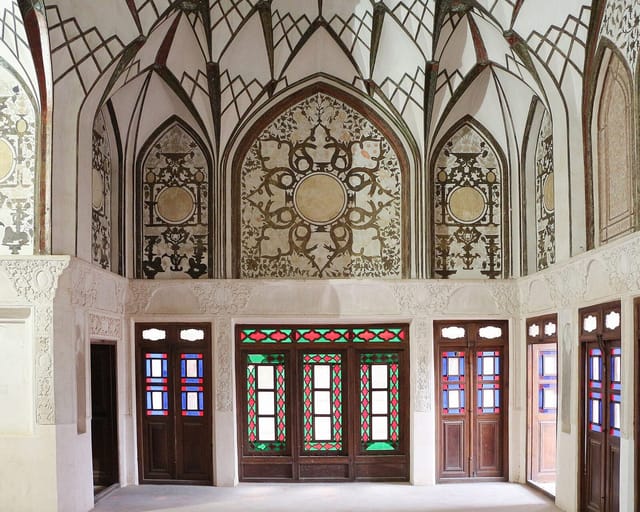
Image: Bernard Gagnon, Interior of the Tabatabaei House, Kashan, 2016. CC BY-SA 4.0, via Wikimedia Commons.. Image credits
