Is gambling or the lottery haram?
Question 1100
Question
Is gambling forbidden in Islam, including buying lottery tickets, sports betting, and charity raffles?
Summary of answer
Gambling (maysir) is haram by the clear text of the Quran (5:90–91), which names it with wine as a source of enmity that turns hearts from prayer, and the lottery is one of its forms. Its burden falls hardest on the poor. Prizes offered freely by a sponsor, free-entry draws, and races with a prize put up by one side are lawful, as the Sunnah shows.
Answer
الحمد لله Praise be to Allah.
If gambling has become a struggle for you or someone you love, help is free and confidential: in the US call or text 1-800-MY-RESET (1-800-697-3738) at any hour, and in Britain call the National Gambling Helpline on 0808 8020 133.
Gambling, in Arabic maysir or qimār, is haram. The Quran names it twice and forbids it with no room for doubt, and the jurists of every Sunni and Shia school agree. Buying lottery tickets, betting on sports, and playing casino games for money all fall under it. At the same time, the Sunnah shows that prizes and competitions are lawful when no one stakes money to win what others lose, so a free prize draw or a sponsored contest is a different matter.
Why is gambling haram in Islam?
The Quran first spoke to gambling gently. When the Companions asked about wine and gambling, it answered that both carry some benefit, and then weighed that benefit against the harm:
قُلۡ فِيهِمَآ إِثۡمٞ كَبِيرٞ وَمَنَٰفِعُ لِلنَّاسِ وَإِثۡمُهُمَآ أَكۡبَرُ مِن نَّفۡعِهِمَاۗ
“Say: in both there is great sin and some benefit for people, but their sin is greater than their benefit.”
Later revelation made the ruling final. Sūrat al-Māʾida calls wine and gambling a filth from the work of Satan and commands the believers to keep away from them so that they may prosper (Quran 5:90). The next verse gives the reason:
إِنَّمَا يُرِيدُ ٱلشَّيۡطَٰنُ أَن يُوقِعَ بَيۡنَكُمُ ٱلۡعَدَٰوَةَ وَٱلۡبَغۡضَآءَ فِي ٱلۡخَمۡرِ وَٱلۡمَيۡسِرِ وَيَصُدَّكُمۡ عَن ذِكۡرِ ٱللَّهِ وَعَنِ ٱلصَّلَوٰةِۖ
“Satan only wants to stir up enmity and hatred among you through wine and gambling, and to turn you away from the remembrance of Allah and from prayer.”
Gambling moves wealth from one person to another with no work, no trade, and no gift freely given. One player’s gain is another’s loss, and the loss breeds resentment. The Quran forbids consuming one another’s wealth unjustly (2:188), and gambling is among the clearest cases. The Prophet ﷺ took even the invitation seriously: whoever says to a friend, “Come, let me gamble with you,” should give something in charity (Sahih al-Bukhari 4860).
Is the lottery haram?
A lottery ticket is a stake paid for a chance to win a prize built from the stakes of everyone who loses. That is gambling in its plainest modern form, whether the operator is a casino or a state that spends the proceeds on schools.
The lottery also falls heaviest on those with least. A 2024 analysis of state sales data in Minnesota found that adults in the poorest neighborhoods spent about four times as large a share of their income on lottery tickets as those in the richest, and researchers have described state lotteries as a tax on lower-income families since soon after the first modern one began in New Hampshire in 1964. The sharia protects wealth (ḥifẓ al-māl) and takes the side of the poor (What does Islam say about poverty and the poor?). A practice that drains the savings of struggling households cuts against both.
What if I already won the lottery?
Winnings from gambling do not become lawful earnings. The majority of scholars advise giving the money to the poor or to public benefit, without counting it as one’s own charity, and turning to Allah. Repentance (tawba) is a door that stays open, and the One who forbade the wager is the One who forgives.
Are raffles, prize draws, and competitions haram?
The line runs between staking money to win and receiving a prize offered freely.
- Free prize draws and promotions. When a company or a host offers a prize and no one pays to enter, nothing is gambled. These are halal.
- Races and contests. The Prophet ﷺ said that prizes may be set for racing camels and horses and for archery (Sunan Abi Dawud 2574, graded sahih by al-Albani). The jurists allowed a prize put up by a sponsor or by one contestant, and forbade a pot that every contestant pays into so the winner takes all. The Prophet ﷺ himself raced Aisha (may Allah be pleased with her) on foot, and when he won the rematch he told her, “This one is for that one” (Sunan Abi Dawud 2578).
- Charity raffles. The scholars differ. Many hold that a ticket bought for a chance at a prize is still a wager, whatever the cause. The cleanest way to raise funds is to ask for donations and hold a free draw open to all.
Insurance and investing in shares share risk without creating a wager, and are discussed in Is insurance haram? and Is investing in stocks haram?
Is sports betting or online poker haram?
Betting on the outcome of a match, a fight, or a race is gambling, online or off. Playing cards, board games, or chess for fun with no money at stake is another question, answered in Is playing poker or cards without money haram? and Is chess haram?
What if I can’t stop gambling?
Compulsive gambling is an illness of the heart and the mind, and like any illness it deserves treatment without shame. Speak to a counselor, use the helplines above, block betting apps and sites, and hand control of your money to someone you trust for a time. Bring the struggle to Allah in prayer, as often as it returns. Every step back is a step toward Him.
A closing word
The Prophet ﷺ praised the bread a person earns with his own hands:
«مَا أَكَلَ أَحَدٌ طَعَامًا قَطُّ خَيْرًا مِنْ أَنْ يَأْكُلَ مِنْ عَمَلِ يَدِهِ، وَإِنَّ نَبِيَّ اللَّهِ دَاوُدَ ـ عَلَيْهِ السَّلاَمُ ـ كَانَ يَأْكُلُ مِنْ عَمَلِ يَدِهِ»
“No one has ever eaten better food than what he eats from the work of his own hands, and Allah’s Prophet David, peace be upon him, used to eat from the work of his hands.”
May Allah bless the work of your hands, give you contentment with what is lawful, and free every heart from the pull of the wager.
And Allah knows best. والله أعلم
Frequently asked questions
Is it haram if you win the lottery?
Winnings from a lottery are not lawful earnings. The majority of scholars advise giving the money away to the poor or to public good, without counting it as one's own charity, and turning to Allah in repentance, which He loves to accept.
Are charity raffles haram?
The scholars differ. Many treat a ticket bought for a chance at a prize as a form of gambling even when the proceeds go to charity. A cleaner way is to ask for donations and hold a free draw open to everyone present.
Is it haram to work at a casino?
Running the gambling itself, such as dealing cards or taking bets, shares in what the Quran forbids and should be avoided. Work separate from the gaming floor is weighed more gently by many scholars.
Is gambling haram in Shia Islam?
Yes. Gambling (qimār) is forbidden by the agreement of Sunni and Shia jurists, since the verses of Sūrat al-Māʾida are explicit.
Related questions
Sources
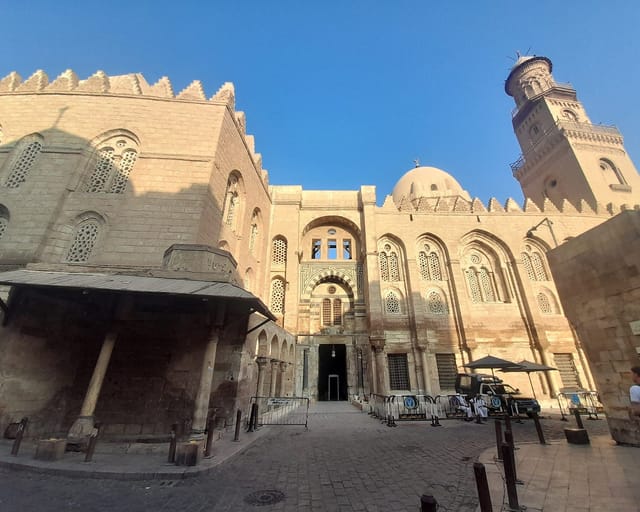
Image: Marsupium, The complex of Sultan Qalawun, Cairo, 2024. CC BY 4.0, via Wikimedia Commons.. Image credits
