Is bank interest haram?
Question 1096
Question
Is the interest paid on savings accounts, bonds, and ordinary bank loans the same as the riba forbidden in the Quran?
Summary of answer
The Quran forbids riba, the exploitative increase that doubled the debts of the poor and ended in injustice (2:279). Whether modern bank interest is that riba is disputed. Egypt's Grand Mufti Muhammad Sayyid Tantawi permitted it in 1989, and al-Azhar's Islamic Research Academy ruled in 2002 that fixed bank returns are lawful, following thinkers such as Fazlur Rahman. Many fiqh councils hold it is riba. The stronger view permits fair, regulated interest while forbidding predatory lending.
﴿لَا تَظۡلِمُونَ وَلَا تُظۡلَمُونَ﴾
You will do no wrong, and no wrong will be done to you.
Answer
الحمد لله Praise be to Allah.
Is bank interest haram? Few questions trouble ordinary Muslims more, because few are harder to avoid. Salaries are paid into bank accounts, savings earn interest, pensions hold bonds, and homes, cars, and degrees are bought on credit. The Quran’s prohibition of riba is absolute, and every Muslim must avoid it. The question is what riba is. The stronger view (al-rājiḥ), held by al-Azhar’s Islamic Research Academy and by a line of modern scholars, is that the riba the Quran forbids is the exploitative increase that preyed on the poor, and that fair, regulated bank interest is a different transaction. Many fiqh councils disagree, and their view deserves respect.
What is the riba forbidden in the Quran?
The Quran distinguishes trade from riba in one of its sharpest verses:
وَأَحَلَّ ٱللَّهُ ٱلۡبَيۡعَ وَحَرَّمَ ٱلرِّبَوٰاْ
“Allah has made trade lawful and forbidden riba.”
The riba known to the Arabs before Islam (ribā al-jāhiliyya) worked like this: when a debt fell due, the lender said to the borrower, “pay, or increase.” A debtor who could not pay saw his debt doubled, then doubled again (3:130). The Quran’s remedy is mercy toward the one in hardship:
وَإِن كَانَ ذُو عُسۡرَةٖ فَنَظِرَةٌ إِلَىٰ مَيۡسَرَةٖۚ وَأَن تَصَدَّقُواْ خَيۡرٞ لَّكُمۡ إِن كُنتُمۡ تَعۡلَمُونَ
“If the debtor is in hardship, give him time until things are easier. And to forgive it as charity is better for you, if only you knew.”
At the Farewell Pilgrimage the Prophet ﷺ abolished this practice, beginning with his own family:
«وَرِبَا الْجَاهِلِيَّةِ مَوْضُوعٌ وَأَوَّلُ رِبًا أَضَعُ رِبَانَا رِبَا عَبَّاسِ بْنِ عَبْدِ الْمُطَّلِبِ فَإِنَّهُ مَوْضُوعٌ كُلُّهُ»
“The riba of the Age of Ignorance is abolished, and the first riba I abolish is our own, the riba owed to ʿAbbās ibn ʿAbd al-Muṭṭalib. All of it is abolished.”
The Quran names the reason: “you will do no wrong, and no wrong will be done to you” (2:279). Riba is forbidden because it is injustice (ẓulm).
How did classical scholars understand riba?
The jurists built a large body of law on riba, including rules on exchanging gold, silver, and certain foods. Ibn Qayyim al-Jawziyya (d. 1350), in Iʿlām al-Muwaqqiʿīn, drew a distinction that later scholars found illuminating. “Manifest riba” (al-ribā al-jalī), the pre-Islamic increase on debts, is forbidden for the great harm it does. “Hidden riba” (al-ribā al-khafī), the rules on exchanging like for like, is forbidden as a means of blocking the road to the first (sadd al-dharāʾiʿ), and such means can give way to a real need.
Why do some scholars say bank interest is permissible?
In the twentieth century, scholars asked whether a deposit in a regulated bank, or a loan at a disclosed rate under consumer protection law, is the same as the doubling of debts that destroyed the poor of Mecca. Fazlur Rahman, in his study “Riba and Interest” (1964), argued that the Quran’s target was the exploitative riba of its time, and that the moral test is injustice. Abdullah Saeed set out the same reading in Islamic Banking and Interest (Brill, 1996).
Muhammad Sayyid Tantawi, as Grand Mufti of Egypt, issued a fatwa in 1989 permitting interest on government bonds and savings. In December 2002, after he had become Grand Imam of al-Azhar, the Islamic Research Academy issued a fatwa holding that “investing funds with banks that prespecify profits or returns is legally permissible.” It reasoned that no text of the Quran or Sunnah forbids this form of dealing, that the bank acts as the depositor’s agent in investment, and that fixing the return in advance protects both parties from dispute.
Why do most fiqh councils still say it is riba?
The stricter view is held by a majority of contemporary institutions. The International Islamic Fiqh Academy in Jeddah ruled in 1985 that any increase fixed at the start of a loan is riba, and it encouraged Islamic banking as the alternative. Its supporters cite the curse of the Prophet ﷺ on the one who consumes riba, the one who pays it, the one who records it, and its witnesses (Sahih Muslim 1598), and they hold that any guaranteed increase on a loan falls under the prohibition. Muslims who follow this view and use Islamic banks are acting on serious scholarship. The difference between the two views is real, and a Muslim may follow either in good conscience.
How should a Muslim deal with interest today?
- Never profit from another’s distress. Payday loans, loan-sharking, and debt traps aimed at the desperate are the modern form of the Jāhiliyya’s riba, and they are haram on every view.
- Be lenient as a lender. “May Allah have mercy on a person who is generous when he sells, when he buys, and when he asks for repayment” (Sahih al-Bukhari 2076).
- Choose your view and keep it consistently. On the permissive view, interest on savings is lawful income. On the stricter view, give it to the poor.
- Pay zakat on your savings. Whatever view you follow, wealth held for a year above the threshold owes zakat (How does zakat work?).
- Avoid needless debt. Consumer debt at high rates harms families, whatever its legal status (Are credit cards haram?).
Related questions are answered in Is a mortgage haram?, Is it haram to work in a bank?, and Is investing in stocks haram?
Wealth that grows with Allah
The Quran contrasts two kinds of growth: “Whatever you lend at riba to increase in other people’s wealth does not increase with Allah, but whatever you give in zakat, seeking His face, is multiplied” (30:39). The final test of any transaction is whether it does justice to the person on the other side of it. May Allah make our earnings pure, our dealings fair, and our wealth a means of lifting the poor (What does Islam say about poverty?).
And Allah knows best. والله أعلم
Frequently asked questions
Is it haram to have a savings account that pays interest?
On the view of al-Azhar's Islamic Research Academy, interest on a savings account is lawful profit on money the bank invests. Those who follow the stricter view may keep a savings account and give the interest to charity, or choose an Islamic account.
What should I do with interest I have already earned?
On the permissive view you may keep it. On the stricter view you give it to the poor or to public benefit without counting it as your own charity. Either way, zakat is due on your savings once they reach the threshold.
What do Hanafi scholars say about bank interest?
Most Hanafi scholars today consider bank interest riba. Abu Hanifa and Muhammad al-Shaybani held that some transactions forbidden between Muslims are allowed with non-Muslims in a non-Muslim land, and some modern scholars apply this to banks in the West.
Is it haram to work in a bank?
The ruling depends on the view of interest one follows and on the job itself. See the separate answer on working in a bank.
Related questions
Sources
- Sahih Muslim 1218a (the Farewell Sermon: the riba of the Jāhiliyya is abolished)
- Ibn Qayyim al-Jawziyya, Iʿlām al-Muwaqqiʿīn (manifest and hidden riba)
- Fazlur Rahman, "Riba and Interest," Islamic Studies 3, no. 1 (1964)
- Abdullah Saeed, Islamic Banking and Interest (Brill, 1996)
- Mahmoud A. El-Gamal, "'Interest' and the Paradox of Contemporary Islamic Law and Finance," Fordham International Law Journal 27 (2003), with a translation of the al-Azhar fatwa
- International Islamic Fiqh Academy, Resolution 10 (10/2) (Jeddah, 1985)
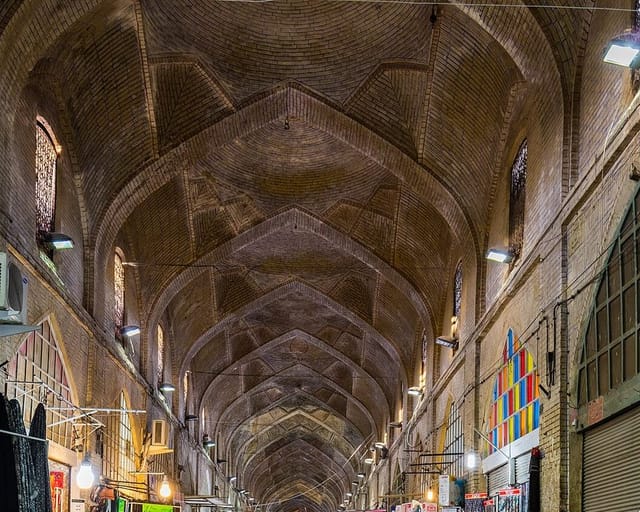
Image: Diego Delso, The Vakil Bazaar, Shiraz, 2016. CC BY-SA 4.0, via Wikimedia Commons.. Image credits
