Is it haram to work in a bank?
Question 1175
Question
Is it permissible for a Muslim to work in a conventional bank, for example as a teller, analyst, software engineer, or loan officer?
Summary of answer
Working in a bank is halal. Al-Azhar's Islamic Research Academy ruled in 2002 that fixed bank returns are lawful, and on that view the ordinary work of a bank involves no forbidden riba. Scholars who hold bank interest to be riba cite the Prophet's ﷺ curse on its scribe and witnesses (Muslim 1598), and many of them still permit roles that do not draw up interest contracts. Predatory lending is forbidden on every view.
Answer
الحمد لله Praise be to Allah.
Is it haram to work in a bank? Banks employ tellers, analysts, software engineers, compliance officers, cleaners, and financial advisers, and many young Muslims with a degree in finance or computing ask the question before accepting an offer. The stronger view (al-rājiḥ) is that working in a bank is halal. Many leading scholars, including al-Azhar’s Islamic Research Academy, hold that regulated bank interest is a different transaction from the riba the Quran forbids. Earning a living by useful work is itself praised in the Sunna: “No one has ever eaten better food than what he earned by the work of his own hands” (Sahih al-Bukhari 2072).
Why do some scholars say working in a bank is haram?
The stricter view rests on a hadith reported by Jābir: the Prophet ﷺ cursed the one who consumes riba, the one who pays it, the one who writes it down, and its two witnesses, and said that they are all alike (Sahih Muslim 1598). The International Islamic Fiqh Academy in Jeddah ruled in 1985 that any increase fixed at the start of a loan is riba. Scholars who follow that ruling regard a bank’s lending as riba and its clerks as the scribes and witnesses of the hadith. Some of them forbid every bank job; many forbid only roles that draw up, approve, or sell interest-bearing loans. This is a recognized view held by serious scholars, and a Muslim who turns down a bank job out of caution is acting on it in good faith.
Is bank interest the same as riba?
Everything turns on this question, which is answered in full in Is bank interest haram? The Quran forbids riba because it is injustice, the doubling of debts that ruined the poor of Mecca, and it states the moral test in a few words:
لَا تَظۡلِمُونَ وَلَا تُظۡلَمُونَ
“You will do no wrong, and no wrong will be done to you.”
Muhammad Sayyid Tantawi, as Grand Mufti of Egypt, permitted interest on savings and government bonds in 1989. In 2002 al-Azhar’s Islamic Research Academy ruled that investing money with banks that fix the return in advance is lawful, reasoning that the bank acts as the depositor’s agent and that no text of the Quran or Sunnah forbids this form of dealing. Fazlur Rahman and Abdullah Saeed made the scholarly case that the Quran’s target was exploitation of the needy. On this view the scribe in a modern bank is recording lawful contracts, and the Quran honors that work:
وَلۡيَكۡتُب بَّيۡنَكُمۡ كَاتِبُۢ بِٱلۡعَدۡلِۚ وَلَا يَأۡبَ كَاتِبٌ أَن يَكۡتُبَ كَمَا عَلَّمَهُ ٱللَّهُ
“Let a scribe write it down between you with justice, and let no scribe refuse to write as Allah has taught him.”
The longest verse of the Quran is about recording debts fairly, and a bank clerk who documents loans with accuracy and justice is doing what it describes.
Does it matter what job you do in the bank?
On the permissive view, any lawful role in a regulated bank is permitted. On the stricter view, the role matters a great deal. A bank keeps salaries, savings, pensions, and payments moving for whole cities, and most of its staff never draw up a loan: the engineer who secures accounts, the officer who stops fraud, the clerk who opens an account for a widow. Many scholars of the stricter view permit these jobs.
On every view, some products are forbidden: payday loans, debt traps aimed at the desperate, and penalties that pile up on people who cannot pay. These are the modern face of the riba of the Jāhiliyya. A Muslim inside a bank can be the one who argues for hardship relief, following the Quran’s command to give a struggling debtor time (2:280) and the Prophet’s ﷺ prayer: “May Allah have mercy on a person who is generous when he sells, when he buys, and when he asks for repayment” (Sahih al-Bukhari 2076).
Did Muslims have banking in history?
Muslim civilization developed sophisticated finance long before modern banks. Under the Abbasids, money-changers and financiers (jahābidha) held deposits and paid on written orders (ṣakk), and merchants sent funds across the empire by bill of exchange (suftaja). In the twentieth century Muslims founded Islamic banks, from the savings bank of Mit Ghamr in Egypt in 1963 to Dubai Islamic Bank in 1975. Working in an Islamic bank is a fine choice; so is bringing Muslim ethics into a conventional one.
How should a Muslim work in a bank?
- Be truthful with customers. “Whoever deceives is not of me” (Sahih Muslim 102). Never mis-sell a product.
- Treat borrowers with mercy, especially those in hardship.
- Follow your conscience. If a role troubles you, the Prophet ﷺ said that sin is “what wavers in your chest” (Sahih Muslim 2553a). Moving to another team or bank is always open to you.
- Pay zakat on your savings, and use your skills for your community: many Muslim banks and charities need financial expertise.
- Know your rights as a worker (What does Islam say about workers’ rights?). Women have the same right to this work as men (Can women work in Islam?).
Related answers on everyday finance include Is a mortgage haram? and Are credit cards haram?
Seeking Allah’s bounty
The Quran sends believers from prayer straight into the marketplace: “When the prayer is ended, spread through the land and seek Allah’s bounty, and remember Allah often, so that you may prosper” (62:10). May Allah bless your work, make your earnings pure, and make your skill a means of fairness for everyone who comes to your desk.
And Allah knows best. والله أعلم
Frequently asked questions
Is my salary from a bank halal?
On the view of al-Azhar's Islamic Research Academy, a salary for lawful work in a regulated bank is halal. Many scholars who hold the stricter view of interest also consider the salary lawful for roles that do not write or approve interest contracts.
Can I work in IT, customer service, or security at a bank?
Yes. These roles keep payments, savings, and accounts running for millions of people, and even many scholars who forbid interest permit them, since the worker neither takes, pays, nor records riba.
Is it better to work in an Islamic bank?
Working in an Islamic bank is a good choice for anyone who prefers it. It is a preference, and a Muslim working in a conventional bank on the permissive view is earning a lawful living.
What do Hanafi scholars say about working in a bank?
Many Hanafi scholars today hold bank interest to be riba and advise against roles that directly draw up interest contracts. Abu Hanifa and Muhammad al-Shaybani held that some contracts forbidden between Muslims are allowed with non-Muslims in a land not under Muslim law, and some modern scholars apply this to work in Western banks.
Related questions
Sources
- Mahmoud A. El-Gamal, "'Interest' and the Paradox of Contemporary Islamic Law and Finance," Fordham International Law Journal 27 (2003), with a translation of the al-Azhar fatwa
- International Islamic Fiqh Academy, Resolution 10 (10/2) (Jeddah, 1985)
- Sahih Muslim 1598 (the curse on riba, its scribe and witnesses)
- Sahih al-Bukhari 2072, 2076
- Abdullah Saeed, Islamic Banking and Interest (Brill, 1996)
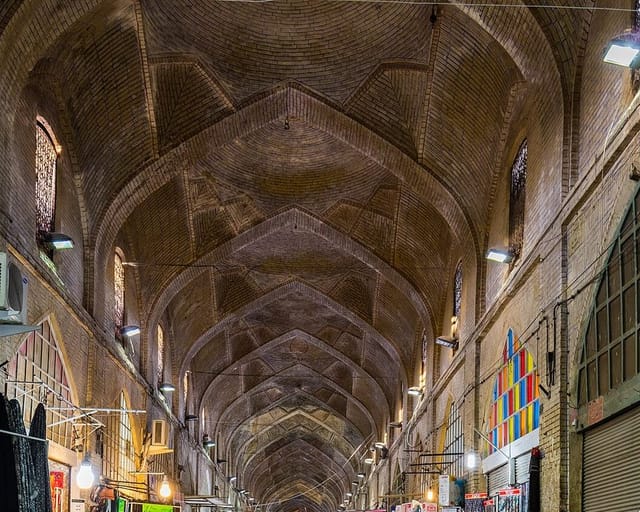
Image: Diego Delso, The Vakil Bazaar, Shiraz, 2016. CC BY-SA 4.0, via Wikimedia Commons.. Image credits
