Are prediction markets like Polymarket and Kalshi haram?
Question 1265
Question
Is it permissible for a Muslim to buy and sell event contracts on prediction markets such as Polymarket, Kalshi, Robinhood, or Coinbase?
Summary of answer
Buying event contracts on Polymarket, Kalshi, and similar prediction markets is gambling (maysir), and gambling is haram by the Quran (5:90–91). Each side stakes money on an uncertain event, and the winner collects what the loser staked. A license from a financial regulator, a trading screen, and a forecaster's skill do not change what the contract is. A business that buys a contract only to offset a real loss it faces is closer to insurance, and its case is a matter of scholarly judgment.
Answer
الحمد لله Praise be to Allah.
If betting has become a struggle for you or someone you love, help is free and confidential: in the US call or text 1-800-MY-RESET (1-800-697-3738) at any hour, and in Britain call the National Gambling Helpline on 0808 8020 133.
Prediction markets let anyone with a phone bet on almost anything: a football match, an election, an interest-rate decision, a missile strike. Polymarket and Kalshi are the largest, and Robinhood, Coinbase, and other trading apps now offer the same contracts. The platforms call them “event contracts” and call their users “traders.” In the language of the sharia, buying these contracts is gambling (maysir), and gambling is haram. The trading screen, the federal license, and the forecaster’s skill do not change what the contract does.
How do Polymarket and Kalshi work?
Every market is a question with a deadline, such as “Will the Federal Reserve cut rates in December?” A Yes share pays $1 if the event happens and nothing if it does not, and a No share pays the reverse. Shares trade between 1 and 99 cents, and the price is the crowd’s estimate of the odds. Every dollar paid out to the winners comes from the people who bought the losing side.
Kalshi is an American exchange licensed by the Commodity Futures Trading Commission (CFTC) and trades in dollars. Polymarket runs on cryptocurrency; it was barred from American customers in a 2022 settlement with the CFTC and has since returned through a licensed US exchange it bought in 2025. Pew Research Center found that combined monthly trading on the two grew from less than $5 billion in September 2025 to about $24 billion in April 2026, more than legal American sportsbooks handled in a typical month of 2025. Sports made up 80% of Kalshi’s trading volume and 39% of Polymarket’s since July 2024. Several American states have sued the platforms under their gambling laws.
Why are prediction markets haram?
The Quran forbids gambling in the plainest terms:
يَـٰٓأَيُّهَا ٱلَّذِينَ ءَامَنُوٓاْ إِنَّمَا ٱلۡخَمۡرُ وَٱلۡمَيۡسِرُ وَٱلۡأَنصَابُ وَٱلۡأَزۡلَٰمُ رِجۡسٞ مِّنۡ عَمَلِ ٱلشَّيۡطَٰنِ فَٱجۡتَنِبُوهُ لَعَلَّكُمۡ تُفۡلِحُونَ
“Believers, wine, gambling, idols, and divining arrows are a filth from the work of Satan, so keep away from them, that you may prosper.”
The classical jurists defined gambling (qimār) by its structure. Ibn ʿĀbidīn (d. 1836), the great Hanafi jurist of Damascus, explained that it takes its name from the moon (qamar), which waxes and wanes, because each gambler may lose his money to the other or win the other’s money. An event contract fits that description exactly. Two people put up money on opposite answers to the same question, and when the question resolves, one takes what the other staked. No goods change hands, no business is owned, and no work is done. The whole return is the other side’s loss.
The Prophet ﷺ treated even the invitation to gamble as a sin needing atonement: whoever says to a friend, “Come, let me gamble with you,” should give something in charity (Sahih al-Bukhari 4860). He also forbade sales built on excessive uncertainty (gharar) (Sahih Muslim 1513). In an event contract, the uncertainty is the very thing being sold.
Muslim scholars and Islamic finance services who have examined these platforms have reached the same conclusion. A September 2026 study from the Shariyah Review Bureau, written by Mufti Faraz Adam, concluded that a binary event contract is qimār because one side’s gain is the other side’s loss. The Islamic finance services Zoya and Islamic Finance Guru classify Polymarket and Kalshi as gambling.
Didn’t Abu Bakr make a bet like this?
He did, and the story shows when the door closed. When the opening verses of Sūrat al-Rūm foretold that the defeated Byzantines would defeat the Persians “within a few years” (Quran 30:2–4), men of Quraysh offered Abu Bakr (may Allah be pleased with him) a wager on it, and he accepted. The narrator adds, “that was before wagering was forbidden” (Jami’ al-Tirmidhi 3194, graded ṣaḥīḥ ḥasan gharīb by al-Tirmidhi). The Byzantines won in the seventh year, and many people entered Islam. Abu Bakr’s wager was, in effect, a prediction market on a war between two empires, and the verses of Sūrat al-Māʾida, revealed later in Medina, forbade every wager of its kind.
Is it different because the CFTC regulates it?
No. A license answers the question of American law, and the sharia asks a different question: what the contract actually does. The jurists summed this up in a maxim, recorded as the third article of the Ottoman civil code (the Majalla): in contracts, what counts is the purpose and the meaning, and not the words and the form. A wager remains a wager when it is called a contract, when it is matched by an exchange instead of a bookmaker, and when the stakes are paid in dollars or in stablecoins.
Isn’t it like trading stocks or futures?
A share of stock is part-ownership of a real business that produces goods and services, so its owners can all grow richer together (Is investing in stocks haram?). An event contract owns nothing. Across all its holders it adds up to zero, minus the platform’s fees, so every winner’s gain is someone else’s loss.
Futures and options are the closest cousins of event contracts, and the scholars were strict even with them. The International Islamic Fiqh Academy ruled in 1992 (Resolution 63) that options as traded in global markets are impermissible, and Mufti Muhammad Taqi Usmani has written that conventional futures are invalid whether they are used to speculate or to hedge. An event contract is further from lawful trade than either, because there is no underlying commodity at all (Is day trading or options trading haram?). Selling a contract before the event resolves does not help either: it is the sale of a betting slip at the current odds.
What if I win through research and skill?
Skill does not make a wager lawful. Horse racing and archery are contests of pure skill, and the Prophet ﷺ allowed prizes for them (Sunan Abi Dawud 2574, graded sahih by al-Albani). The jurists explained that the prize must come from a sponsor or from one side only; when every contestant pays into a pot that the winner takes, it becomes gambling, however skilled the riders. A forecaster who studies the polls is in the position of the skilled rider who has paid into the pot (Is gambling or the lottery haram?).
Can a business use event contracts to hedge?
A farmer may fear a drought, and an importer may fear a new tariff. A business that buys a contract only to offset a loss it really faces is doing something closer to insurance than to gambling, and Mustafa al-Zarqa and many later scholars permitted insurance (Is insurance haram?). In 2018 the Fiqh Academy affirmed that hedging, protecting one’s property against risk, agrees with the objectives of the sharia, and that the aim of any hedging tool must be to protect property and never to speculate (Resolution 224). Scholars such as Mufti Taqi Usmani still reject conventional derivatives even for hedging, and the Shariyah Review Bureau study suggests that such a case be brought to a Shariah board for individual review. This is a narrow question of ijtihād for businesses. It does not describe the person betting on Sunday’s game or on next month’s election.
What other harms do these markets bring?
- Profiting from war and death. Prediction markets list contracts on whether one country will strike another, whether a ruler will fall, and whether hostages will be freed by a certain date. Turning bloodshed into a source of profit is far from the mercy the Quran asks of believers.
- Insider betting. In January 2026, a Polymarket account opened a week earlier bet about $35,000 on the fall of Venezuela’s president Nicolás Maduro shortly before the US operation that captured him, and news reports put one trader’s profit at more than $400,000. The Prophet ﷺ said, “Whoever cheats is not of me” (Sahih Muslim 102).
- Addiction in every pocket. A contract can be bought on any game at any hour, and in-game markets resolve within minutes. The Quran’s description of wine and gambling fits: they “turn you away from the remembrance of Allah and from prayer” (Quran 5:91).
What should I do if I already have positions or winnings?
- Stop and withdraw. Close your positions and take out your own money.
- Give away the winnings. The majority of scholars advise giving gambling winnings to the poor or to public good, without counting the gift as your own charity.
- Return to Allah. Repentance (tawba) is accepted, and the One who forbade the wager is the One who forgives.
- Ask for help if you cannot stop. Delete the apps, block the sites, hand control of your money to someone you trust for a time, and use the helplines above. Compulsive betting is an illness, and treating it is part of faith.
Reading prediction-market odds as news is not haram, since the reader stakes nothing. Owning shares in companies that run these markets is a separate question of investment screening (Is investing in stocks haram?).
A closing word
Allah alone knows what tomorrow brings:
وَمَا تَدۡرِي نَفۡسٞ مَّاذَا تَكۡسِبُ غَدٗاۖ وَمَا تَدۡرِي نَفۡسُۢ بِأَيِّ أَرۡضٖ تَمُوتُۚ إِنَّ ٱللَّهَ عَلِيمٌ خَبِيرُۢ
“No soul knows what it will earn tomorrow, and no soul knows in what land it will die. Allah is All-Knowing, All-Aware.”
May Allah give you contentment with what is lawful, bless the work of your hands, and free every heart from the pull of the wager.
And Allah knows best. والله أعلم
Frequently asked questions
Is Polymarket haram?
Yes. Buying Yes or No shares on Polymarket is a wager on an uncertain event: the winners are paid from the stakes of the losers. Paying in cryptocurrency or trading through a licensed US exchange does not change that.
Is Kalshi halal because it is regulated by the CFTC?
No. The Commodity Futures Trading Commission decides whether a contract is lawful under American law. The sharia looks at what the contract does, and a Kalshi event contract still moves money from those who guessed wrong to those who guessed right.
Is it haram to look at Polymarket odds?
No. Reading the odds as news, like reading a poll or a weather forecast, stakes nothing. The prohibition falls on placing the bet.
What should I do with money I made on prediction markets?
Withdraw your own money, close your positions, and give the winnings to the poor or to public good without counting it as your own charity, which is the majority view for gambling winnings. Then turn to Allah, who loves those who return to Him.
Related questions
Sources
- Jami' al-Tirmidhi 3194 (Abu Bakr's wager on the Romans)
- Sahih al-Bukhari 4860; Sahih Muslim 102, 1513
- Sunan Abi Dawud 2574
- International Islamic Fiqh Academy, Resolution 63 (1/7) on Financial Markets (Jeddah, 1992) and Resolution 224 (8/23) on Hedging, in Resolutions and Recommendations (3rd English ed., 2024)
- Muhammad Taqi Usmani, Permissibility of Certain Financial Contracts (2015)
- Shariyah Review Bureau, When Probability Becomes Prohibited: Deconstructing Prediction Markets (September 2026)
- Zoya, Are Kalshi and Polymarket Halal or Haram? Prediction Markets in Islam (September 2026)
- Islamic Finance Guru, Are Prediction Markets Halal or Haram? (February 2026)
- Pew Research Center, Trading volume on prediction markets has soared in recent months (May 27, 2026)
- Christopher White, A big Polymarket bet on Maduro's capture raises questions about an insider trading scheme, The National News Desk (January 5, 2026)
- National Council on Problem Gambling, National Helpline
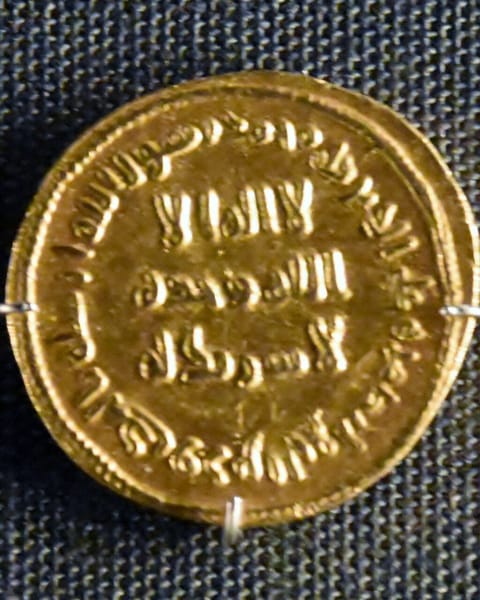
Image: Richard Mortel, Gold dinar of ʿAbd al-Malik ibn Marwan, dated AH 78 (697–698), 2017. David Collection, Copenhagen. CC BY 2.0, via Wikimedia Commons.. Image credits
,_The_David_Collection,_Copenhagen_(36240895662).jpg)