What does Islam say about poverty and the poor?
Question 1045
Question
What does Islam teach about poverty, the duties of the rich, and how Muslims should treat people who are poor?
Summary of answer
Islam teaches that the poor have a right (ḥaqq) in the wealth of the rich (51:19), that wealth must not circulate only among the wealthy (59:7), and that denying the faith shows itself in neglecting the orphan and the hungry (107). Zakat makes this care a duty, and the Prophet ﷺ said no believer eats his fill while his neighbor goes hungry. Ibn Hazm held that the rich of every town must provide for their poor.
﴿وَفِيٓ أَمۡوَٰلِهِمۡ حَقّٞ لِّلسَّآئِلِ وَٱلۡمَحۡرُومِ﴾
And in their wealth there was a right for the one who asks and the one who is deprived.
Answer
الحمد لله Praise be to Allah.
Islam teaches that the poor have a right in the wealth of the rich. The Quran describes the people of taqwā as those in whose wealth “there was a right for the one who asks and the one who is deprived” (Quran 51:19). Giving to the poor is a debt owed to them by Allah’s command, and the giver repays what was always theirs.
Poverty in the Quran is a hardship that the community is commanded to relieve. Hunger beside plenty is a wrong, and the faithful are those who set it right.
What does the Quran say about the poor?
One of the shortest chapters of the Quran, Sūrat al-Māʿūn, defines the denial of faith by the way a person treats the weak:
أَرَءَيۡتَ ٱلَّذِي يُكَذِّبُ بِٱلدِّينِ فَذَٰلِكَ ٱلَّذِي يَدُعُّ ٱلۡيَتِيمَ وَلَا يَحُضُّ عَلَىٰ طَعَامِ ٱلۡمِسۡكِينِ
“Have you seen the one who denies the Judgment? That is the one who pushes the orphan away, and does not urge others to feed the poor.”
The surah then warns those who pray to be seen and withhold small kindnesses (107:4–7). Prayer without care for the poor is empty in its sight.
Sūrat al-Balad calls feeding the hungry “the steep road” (al-ʿaqaba) that a believer must climb: freeing a slave, or feeding, on a day of hunger, an orphan relative or a poor person lying in the dust (90:11–16). Sūrat al-Insān praises those who give food they love to the poor, the orphan, and the captive, saying, “We feed you for the sake of Allah alone; we want no reward from you, and no thanks” (76:8–9).
The Quran also speaks to the shape of a whole economy. When it set out how public wealth in Medina should be shared among relatives, orphans, the poor, and travelers, it gave the reason:
كَيۡ لَا يَكُونَ دُولَةَۢ بَيۡنَ ٱلۡأَغۡنِيَآءِ مِنكُمۡ
“So that it does not circulate only among the rich among you.”
What did the Prophet ﷺ teach about the poor?
The Prophet ﷺ tied faith itself to the hunger of one’s neighbor:
«لَيْسَ الْمُؤْمِنُ الَّذِي يَشْبَعُ وَجَارُهُ جَائِعٌ»
“He is no believer who eats his fill while his neighbor goes hungry.”
al-Adab al-Mufrad 112, graded sahih by al-Albani
He taught that the poor carry blessing for the whole community. When Saʿd ibn Abī Waqqāṣ (may Allah be pleased with him) thought himself better than poorer Muslims, the Prophet ﷺ asked him, “Are you given victory and provision except through your weak ones?” (Sahih al-Bukhari 2896).
He also taught Muslims to see the poor who do not ask. The truly needy person, he said, is the one who lacks enough to live on, whose need goes unnoticed, and who does not stand up to beg (Sahih al-Bukhari 1479). And he gave those who serve the poor one of the highest ranks in the religion: “The one who works for the widow and the poor is like one who strives in the path of Allah, or like one who fasts by day and prays by night” (Sahih al-Bukhari 6006).
How does zakat fight poverty?
Zakat is one of the five pillars of Islam, as fundamental as prayer. Each year a Muslim whose savings pass the minimum (niṣāb) gives a share, usually 2.5 percent, to eight groups named in the Quran (9:60), led by the poor and the needy. The details are in How does zakat work?.
The scholars did not treat zakat as the ceiling of a Muslim’s duty. Imam Ibn Hazm of Córdoba (d. 1064) wrote in al-Muḥallā that the rich of every land are obliged to provide for their poor, and that if zakat does not suffice, the ruler may compel the wealthy to give. The poor, he said, must have bread to eat, clothing for summer and winter, and a home that shelters them from rain, sun, and the eyes of passers-by.
The sharia also closes the doors through which the poor are exploited. It forbids usury that preys on the desperate and gambling that drains the household of the poor, as explained in Is bank interest haram? and Is gambling haram?.
Who spoke for the poor in early Islam?
Abu Dharr al-Ghifārī, one of the earliest Muslims, became the conscience of the community on this question. In Syria he argued with the governor Muʿāwiya over the verse that warns those “who hoard gold and silver and do not spend it in the way of Allah” (9:34). Muʿāwiya said it was about the People of the Book. Abu Dharr replied that it was revealed about us and about them. He spent his last years at al-Rabadha, outside Medina, still holding to his view (Sahih al-Bukhari 1406).
Rulers who took this duty to heart are remembered with love. Under the Umayyad caliph Umar ibn Abd al-Aziz (r. 717–720), the histories report that zakat collectors in some provinces found no one poor enough to receive it. In North Africa, the collector Yahya ibn Saʿid is reported to have spent the surplus on freeing slaves.
How did Muslim societies care for the poor?
The great instrument of Muslim charity was the endowment (waqf, وقف). A believer would give a property forever, and its income would feed, house, heal, or teach. Across the Ottoman Empire, public kitchens called imarets served bread and soup each day to students, travelers, and the poor. In Jerusalem, Hürrem Sultan, the wife of Süleyman the Magnificent, founded the Haseki Sultan imaret in the mid-sixteenth century, and the historian Amy Singer has told its story in Constructing Ottoman Beneficence (2002). Endowments also funded the free hospitals described in Does Islam support universal healthcare?.
Is it wrong to be poor?
Poverty carries no shame in Islam. Aisha (may Allah be pleased with her) recalled that two months could pass in the Prophet’s ﷺ households without a cooking fire being lit, when the family lived on dates and water (Sahih al-Bukhari 2567). A poor believer has the same dignity before Allah as a king, and the Quran warns the rich against looking down on them.
The Prophet ﷺ also sought refuge in Allah from the trial of poverty (Sahih al-Bukhari 6368), because it is a real hardship that can crush a person. Muslims are therefore called both to honor the poor and to end their poverty, with zakat, charity, fair wages, and just laws. This is part of what sharia asks of a society.
A closing word
The Prophet ﷺ promised, “Charity never decreases wealth” (Sahih Muslim 2588). May Allah make us among those who climb the steep road, who feed the hungry for His sake alone, and who build communities where no neighbor goes to sleep hungry.
And Allah knows best. والله أعلم
Frequently asked questions
Is being poor a punishment from Allah?
No. The Prophet's ﷺ own household often lived on dates and water, and the Quran praises many poor believers. Poverty is a hardship the community is commanded to relieve, and the poor carry special honor with Allah.
Is charity optional in Islam?
Zakat is a pillar of Islam and a duty on everyone whose savings pass the minimum (nisab). Voluntary charity (sadaqa) goes beyond it, and the jurists held that when zakat is not enough, the rich must give more.
Can I give zakat or charity to non-Muslims?
Voluntary charity may go to anyone in need, and the Quran praises those who feed the captive, who in Medina was usually a non-Muslim (76:8). Many scholars also allow zakat to reach poor non-Muslims, a view reported from the caliph Umar ibn al-Khattab.
What is the reward for feeding the poor?
The Prophet ﷺ said that one who works for the widow and the poor is like one who strives in the path of Allah, or one who fasts every day and prays every night (Sahih al-Bukhari 6006).
Related questions
Sources
- al-Bukhari, al-Adab al-Mufrad 112
- Sahih al-Bukhari 1406, 1479, 2896, 6006
- Ibn Hazm, al-Muḥallā, Kitāb al-Zakāt
- Amy Singer, Constructing Ottoman Beneficence: An Imperial Soup Kitchen in Jerusalem (SUNY Press, 2002)
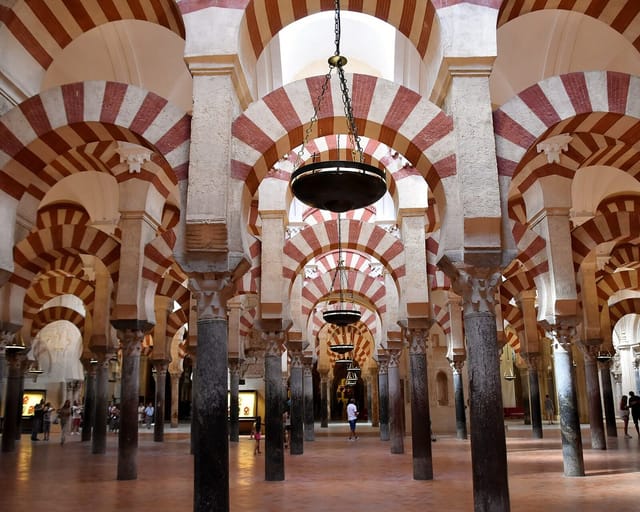
Image: Richard Mortel, The prayer hall of the Great Mosque of Córdoba, 2016. CC BY 2.0, via Wikimedia Commons.. Image credits
_(29721130342).jpg)