Is Islam a religion of peace?
Question 1048
Question
Is Islam a religion of peace, and what does the Quran teach about peace and violence?
Summary of answer
Islam is a religion of peace. Al-Salām, Peace, is one of Allah's names (59:23); Muslims greet every person with 'peace be upon you'; and Paradise is called the Home of Peace (10:25). The Quran commands Muslims to accept peace whenever it is offered (8:61) and counts one murder as the killing of all humanity (5:32). Muslims from the Prophet ﷺ to Abdul Ghaffar Khan have lived this out.
﴿وَٱللَّهُ يَدۡعُوٓاْ إِلَىٰ دَارِ ٱلسَّلَٰمِ﴾
And Allah invites to the Home of Peace.
Answer
الحمد لله Praise be to Allah.
Islam is a religion of peace. Peace is one of the names of Allah, the greeting Muslims give each other many times a day, and the name of the Paradise toward which every believer walks. The Quran says, “Allah invites to the Home of Peace” (Quran 10:25). The word islām itself comes from the same Arabic root as salām, peace: surrender to Allah brings peace with Him, within oneself, and with His creation.
Like every community, Muslims have fought wars, and the Quran regulates war with strict limits. Its goal for human life is peace, and it calls believers to choose peace wherever they can.
Is peace one of the names of Allah?
Near the end of Sūrat al-Ḥashr, the Quran lists some of Allah’s most beautiful names:
هُوَ ٱللَّهُ ٱلَّذِي لَآ إِلَٰهَ إِلَّا هُوَ ٱلۡمَلِكُ ٱلۡقُدُّوسُ ٱلسَّلَٰمُ
“He is Allah, besides whom there is no god: the Sovereign, the Most Holy, Peace.”
Al-Salām (السلام) means Peace itself, the One free of every flaw and the source of safety for all things. Muslims name their children ʿAbd al-Salām, “Servant of Peace.” The people of Paradise greet one another with “Peace” (10:10), and Allah Himself greets them with “Peace, a word from a merciful Lord” (36:58).
Why do Muslims greet everyone with peace?
The Muslim greeting, al-salāmu ʿalaykum, means “peace be upon you.” The Prophet ﷺ made spreading it a path to Paradise:
«لاَ تَدْخُلُونَ الْجَنَّةَ حَتَّى تُؤْمِنُوا وَلاَ تُؤْمِنُوا حَتَّى تَحَابُّوا أَوَلاَ أَدُلُّكُمْ عَلَى شَىْءٍ إِذَا فَعَلْتُمُوهُ تَحَابَبْتُمْ أَفْشُوا السَّلاَمَ بَيْنَكُمْ»
“You will not enter Paradise until you believe, and you will not believe until you love one another. Shall I tell you something that, if you do it, will make you love one another? Spread peace among yourselves.”
When a man asked what the best of Islam is, the Prophet ﷺ answered, “To feed people, and to greet with peace those you know and those you do not know” (Sahih al-Bukhari 12). The greeting is for strangers too, and the article Can Muslims be friends with non-Muslims? shows how far that friendship reaches.
What does the Quran say about peace and war?
The Quran treats every human life as sacred. Whoever kills one innocent person, it says, has killed all of humanity, and whoever saves one life has saved all of humanity (Quran 5:32). Fighting is permitted only to defend against those who attack, “and do not transgress” (2:190). The reasons and rules are set out in What does jihad really mean?.
When an enemy offers peace, the Quran commands Muslims to accept it, even when they cannot be sure of the enemy’s intentions:
وَإِن جَنَحُواْ لِلسَّلۡمِ فَٱجۡنَحۡ لَهَا وَتَوَكَّلۡ عَلَى ٱللَّهِ
“If they incline toward peace, then incline toward it too, and put your trust in Allah.”
The next verse adds that if they mean to deceive, “Allah is enough for you” (8:62). The believer’s part is to choose peace and leave the rest to Allah.
The Quran also asks for peace in daily life. The servants of the All-Merciful “walk on the earth gently, and when the ignorant address them, they say: Peace” (25:63). Believers are told to answer harm with what is better, so that an enemy may become a close friend:
ٱدۡفَعۡ بِٱلَّتِي هِيَ أَحۡسَنُ فَإِذَا ٱلَّذِي بَيۡنَكَ وَبَيۡنَهُۥ عَدَٰوَةٞ كَأَنَّهُۥ وَلِيٌّ حَمِيمٞ
“Repel evil with what is better, and the one with whom you had enmity will become like a devoted friend.”
How did the Prophet ﷺ make peace?
In 628 the Prophet ﷺ set out for Mecca with some 1,400 companions to perform the pilgrimage, and the Quraysh blocked their way at Ḥudaybiya. He accepted a ten-year truce on terms that many companions thought humiliating: the Muslims would turn back that year, and the treaty would be written without the title “Messenger of Allah.” The Quran called this peace “a clear victory” (48:1), and the early historian al-Zuhrī observed that more people entered Islam in the two years after it than in all the years before.
When he returned to Mecca in 630, the city that had persecuted and fought him for twenty years, he entered almost without bloodshed. The biographers report that he forgave its people with the words of Joseph (peace be upon him) to his brothers: “No blame on you today” (12:92).
Who are the Muslim peacemakers in history?
The tradition has many. In 1860, when a mob attacked the Christian quarter of Damascus, the Algerian scholar and former resistance leader Emir Abdelkader opened his home and sent his men through the streets to bring Christians to safety, saving thousands of lives.
In the North-West Frontier of British India, the Pashtun Muslim Abdul Ghaffar Khan, known as Bacha Khan, founded the Khudai Khidmatgar, “Servants of God,” around 1929–1930. Its members, at their peak close to 100,000, swore an oath to avoid revenge, serve all people regardless of religion, and keep to nonviolence, even when British troops fired on their peaceful protesters in Peshawar in 1930. “There is nothing surprising,” he said, “in a Muslim or a Pathan like me subscribing to the creed of nonviolence.”
In our own century, scholars of every school have spoken for peace. The Amman Message (2004) and its endorsement by some two hundred scholars condemned extremism and declared that Muslims of every recognized school must not declare one another unbelievers. Forbearance toward those who insult the faith is part of this same peace, as explained in Is there a punishment for blasphemy in Islam?.
Living as people of peace
A Muslim’s day begins and ends in peace. Every prayer closes with the words al-salāmu ʿalaykum wa raḥmatullāh, turning to the right and to the left, a greeting of peace and mercy to the whole world. May Allah, who is Peace, make us people of peace in our homes, our neighborhoods, and our world, and bring us at last to the Home of Peace.
And Allah knows best. والله أعلم
Frequently asked questions
Does the word Islam mean peace?
Islam means surrender to Allah, and it comes from the same Arabic root (s-l-m) as salām, peace. Classical scholars explained that the one who surrenders to Allah finds peace with Him, with themselves, and with others.
What about the verses on fighting in the Quran?
The verses on fighting were revealed during wars of defense. They permit fighting those who fight Muslims, forbid transgression (2:190), and command Muslims to accept peace when the enemy inclines to it (8:61).
Can Muslims say 'peace be upon you' to non-Muslims?
Yes. The Prophet ﷺ taught Muslims to greet both those they know and those they do not know (Sahih al-Bukhari 12), and many scholars hold that a greeting of peace may be offered to everyone.
Why do some Muslims commit violence?
Some people of every faith commit violence, often for political reasons. Muslim scholars worldwide have condemned terrorism in the name of Islam, in the Amman Message (2004) and the Letter to Baghdadi (2014).
Related questions
Sources
- Sahih Muslim 54a; Sahih al-Bukhari 12
- The Amman Message (2004)
- Eknath Easwaran, Nonviolent Soldier of Islam: Badshah Khan, a Man to Match His Mountains (Nilgiri Press, 1999)
- Khudai Khidmatgar
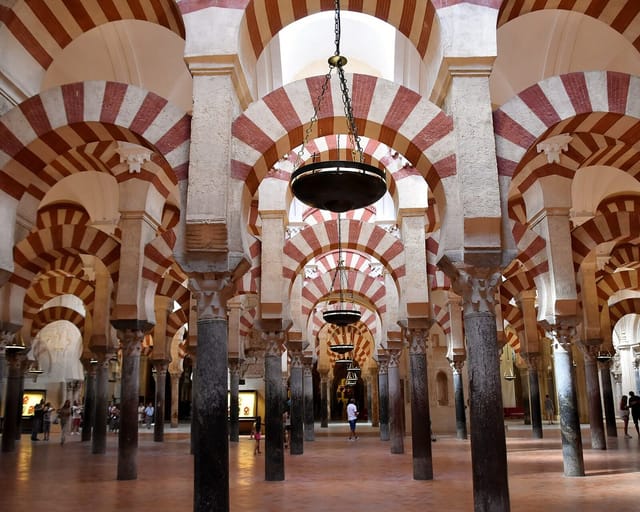
Image: Richard Mortel, The prayer hall of the Great Mosque of Córdoba, 2016. CC BY 2.0, via Wikimedia Commons.. Image credits
_(29721130342).jpg)