Did the Prophet Muhammad have slaves, and does Islam allow slavery?
Question 1050
Question
Did the Prophet Muhammad own slaves, and does Islam permit slavery today?
Summary of answer
Slavery is haram today, and Muslim scholars hold that its abolition stands by consensus. The Prophet ﷺ lived in a world where slavery was everywhere; he owned slaves and freed them, among them Zayd ibn Haritha, whom he adopted as a son. The Quran made freeing slaves an act of worship (90:13), an expiation for sins, and a use of zakat (9:60), setting Muslims on a path toward freedom that Muslim states completed between 1846 and 1981.
﴿فَكُّ رَقَبَةٍ﴾
The freeing of a slave.
Answer
الحمد لله Praise be to Allah.
Slavery is haram today, and Muslim scholars hold that its abolition stands by consensus. The Prophet ﷺ was born into a world where slavery existed in every society, from Arabia to Byzantium to Persia. Like others of his time, he owned slaves, and he freed them. The Quran he brought made freeing slaves an act of worship and set Muslims on a path toward freedom. Muslim states completed that path in the nineteenth and twentieth centuries.
This is a painful subject, and it deserves a truthful answer. Muslim societies, like nearly every society in history, practiced slavery for centuries. The question is what the Quran and Sunnah taught about it, and where their teaching leads.
Did the Prophet Muhammad ﷺ own slaves?
Yes. In seventh-century Arabia, slavery was part of ordinary life, and the Prophet ﷺ owned slaves at various times. The biographies name many whom he freed. Umm Ayman, an Abyssinian woman who had nursed him as a child, was freed by him and remained part of his family all her life. Abu Rāfiʿ and Thawbān were freed and stayed among his closest companions.
The best known is Zayd ibn Ḥāritha (may Allah be pleased with him). Zayd was captured as a boy and sold in Mecca, and Khadija gave him to Muhammad before his prophethood. The biographers report that when Zayd’s father and uncle came to buy him back, Muhammad let Zayd choose, and Zayd chose to stay with him. Muhammad freed him and adopted him as his son. Zayd is the only companion named in the Quran (33:37), and he died commanding a Muslim army at Muʾta.
What does the Quran say about freeing slaves?
The Quran calls the freeing of a slave “the steep road,” the hard and noble climb of faith:
فَلَا ٱقۡتَحَمَ ٱلۡعَقَبَةَ وَمَآ أَدۡرَىٰكَ مَا ٱلۡعَقَبَةُ فَكُّ رَقَبَةٍ
“Yet he has not attempted the steep road. And what will make you understand what the steep road is? The freeing of a slave.”
It made freeing a slave the expiation for accidental killing (4:92), for broken oaths (5:89), and for certain marital wrongs (58:3). It listed “freeing slaves” among the core acts of righteousness (2:177), and it set aside part of zakat for freeing captives (9:60). It also gave enslaved people the right to buy their own freedom by contract, and told owners to help them with money:
وَٱلَّذِينَ يَبۡتَغُونَ ٱلۡكِتَٰبَ مِمَّا مَلَكَتۡ أَيۡمَٰنُكُمۡ فَكَاتِبُوهُمۡ إِنۡ عَلِمۡتُمۡ فِيهِمۡ خَيۡرٗاۖ وَءَاتُوهُم مِّن مَّالِ ٱللَّهِ ٱلَّذِيٓ ءَاتَىٰكُمۡ
“Those in your possession who seek a contract of freedom, grant it to them if you know good in them, and give them from the wealth of Allah that He has given you.”
How did the Prophet ﷺ teach Muslims to treat slaves?
He called enslaved people “your brothers,” and told owners to feed them from what they ate, clothe them from what they wore, and never burden them beyond their strength (Sahih al-Bukhari 30). He promised that whoever frees a slave will be freed from the Fire, limb for limb (Sahih al-Bukhari 2517). He even made freedom the penalty for cruelty:
«مَنْ لَطَمَ مَمْلُوكَهُ أَوْ ضَرَبَهُ فَكَفَّارَتُهُ أَنْ يُعْتِقَهُ»
“Whoever slaps or beats his slave, the expiation for it is to set him free.”
Among his last words, Ali reported, were these: “The prayer, the prayer, and be mindful of Allah regarding those in your possession” (Sunan Abi Dawud 5156, graded sahih by al-Albani).
Why did Islam not abolish slavery at once?
Slavery ran through the whole economy and household life of the ancient world. The Quran reformed it in the way it reformed drinking: step by step, so that the change would hold. The article Is alcohol haram? describes that gradual method. The Quran opened many doors out of slavery, and the jurists summed up its direction in a maxim: the Lawgiver longs for freedom.
The Pakistani scholar Fazlur Rahman (d. 1988) argued that the Quran’s laws must be read for their moral direction, and on slavery that direction is freedom. Laws that regulated an institution in seventh-century Arabia point to its end, as explained in How should the Quran be interpreted?. The scholars also recognized that the classical law of slavery had been abused. Rulers and traders enslaved free people, Muslims among them, in violation of the sharia’s own rules, and the trades across the Sahara and the Indian Ocean caused immense suffering.
When did Muslim countries abolish slavery?
Tunisia led the way. Ahmad Bey closed the slave market of Tunis in 1841, declared everyone born in the country free in 1842, and abolished slavery entirely by decree on 23 January 1846. He secured fatwas from the leading scholars of Tunis beforehand. In 1857 an Ottoman decree banned the trade in African slaves across most of the empire. Saudi Arabia and Yemen abolished slavery in 1962. Mauritania was the last state to abolish it, in 1981, and made it a crime in 2007.
Is slavery allowed in Islam today?
No. Slavery is haram. When the group calling itself ISIS enslaved Yazidi women and children in 2014, more than 120 Muslim scholars answered in their open letter: “The re-introduction of slavery is forbidden in Islam. It was abolished by universal consensus.”
The same ruling covers the slavery of our own time. Human trafficking, forced labor, debt bondage, and the abuse of domestic and migrant workers violate everything the Prophet ﷺ taught about those under our hands. Muslims are called to oppose them with the zeal of the early believers who spent their wealth on freeing captives. Contempt based on race, often an echo of the old slave trades, is also a sin, as explained in What does Islam say about racism?.
A closing word
The steep road of Sūrat al-Balad begins with freeing a slave and continues with feeding the hungry orphan and the poor (90:14–16), which the article on poverty explores. May Allah make us among those who climb it: who free the captive, feed the hungry, and honor the dignity of every human being He has made.
And Allah knows best. والله أعلم
Frequently asked questions
Is slavery haram in Islam today?
Yes. Over 120 scholars stated in 2014 that 'the re-introduction of slavery is forbidden in Islam' and that it was abolished by universal consensus. Human trafficking and forced labor are likewise haram.
Did the Prophet ﷺ free his slaves?
Yes. The biographies name many people he freed, including Zayd ibn Haritha, whom he adopted as his son, Umm Ayman, who had nursed him as a child, Abu Rafi', and Thawban.
Why did the Quran not ban slavery outright?
Slavery ran through the whole economy of the ancient world, and the Quran reformed it step by step, as it did with alcohol. It closed the ways into slavery, opened many ways out, and taught that freeing a slave is an act of worship.
Which Muslim country abolished slavery first?
Tunisia, under Ahmad Bey, whose decree of 23 January 1846 abolished slavery throughout the country, with fatwas from the country's leading scholars supporting it.
Related questions
Sources
- Sahih al-Bukhari 30, 2517; Sahih Muslim 1657a; Sunan Abi Dawud 5156
- Open Letter to al-Baghdadi (2014), executive summary
- Slavery in Tunisia
- Jonathan A. C. Brown, Slavery and Islam (Oneworld, 2019)
- Fazlur Rahman, Islam and Modernity (University of Chicago Press, 1982)
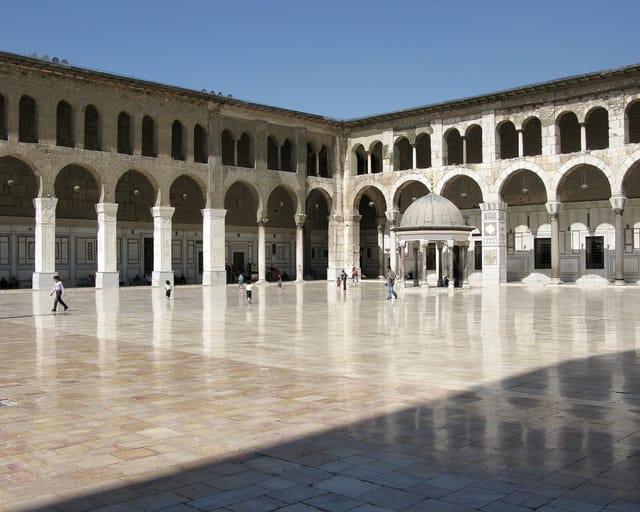
Image: Vyacheslav Argenberg, Courtyard of the Umayyad Mosque, Damascus, 2008. CC BY 4.0, via Wikimedia Commons.. Image credits
