What does jihad really mean?
Question 1046
Question
What does the word jihad mean in Islam, and does it mean holy war?
Summary of answer
Jihad means striving or struggle in the path of Allah. The Prophet ﷺ called the one who strives against his own self a mujahid, named serving one's parents and speaking justice to a tyrant as jihad, and allowed fighting only in self-defense, with strict limits. Killing civilians, women, children, and non-combatants is forbidden, and the world's leading scholars condemned terrorism in the Amman Message (2004) and the Letter to Baghdadi (2014).
Answer
الحمد لله Praise be to Allah.
Jihad (jihād, جهاد) means striving: the effort of a believer to do what Allah loves, in their own heart and in the world. The word comes from the root j-h-d, “to exert oneself,” and most of its uses in the Quran and Sunnah have nothing to do with fighting. The Prophet ﷺ called the person who struggles against their own ego a mujahid, called serving one’s parents a jihad, and called a word of justice spoken to a tyrant the best jihad of all.
Fighting is one narrow form of jihad. Islamic law allows it only in defense against aggression and under strict ethics, and it forbids harming those who do not fight. Terrorism is haram, and the scholars of every school have said so.
What does the Quran mean by jihad?
The Quran first speaks of jihad in Mecca, years before Muslims were permitted to fight. There Allah told the Prophet ﷺ to strive against those who rejected him “with it,” meaning the Quran, “a great striving” (25:52). That first jihad was argument, patience, and preaching. The Meccan verses also promise guidance to everyone who strives:
وَٱلَّذِينَ جَٰهَدُواْ فِينَا لَنَهۡدِيَنَّهُمۡ سُبُلَنَا
“As for those who strive for Our sake, We will surely guide them along Our paths.”
Classical Arabic has separate words for war: ḥarb, and qitāl for fighting. When the Quran speaks of jihad, it can mean spending wealth for the poor, enduring hardship, keeping faith under pressure, or defending the community. “Holy war” is a European phrase that does not translate any Arabic term.
What is the greater jihad?
Many Muslims have heard that the Prophet ﷺ, returning from a battle, said, “We have returned from the lesser jihad to the greater jihad,” meaning the struggle against the self. This well-known saying has a weak chain. Al-Bayhaqi recorded it with a weak chain, and Ibn Ḥajar al-ʿAsqalānī (d. 1449) identified it as a saying of the early Syrian scholar Ibrāhīm ibn Abī ʿAbla.
The idea behind it rests on sound hadith. The Prophet ﷺ said:
«الْمُجَاهِدُ مَنْ جَاهَدَ نَفْسَهُ»
“The one who truly strives is the one who strives against his own self.”
Jami’ al-Tirmidhi 1621, graded sahih by al-Albani
He also gave the name jihad to the work of daily life. A young man came asking permission to join an expedition. The Prophet ﷺ asked, “Are your parents living?” When he said yes, the Prophet ﷺ told him, “Then strive in their service” (Sahih al-Bukhari 3004). The article Do I have to obey my parents? explains what that service includes. And he said, “The best jihad is a word of justice before an unjust ruler” (Sunan Abi Dawud 4344, graded sahih by al-Albani).
When does Islam permit fighting?
The first verse permitting Muslims to fight came after thirteen years of persecution in Mecca and the flight to Medina. It gives the reason in its opening words:
أُذِنَ لِلَّذِينَ يُقَٰتَلُونَ بِأَنَّهُمۡ ظُلِمُواْ
“Permission is given to those who are fought against, because they have been wronged.”
The next verse explains that without this permission, “monasteries, churches, synagogues, and mosques in which Allah’s name is often remembered” would be destroyed (22:40). The Quran’s own reason for permitting defense includes the protection of other faiths’ houses of worship.
The Quran then sets a firm limit:
وَقَٰتِلُواْ فِي سَبِيلِ ٱللَّهِ ٱلَّذِينَ يُقَٰتِلُونَكُمۡ وَلَا تَعۡتَدُوٓاْۚ إِنَّ ٱللَّهَ لَا يُحِبُّ ٱلۡمُعۡتَدِينَ
“Fight in the way of Allah those who fight you, and do not transgress. Allah does not love those who transgress.”
If the enemy inclines to peace, Muslims must incline to it too (8:61). The scholars added that only a legitimate public authority may declare war. No individual or private group may declare it.
What are the rules of war in Islam?
The Prophet ﷺ saw a woman killed after one of the battles and forbade the killing of women and children (Sahih al-Bukhari 3015). The jurists extended this protection to the elderly, the sick, monks and hermits, farmers, merchants, and all who do not take part in fighting.
When the caliph Abu Bakr (may Allah be pleased with him) sent his armies to Syria, he gave his commander ten instructions, preserved in Imam Mālik’s Muwaṭṭaʾ with a broken chain: do not kill a woman, a child, or an old man; do not cut down fruit trees; do not destroy a place where people live; do not slaughter sheep or camels except for food; do not burn or scatter bees; do not steal from the spoils; and do not be cowards. He told him to leave alone those who had devoted themselves to worship in their cells (Muwatta Malik 968).
Is terrorism jihad?
No. Attacking civilians, taking hostages, and suicide bombings in markets and places of worship break every one of these rules. The jurists had a name for this crime: ḥirāba, spreading terror and corruption in the land, and they counted it among the gravest offenses.
In November 2004, King Abdullah II of Jordan issued the Amman Message. The following year some two hundred scholars from about fifty countries, Sunni and Shia, endorsed its three points: the recognized schools of law are all Muslim, no one may declare another Muslim an unbeliever (takfīr), and only qualified scholars may issue fatwas. The article on Sunni and Shia Islam says more about that recognition.
In September 2014, more than 120 Muslim scholars published an open Letter to Baghdadi, the leader of ISIS. Drawing on the Quran and hadith, it showed that killing emissaries, journalists, and aid workers is forbidden, that harming Christians and other People of the Book is forbidden, and that armed jihad is defensive.
What does jihad mean for Muslims today?
For nearly every Muslim, jihad is a daily matter. It is waking for the dawn prayer, holding the tongue in anger, caring for aging parents, working with integrity, studying, and standing up for the wronged with words and lawful means. It is also the patient work of building friendship and trust with neighbors of other faiths (Can Muslims be friends with non-Muslims?). The article Is Islam a religion of peace? shows how all of this flows from Allah’s name al-Salām, Peace.
May Allah make us among those who strive for His sake in the struggles that matter most, against our own selfishness and for the good of others, and guide us along His paths of peace.
And Allah knows best. والله أعلم
Frequently asked questions
Does jihad mean holy war?
No. Jihad means striving, and classical Arabic has other words for war (ḥarb, qitāl). Armed struggle is one narrow form of jihad, allowed only in defense and under strict ethics.
What is the greater jihad?
Muslims often speak of the struggle against one's own ego (jihād al-nafs) as the greater jihad. The famous report 'We have returned from the lesser jihad to the greater jihad' has a weak chain, but the idea rests on sound hadith, such as 'The mujahid is the one who strives against himself' (Jami' al-Tirmidhi 1621).
Is terrorism jihad?
No. Killing civilians is haram in every school of Islamic law. The Prophet ﷺ forbade killing women and children in war, and hundreds of scholars across the Sunni and Shia schools have condemned terrorism by name.
Can women do jihad?
Yes. Every believer strives against their ego, for justice, and for good. When Aisha asked the Prophet ﷺ whether women should join the fighting, he told her that the finest jihad is a hajj accepted by Allah (Sahih al-Bukhari 1520).
Related questions
Sources
- Jami' al-Tirmidhi 1621; Sahih al-Bukhari 3004, 3015; Sunan Abi Dawud 4344
- Muwatta Malik 968 (Abu Bakr's instructions to his commanders)
- The Amman Message (2004)
- Open Letter to Dr. Ibrahim Awwad al-Badri, alias Abu Bakr al-Baghdadi (2014)
- al-Khaṭīb al-Baghdādī, Tārīkh Baghdād; Ibn Ḥajar al-ʿAsqalānī on the 'greater jihad' report
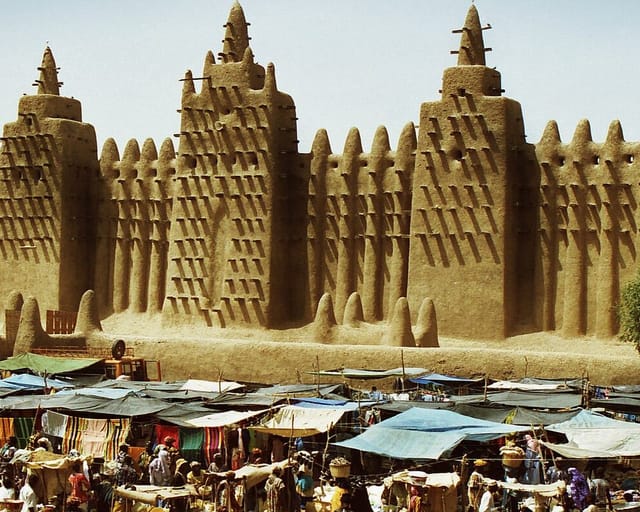
Image: Ondřej Havelka, The Great Mosque of Djenné, Mali, 2021. CC BY-SA 4.0, via Wikimedia Commons.. Image credits
