Are student loans haram?
Question 1179
Question
Is it permissible for a Muslim to take out a student loan with interest to pay for university or professional training?
Summary of answer
Taking a student loan to pay for education is halal where it is needed and no fair interest-free option exists. The Quran raises those given knowledge by degrees (58:11), and the Prophet ﷺ promised that whoever seeks knowledge walks a path to Paradise (Sahih Muslim 2699a). Islamic law treats a general need like a necessity, and loans repaid as a share of income and later cancelled are far from the riba that ruined the poor.
Answer
الحمد لله Praise be to Allah.
For many young Muslims a degree or a professional qualification is the door to a livelihood, to work that serves others, and to the means of supporting a family. In most countries that door is paid for with a student loan, and students often ask whether borrowing for their studies is a sin. Student loans are halal where they are needed to study and no fair interest-free option is available. The tradition praises the seeking of knowledge in the strongest terms, it treats a general need like a necessity, and many student loans today look very different from the riba the Quran forbids.
Why does Islam value education so highly?
The first word revealed to the Prophet ﷺ was a command: “Read, in the name of your Lord who created” (Quran 96:1). The Quran asks, “Are those who know equal to those who do not know?” (39:9), and promises that Allah raises the believers and those given knowledge by degrees (58:11). It teaches the Prophet ﷺ himself to pray:
وَقُل رَّبِّ زِدۡنِي عِلۡمٗا
“And say: My Lord, increase me in knowledge.”
The Prophet ﷺ described the student’s road in words that have encouraged learners for fourteen centuries:
«مَنْ سَلَكَ طَرِيقًا يَلْتَمِسُ فِيهِ عِلْمًا سَهَّلَ اللَّهُ لَهُ بِهِ طَرِيقًا إِلَى الْجَنَّةِ»
“Whoever walks a path seeking knowledge, Allah makes easy for him by it a path to Paradise.”
The jurists did not limit this praise to religious study. Al-Ghazali (d. 1111), in the Book of Knowledge that opens his Iḥyāʾ ʿUlūm al-Dīn, counted medicine and arithmetic among the communal obligations (furūḍ al-kifāya): sciences the community sins by neglecting, because its life depends on them. Doctors, nurses, engineers, teachers, and lawyers carry that trust today. The same is true for women and men alike (What does Islam say about education for girls?).
Are student loans riba?
The scholars differed (ikhtalafa al-ʿulamāʾ). The International Islamic Fiqh Academy ruled in 1985 that any increase fixed on a loan is riba, and many scholars apply this to every interest-bearing student loan. They advise students to seek scholarships, grants, family support, or interest-free community loans, and to study part-time if needed. Students who follow this view act on serious scholarship, and their care is admirable.
The stronger view (al-rājiḥ) is that a student loan is permissible where it is needed, for three reasons.
Need is treated like necessity
Islamic law holds that a general need (ḥāja) is treated like a necessity (ḍarūra). The European Council for Fatwa and Research applied this principle in 1999 to Muslims in Europe who could not otherwise buy a family home (Is a mortgage haram?). A young person who cannot enter a profession without a degree, and cannot pay for the degree without a loan, faces the same kind of need. “Allah does not burden any soul beyond its capacity” (2:286).
Many student loans work like a graduate contribution
The Quran’s last word on riba names its wrong: “you will do no wrong, and no wrong will be done to you” (Quran 2:279). Riba in Arabia doubled the debts of the poor until they lost everything. Public student loans in several countries work the other way. In England, for example, repayments are a fixed share of earnings above a threshold, nothing is due when earnings fall below it, and any balance left after a set number of years is cancelled. A graduate who struggles pays little or nothing. Such a scheme behaves more like a contribution from future earnings to public funding of universities than like a lender profiting from distress.
Modern interest is debated
Many scholars hold that regulated, disclosed interest differs from the exploitative riba of the Quran, as the Pakistani scholar Fazlur Rahman argued in 1964. The full debate is set out in Is bank interest haram?
What are the alternatives to a student loan?
- Scholarships, bursaries, and grants, including those offered by Muslim foundations and universities.
- Employer sponsorship and apprenticeships, which pay for training in return for work.
- Interest-free loans (qarḍ ḥasan) from mosques and community funds where they exist.
- Zakat. A student in poverty may receive zakat, and so may a graduate burdened by debt, since the Quran names those in debt (al-ghārimīn) among its recipients (9:60). See How does zakat work?
Muslim communities have funded learning for centuries through endowments (awqāf) that paid for colleges, libraries, and students’ bread. Supporting a student today continues that Sunnah.
How should a Muslim student handle a loan?
- Borrow what you need for your studies, and avoid high-interest private loans where public or Islamic options exist.
- Repay on time and use every forgiveness or income-based plan you are entitled to.
- Do not let fear of debt keep you from learning a skill your family and community need.
- Use your knowledge for good. The degree is a trust (amāna), and its fruit is service to Allah’s creation.
Similar questions about other credit are answered in Is car financing or leasing haram?
A prayer for the student
Umm Salama (may Allah be pleased with her) reported that after the dawn prayer the Prophet ﷺ would say:
«اللَّهُمَّ إِنِّي أَسْأَلُكَ عِلْمًا نَافِعًا، وَرِزْقًا طَيِّبًا، وَعَمَلاً مُتَقَبَّلاً»
“O Allah, I ask You for knowledge that benefits, provision that is good, and deeds that are accepted.”
Sunan Ibn Majah 925, graded sahih by al-Albani
May Allah open the doors of learning for you, lighten every debt you carry, and make your knowledge a blessing for those you serve.
And Allah knows best. والله أعلم
Frequently asked questions
Is the UK student loan haram?
The stronger view permits it. Repayments are a share of earnings above a threshold, nothing is due on lower earnings, and the remaining balance is cancelled after a set number of years, so the loan works more like a graduate contribution than a commercial debt. Students who prefer to avoid it may seek scholarships, grants, or community loans.
Are US federal student loans haram?
Federal loans carry interest, so scholars who forbid all interest advise against them. Where a student needs them to study and has no fair alternative, they fall under the principle of need, and income-driven repayment plans soften the burden.
Can zakat be used to pay off student loans?
Yes, for a student or graduate who cannot repay. The Quran names those burdened by debt (al-ghārimīn) among the people zakat is for (9:60).
Should I use my savings instead of a loan?
If you can pay for your studies from savings or family help without hardship, that is the cleaner path. The permission for a loan rests on need.
Related questions
Sources
- Sahih Muslim 2699a; Sunan Ibn Majah 925
- European Council for Fatwa and Research, resolution on buying homes with mortgages (fourth session, October 1999)
- International Islamic Fiqh Academy, Resolution 10 (10/2) on bank interest (Jeddah, 1985)
- al-Ghazali, Iḥyāʾ ʿUlūm al-Dīn, Kitāb al-ʿIlm (The Book of Knowledge)
- Fazlur Rahman, "Riba and Interest," Islamic Studies 3, no. 1 (1964)
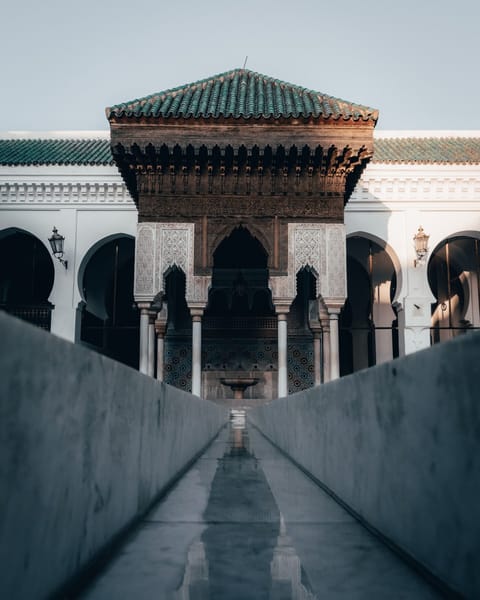
Image: Reda.bnhd, Courtyard of the Qarawiyyin Mosque, Fez, 2019. CC BY-SA 4.0, via Wikimedia Commons.. Image credits
