Is it haram to depict the Prophet Muhammad?
Question 1023
Question
Is it permissible in Islam to draw, paint, or show the Prophet Muhammad in a picture or film?
Summary of answer
Respectful depiction of the Prophet ﷺ is halal. No verse of the Quran forbids it, and the hadiths on images concern idols. Muslim painters showed him for centuries: in Rashid al-Din's Jāmiʿ al-Tawārīkh (Tabriz, early fourteenth century), the Miʿrājnāma made for Shah Rukh (1436–37), and the Ottoman Siyer-i Nebi (1595). Ayatollah Sistani permits depicting him with due reverence. Many Muslims prefer not to look, and that preference deserves respect.
Answer
الحمد لله Praise be to Allah.
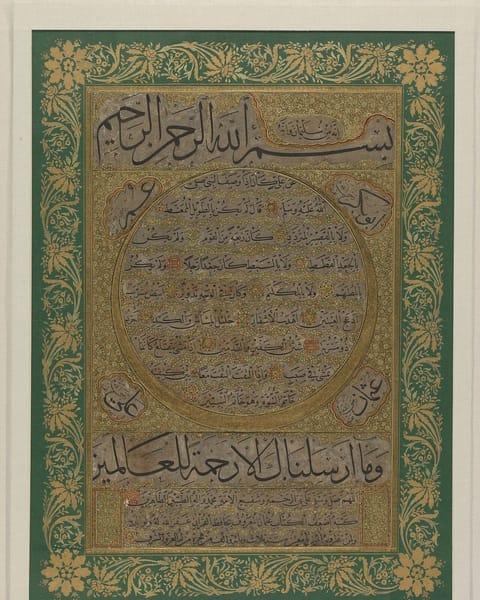
Many Muslims grow up believing that any picture of the Prophet ﷺ is forbidden, and that belief is held with deep love. The stronger view (al-rājiḥ) is that a respectful depiction of the Prophet Muhammad ﷺ is halal. No verse of the Quran forbids it, the hadiths on images concern idols, and for centuries Muslim painters showed him in manuscripts made for Muslim rulers and readers. A Muslim who prefers never to see such an image is also following a long and honorable practice, and nothing in this answer asks anyone to look.
Does the Quran forbid images of the Prophet ﷺ?
No verse of the Quran mentions pictures of the Prophet ﷺ, and no verse forbids drawing people at all. The Quran’s concern is worship: it condemns statues that people bow to (21:52). The hadiths against image-makers address the same danger, the making of idols and the attempt to rival Allah as Creator, as our answer on drawing faces and people explains in detail. A painting in a history book, made with reverence and never prayed to, falls outside both.
What the Quran does ask is love and honor for the Messenger ﷺ:
وَإِنَّكَ لَعَلَىٰ خُلُقٍ عَظِيمٖ
“And you are of a magnificent character.”
Every depiction made by Muslim artists over the centuries tried, in its way, to show that greatness.
Did Muslims depict the Prophet ﷺ in history?
They did, for at least five hundred years, in some of the most precious books of the Muslim world.
- The Jāmiʿ al-Tawārīkh of Rashid al-Din, vizier of the Mongol Ilkhanid rulers, was produced in Tabriz in the early fourteenth century. The portion kept at the University of Edinburgh contains the earliest extended cycle of paintings of the Prophet’s life that survives.
- The Miʿrājnāma, the Book of the Ascension, was made around 1436–37 for Shah Rukh, son of Timur, with its text written in the Uyghur script. Now in the Bibliothèque nationale de France, it shows the Prophet ﷺ riding Buraq through the heavens with Gabriel, meeting the earlier prophets, and visiting Paradise.
- Persian copies of Nizami’s poems often open with a painting of the miʿrāj. One famous example was made for Shah Tahmasp of Iran between 1539 and 1543 and is now in the British Library.
- The Siyer-i Nebi, an Ottoman Turkish life of the Prophet ﷺ, was illustrated in the palace workshop of Sultan Murad III and completed in 1595. Its 814 paintings show the Prophet ﷺ with his face veiled and surrounded by a golden flame.
The early paintings show his face. The veil over the face appears in Persian painting at the start of the sixteenth century, under the Safavid ruler Shah Ismail I, and later became the usual convention. The reticence many Muslims feel today about any image at all grew stronger in more recent centuries.
What do the scholars say about depicting the Prophet ﷺ?
The scholars differed (ikhtalafa al-ʿulamāʾ). Most Sunni scholars today, including al-Azhar, forbid depicting the prophets. Their concern is reverence: they fear that an image may diminish the Prophet ﷺ or become an object of excessive veneration. When the Iranian director Majid Majidi released his film on the Prophet’s ﷺ childhood in 2015, al-Azhar asked for it to be banned, even though the boy playing him is filmed only from behind. This is a recognized view held by people of deep love for the Messenger ﷺ.
The opposing view has its own authorities. Ayatollah Ali al-Sistani, the most widely followed Shia jurist, was asked whether it is permissible to portray the Prophet ﷺ, the earlier prophets or the Imams in cinema, television or theatre. He answered that if due respect is observed and nothing in the scene lowers their sacred image in the minds of viewers, there is no problem. In Iran, devotional posters of the young Prophet ﷺ have been printed and sold openly for decades. The Miʿrājnāma and the Siyer-i Nebi were made for Sunni rulers, the Timurid Shah Rukh and the Ottoman sultans, who saw no conflict between these paintings and their faith. See Sunni vs Shia for more on how the two traditions differ in their schools of law.
Given the absence of any prohibiting text and the long practice of Muslim art, the stronger view is that reverent depiction is permissible.
How else have Muslims pictured the Prophet ﷺ?
Muslims have always longed to know what he looked like. The Companions described him in loving detail. Al-Bara ibn Azib said:
«رَأَيْتُهُ فِي حُلَّةٍ حَمْرَاءَ، لَمْ أَرَ شَيْئًا قَطُّ أَحْسَنَ مِنْهُ»
“I saw him in a red cloak, and I have never seen anything more beautiful than him.”
From such descriptions came the hilye, the Ottoman calligraphic portrait. The calligrapher Hafiz Osman (1642–1698) gave it its classic form: a panel built around Ali’s description of the Prophet ﷺ, preserved in al-Tirmidhi’s Shamāʾil. Many Muslim homes display a hilye today. A painting and a hilye come from the same desire, and Muslims may choose the one that suits their hearts. Hanging either at home is discussed in Is it haram to have photos of people in your house?
How should Muslims treat those who see this differently?
With gentleness on both sides. A Muslim who loves the old paintings should not show them to someone who would be pained by them, and a Muslim who avoids all images should not accuse the painters of Tabriz and Istanbul of disbelief. Mockery is a different act from devotion, and the Quran’s answer to it is patience, as explained in Is there a punishment for blasphemy in Islam? For the historical person behind the paintings, see Was the Prophet Muhammad a real person?
A closing word
Whether you know his face from a Persian manuscript, from the lines of a hilye, or only from the descriptions of those who loved him, the way to him is the same: following his character and sending blessings upon him.
إِنَّ ٱللَّهَ وَمَلَـٰٓئِكَتَهُۥ يُصَلُّونَ عَلَى ٱلنَّبِيِّۚ يَـٰٓأَيُّهَا ٱلَّذِينَ ءَامَنُواْ صَلُّواْ عَلَيۡهِ وَسَلِّمُواْ تَسۡلِيمًا
“Allah and His angels send blessings upon the Prophet. You who believe, send blessings upon him and greet him with peace.”
And Allah knows best. والله أعلم
Frequently asked questions
Is it haram to depict the Companions (sahaba)?
The same reasoning applies. Persian and Ottoman manuscripts often show Ali, Abu Bakr and other Companions, and Ayatollah Sistani permits portraying the prophets, the Imams and other holy figures in film when it is done with reverence.
Can Allah be depicted?
No. Muslims have never pictured Allah, because 'there is nothing like Him' ([Quran 42:11](https://quran.com/42/11)). Any image of Him would be an image of something else.
What is the Shia view on depicting the Prophet?
Ayatollah Sistani rules that showing the Prophet ﷺ, the earlier prophets or the Imams on screen or stage is permissible when due respect is observed. Devotional posters of the Prophet ﷺ have been sold openly in Iran for decades.
What about cartoons that mock the Prophet?
Mockery and devotion are different acts. The Quran's answer to mockery is to leave the gathering and respond with patience, as explained in our answer on blasphemy.
Related questions
Sources
- Rashid al-Din, Jāmiʿ al-Tawārīkh, Edinburgh University Library (Tabriz, early fourteenth century)
- Miʿrājnāma, Bibliothèque nationale de France, Suppl. turc 190 (c. 1436–37)
- Siyer-i Nebi, Topkapı Palace Museum and other collections (completed 1595)
- Christiane Gruber, The Praiseworthy One: The Prophet Muhammad in Islamic Texts and Images (Indiana University Press, 2018)
- Office of Ayatollah Sistani, Question and Answer 01292
- Encyclopaedia Iranica, Meʿrāj ii. Illustrations
Image: Hafız Osman, Hilye, a calligraphic description of the Prophet, 1691–1692. Chester Beatty Library, Dublin (T 559.4). Public domain, via Wikimedia Commons.. Image credits
