Is it haram to have photos of people in your house?
Question 1024
Question
Is it permissible to hang photographs or pictures of people, family members, or animals on the walls of a Muslim home?
Summary of answer
Having photos of family and other people in your home is halal. The hadith that angels do not enter a house with an image was about statues and idol-like figures: Gabriel asked for a statue's head to be removed and a curtain to be cut into cushions, and the narrator himself excepted designs on cloth. Muhammad Bakhit al-Muti'i, Grand Mufti of Egypt, permitted photography, and Egypt's Dar al-Ifta still does.
Answer
الحمد لله Praise be to Allah.
A wedding photo on the mantel, a grandmother’s portrait in the hallway, children’s school pictures on the fridge: these are the faces of the people we love. Some Muslims have been told that every such picture keeps the angels of mercy away. The stronger view (al-rājiḥ) is that photos and pictures of people in the home are halal. The hadith about angels and images concerned statues and idol-like figures, the Prophet ﷺ himself lived with pictured cloth in his house, and the great muftis of Egypt permitted photography more than a century ago.
What does the hadith about angels and pictures mean?
The Prophet ﷺ said, “The angels do not enter a house in which there is an image (ṣūra)” (Sahih al-Bukhari 5958). Read alone, it sounds sweeping. Read with the other narrations, its meaning becomes clear.
In a fuller report, the Prophet ﷺ explained why Gabriel had not come in one night. There was a statue at the door, a curtain with figures on it, and a dog in the house. Gabriel told him to cut off the statue’s head “so that it becomes like a tree,” and to cut the curtain into two cushions to be sat and leaned on (Sunan Abi Dawud 4158, graded sahih by al-Albani). Nothing was thrown away. A carved figure was made to stop looking like an object of worship, and the pictured cloth was put to ordinary use. (The dog in that story belonged to the Prophet’s grandsons; our answer on whether Muslims can have dogs discusses it.)
The narrator of the angels hadith also understood its limits. Busr ibn Saʿid reports that the Companion Zayd ibn Khalid, who had transmitted it, later hung a curtain with a picture on his own door. When Busr asked about this, another student reminded him that the hadith itself said “except a design in cloth” (illā raqman fī thawb) (Sahih al-Bukhari 5958).
Did the Prophet ﷺ have pictures in his house?
He lived with them. When Aisha (may Allah be pleased with her) hung a curtain with figures, he took it down; she cut it into cushions, and he leaned on them at home (Sahih Muslim 2107o). Aisha also kept her dolls in his house, as described in our answer on drawing faces and people.
On another occasion his reason for removing a pictured curtain is recorded in his own words:
«أَمِيطِي عَنَّا قِرَامَكِ هَذَا، فَإِنَّهُ لاَ تَزَالُ تَصَاوِيرُهُ تَعْرِضُ فِي صَلاَتِي»
“Take this curtain of yours away from us, for its pictures keep coming before me in my prayer.”
The concern he named was distraction in prayer. That guidance remains useful: keep the wall in front of your prayer space calm. It is a matter of focus in worship, and a framed photo in the living room raises no such issue.
Is photography haram in Islam?
When photography reached the Muslim world in the nineteenth century, scholars had to decide whether a photograph is an “image” in the sense of the hadiths. Many of the leading jurists of Egypt concluded that it is permissible.
- Muhammad Abduh (d. 1905), Grand Mufti of Egypt, defended pictures as a means of preserving knowledge and beauty.
- Muhammad Bakhit al-Muti’i (d. 1935), Grand Mufti of Egypt during the First World War, wrote a treatise permitting photography. His reasoning, in al-Jawāb al-Shāfī: a photograph holds the shadow of a being Allah has already created, so the photographer invents no rival form.
- Yusuf al-Qaradawi adopted this view in al-Ḥalāl wa-l-Ḥarām fī al-Islām, and it spread across the Arab world.
- Egypt’s Dar al-Ifta ruled in 2013 that photographing and drawing people is permissible as long as the image contains nothing indecent.
Some scholars, especially in South Asia, still forbid photographs except for need, such as passports. That is a recognized opinion. The stronger view is the permissive one: it reads the hadiths with their causes, and it matches what the Muslim world has done for over a century. The first photographs of Medina and Mecca were taken by a Muslim: Muhammad Sadiq, an Egyptian army engineer, photographed Medina in 1861 and Mecca during his Hajj in 1880.
Why does this question matter?
The sharia was given to make life lighter:
يُرِيدُ ٱللَّهُ بِكُمُ ٱلۡيُسۡرَ وَلَا يُرِيدُ بِكُمُ ٱلۡعُسۡرَ
“Allah wants ease for you, and does not want hardship for you.”
Families have taken down their wedding pictures, children have been told that their drawings drive away angels, and grieving people have hidden the last photograph of a parent. These burdens come from reading one hadith without the others. A home full of the faces of people you love, and pictures of birthdays, graduations and Eid mornings, is a home full of gratitude.
What pictures should a Muslim home avoid?
The ethics of the home apply to its walls: avoid indecent images, images that mock people or the sacred, and anything treated as an object of worship. For pictures of the Prophet ﷺ himself, see Is it haram to depict the Prophet Muhammad?
A closing word
Many of us keep a photograph of a parent or grandparent who has returned to Allah, and the soul’s life after death is discussed in What happens after death in Islam? When you pass that photograph, let it bring to your lips the prayer the Quran teaches:
رَّبِّ ٱرۡحَمۡهُمَا كَمَا رَبَّيَانِي صَغِيرٗا
“My Lord, have mercy on them, as they raised me when I was small.”
And Allah knows best. والله أعلم
Frequently asked questions
Can I pray in a room with pictures on the wall?
Yes. Your prayer is valid. If an image in front of you distracts you, move it or face another way, as the Prophet ﷺ asked Aisha to move a patterned curtain that caught his eye during prayer.
Is it haram to keep pictures of people who have died?
No. Keeping a photograph of a parent or friend who has passed away is an act of love, and it can prompt you to pray for them. What the tradition warns against is venerating images, and looking at a loved one's face while making duʿāʾ for them is remembrance.
Is it haram to have pictures of animals on your wall?
No. Pictures of animals take the same ruling as pictures of people: they are lawful as decoration, as art, or as memories.
Is taking selfies haram?
No. Photography is permissible on the view of most modern scholars, including the muftis of Egypt. Use it with the same good sense and modesty that guide the rest of your life.
Related questions
Sources
- Sahih al-Bukhari 374, 5954, 5958
- Sunan Abi Dawud 4158
- Egypt's Dar al-Ifta, Fatwa 5987: What is the Islamic ruling on photography and drawing humans? (2013)
- Yusuf al-Qaradawi, al-Ḥalāl wa-l-Ḥarām fī al-Islām (The Lawful and the Prohibited in Islam)
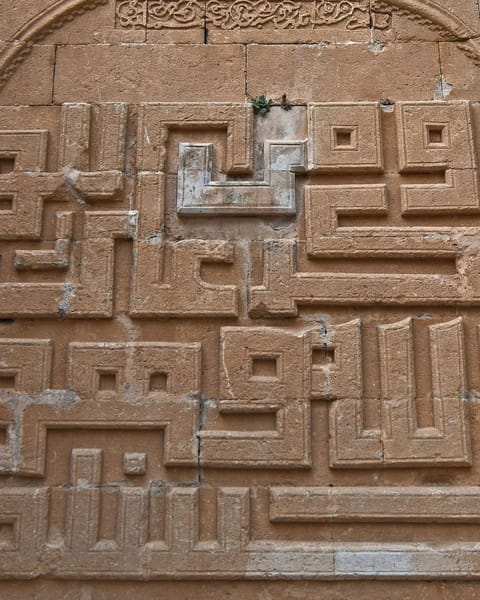
Image: Dosseman, Square Kufic carving at the Great Mosque of Mardin, 2025. CC BY-SA 4.0, via Wikimedia Commons.. Image credits
