Is music haram in Islam?
Question 1020
Question
Is listening to music permissible in Islam, including songs with musical instruments?
Summary of answer
Music is halal, instruments included. No verse of the Quran forbids it, and the Prophet ﷺ let girls sing in his home on Eid and asked why a wedding had no music. The one hadith that names instruments has a disconnected chain according to Ibn Hazm, and al-Ghazali, Abu Bakr ibn al-Arabi, Abd al-Ghani al-Nabulsi and Mahmud Shaltut held music lawful unless it is joined to something forbidden.
Answer
الحمد لله Praise be to Allah.
Music moves the heart: a lullaby, a wedding song, the ney of the Sufis, the song a mother hums in the kitchen. Many Muslims have been told that all of it is haram, and they listen with a heavy conscience. The stronger view (al-rājiḥ) in the tradition is that music is halal, instruments included. No verse of the Quran forbids it, the Prophet ﷺ allowed singing in his own home, and some of the greatest scholars of Islam defended it in writing.
What does the Quran say about music?
The Quran never names music, singing, or any instrument as forbidden. Its general rule for the good things of this world is generous:
قُلۡ مَنۡ حَرَّمَ زِينَةَ ٱللَّهِ ٱلَّتِيٓ أَخۡرَجَ لِعِبَادِهِۦ وَٱلطَّيِّبَٰتِ مِنَ ٱلرِّزۡقِ
“Say: who has forbidden the beauty that Allah brought forth for His servants, and the good things He provides?”
In the law, the default for things and pleasures is permission (al-aṣl fī al-ashyāʾ al-ibāḥa), and only a clear text moves something into the forbidden.
The verse most often quoted against music is Quran 31:6, about a person who “buys idle talk (lahw al-ḥadīth) to lead others astray from the path of Allah without knowledge, and makes a mockery of it.” Some early commentators applied it to singing. Ibn Hazm (d. 1064) answered in al-Muḥallā that the verse condemns a purpose: buying anything in order to mislead people and mock Allah’s path. A person who listens to a song to rest the heart is outside its description.
Did the Prophet ﷺ allow singing?
He did, in his own house. On the day of Eid, two young girls of the Ansar were singing old songs of the battle of Buʿāth beside Aisha (may Allah be pleased with her). Abu Bakr came in and scolded them, calling it the pipes of Satan. The Prophet ﷺ answered him:
«يَا أَبَا بَكْرٍ إِنَّ لِكُلِّ قَوْمٍ عِيدًا، وَهَذَا عِيدُنَا»
“Abu Bakr, every people has its festival, and this is our festival.”
In another narration he told Abu Bakr, “Leave them” (Sahih al-Bukhari 949). When Aisha prepared a bride for a man of the Ansar, he asked her, “Aisha, did you have no music with you? The Ansar love entertainment” (Sahih al-Bukhari 5162). He also said that what separates a lawful marriage from a secret one is “the duff and the voice” (Jamiʿ al-Tirmidhi 1088, graded hasan by al-Tirmidhi and al-Albani). Music at a wedding is a sunna.
What about the hadith on musical instruments?
Those who forbid instruments rely mainly on one report. Al-Bukhari records that the Prophet ﷺ said some people of his community would “make lawful fornication, silk, wine, and instruments (maʿāzif)” (Sahih al-Bukhari 5590). It deserves a careful answer.
First, al-Bukhari did not give it a connected chain. He introduces it with “Hishām ibn ʿAmmār said,” without stating that he heard it from him, and the scholars call such a report muʿallaq (suspended). Ibn Hazm rejected it for this reason. Second, the report lists instruments beside fornication and wine and describes people who will be destroyed for a whole way of life. The Maliki judge Abu Bakr ibn al-ʿArabi (d. 1148) went further and said that no sound hadith forbids singing at all. A warning against a drunken, debauched gathering says little about a family listening to a song after dinner. Our answer on whether all hadith are authentic explains how scholars weigh reports like this one.
What did the classical scholars say about music?
The scholars differed (ikhtalafa al-ʿulamāʾ). Many jurists of the four Sunni schools disliked or forbade instruments other than the duff, and many mosques still teach that view. It is a recognized opinion, held by people of piety. The opposing view has an equally distinguished line:
- Abu Hamid al-Ghazali (d. 1111) devoted Book 18 of his Iḥyāʾ ʿUlūm al-Dīn to listening to music (samāʿ). He concluded that singing and playing are lawful in themselves, and he observed that even a camel quickens its pace at the song of its driver.
- Ibn Hazm held that whatever has been reported to forbid singing is unsound, and that a person’s intention decides whether listening is good or bad.
- Abd al-Ghani al-Nabulsi (d. 1731), the Hanafi scholar and Sufi of Damascus, wrote Īḍāḥ al-Dalālāt fī Samāʿ al-Ālāt in 1677, a treatise on instruments concluding that they are lawful unless used for something forbidden.
- Mahmud Shaltut (d. 1963), Shaykh al-Azhar, ruled that music is permissible and objected only where it is joined to immorality.
Among the Shia, Jaʿfari jurists forbid ghināʾ in the sense of music suited to gatherings of sin, and Ayatollah Sistani rules that music which does not suit such gatherings is permissible.
How has music lived in Muslim civilization?
Muslim civilization is full of music. Ziryab (d. about 857) brought the art of Baghdad to Córdoba at the invitation of the Umayyad court, and he is said to have added a fifth pair of strings to the oud and founded one of the first music schools of al-Andalus. The Mevlevi Sufis of Konya pray with the ney and the drum, and the qawwals of South Asia sing the love of Allah and His Messenger ﷺ through the night (see What is Sufism?). Every year the songs of the Mawlid fill streets from Cairo to Jakarta. In the twentieth century Umm Kulthum, who learned to recite the Quran as a village girl, sang to the whole Arab world.
What kind of music should a Muslim avoid?
Music follows the same rule as speech. A saying recorded in al-Bukhari’s al-Adab al-Mufrad (867) compares poetry to speech: its good is like good speech and its bad like bad speech. The hadith scholars differ on its chain, and the jurists have long accepted its meaning. A song that mocks the sacred, degrades people, or calls to harm takes the ruling of those words. Music that keeps you from prayer or from your duties needs a lighter hand, as any good thing does when it grows too large. Within those bounds, sing at your weddings, play for your children, and let beautiful sound remind you of the One who made it. The same reasoning applies to dancing, and to the songs at a birthday.
A closing word
Rumi opens his Masnavi with the voice of a reed flute, cut from its reed bed and crying for the place it came from. Generations of Muslims have heard in that sound the longing of the soul for Allah. May every song you love draw you closer to Him, and may your heart, like the reed, always know its way home.
And Allah knows best. والله أعلم
Frequently asked questions
Is music haram in Shia Islam?
Jaʿfari jurists forbid ghināʾ, singing of the kind suited to gatherings of frivolity and sin. Leading authorities such as Ayatollah Sistani rule that music which does not suit such gatherings is permissible.
What does the Hanafi school say about music?
The classical Hanafi manuals were strict about instruments while allowing the duff at weddings. The Damascus Hanafi scholar Abd al-Ghani al-Nabulsi (d. 1731) later wrote a whole treatise showing that instruments are lawful when they are not used for sin.
Is it haram to listen to music in the bathroom or shower?
No. The etiquette of keeping the Quran and the names of Allah out of the bathroom applies to sacred words. An ordinary song carries no such rule.
Is singing without instruments allowed?
Yes. The Companions chanted verses while building the Prophet's mosque in Medina, and the Prophet ﷺ chanted with them (Sahih al-Bukhari 428). They sang again while digging the trench around the city (Sahih al-Bukhari 2835).
Related questions
Sources
- Ibn Hazm, al-Muḥallā
- al-Ghazali, Iḥyāʾ ʿUlūm al-Dīn, Book 18: Ādāb al-Samāʿ wa-l-Wajd
- Abu Bakr ibn al-ʿArabi, Aḥkām al-Qurʾān
- ʿAbd al-Ghanī al-Nābulusī, Īḍāḥ al-Dalālāt fī Samāʿ al-Ālāt (1677)
- Sahih al-Bukhari 949–952, 5162, 5590
- Jamiʿ al-Tirmidhi 1088
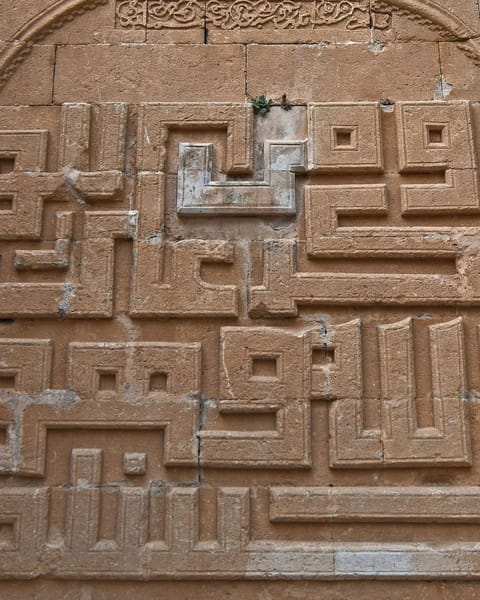
Image: Dosseman, Square Kufic carving at the Great Mosque of Mardin, 2025. CC BY-SA 4.0, via Wikimedia Commons.. Image credits
