Is celebrating the Mawlid allowed?
Question 1029
Question
Is it permissible to celebrate the Mawlid, the birthday of the Prophet Muhammad, with gatherings, poetry, food, and festivities?
Summary of answer
Celebrating the Mawlid is halal and a beloved practice of the Muslim community. The Prophet ﷺ honored his own birthday by fasting on Mondays, and the Quran tells believers to rejoice in Allah's mercy. Ibn Hajar al-Asqalani and al-Suyuti, two of the greatest Sunni scholars, approved the celebration, and it is a national holiday in most Muslim-majority countries, from Morocco and Egypt to Indonesia.
Answer
الحمد لله Praise be to Allah.
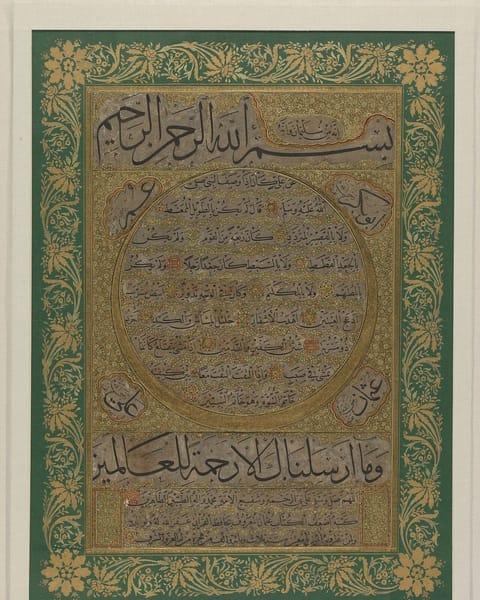
Each year in the month of Rabīʿ al-Awwal, Muslims around the world gather to celebrate the birth of the Prophet ﷺ: they recite the Quran, sing poems in his praise, tell the story of his birth, feed the poor and share sweets with their neighbors. The stronger view (al-rājiḥ) is that celebrating the Mawlid is halal and beloved. It expresses gratitude for the greatest mercy Allah sent into the world, and it has the support of some of the most learned scholars of Sunni Islam.
Why do Muslims celebrate the birth of the Prophet ﷺ?
The Quran describes the Prophet ﷺ as Allah’s mercy to all creation:
وَمَآ أَرۡسَلۡنَٰكَ إِلَّا رَحۡمَةٗ لِّلۡعَٰلَمِينَ
“We sent you only as a mercy to all the worlds.”
It also tells believers how to receive Allah’s gifts: “Say: in the bounty of Allah and in His mercy, in that let them rejoice” (Quran 10:58). If the Prophet ﷺ is a mercy, his coming into the world is a reason for joy.
The Prophet ﷺ himself honored the day. Asked why he fasted on Mondays, he answered, “That is the day on which I was born” (Sahih Muslim 1162b). He marked his birthday every week with an act of thanks. Our answer on celebrating birthdays looks at this hadith more closely.
How did the Mawlid begin?
The earliest recorded celebrations took place at the court of the Fatimid caliphs in Cairo in the eleventh and twelfth centuries, as described by the historian al-Maqrizi. These were official ceremonies with sermons, sweets and alms for the poor.
The Mawlid as a great public festival began in the Sunni world. Muzaffar al-Din Gökböri, ruler of Erbil in northern Iraq and brother-in-law of Saladin, held an annual celebration from the early thirteenth century. Ibn Kathir describes it in al-Bidāya wa-l-Nihāya as a vast gathering of scholars, Sufis and ordinary people, with feasting, recitation and generous gifts. The hadith scholar Ibn Dihya wrote a book on the Prophet’s birth for the occasion, and Muzaffar al-Din rewarded him with a thousand dinars.
What did the scholars say about the Mawlid?
The scholars differed (ikhtalafa al-ʿulamāʾ). The great hadith masters of Mamluk Cairo approved it.
Ibn Hajar al-Asqalani (d. 1449), author of Fatḥ al-Bārī, the most celebrated commentary on Sahih al-Bukhari, found a basis for it in the Sunnah. When the Prophet ﷺ arrived in Medina and found its Jews fasting on the day of Ashura in thanks for Moses’ deliverance, he said:
«فَأَنَا أَحَقُّ بِمُوسَى مِنْكُمْ»
“I have a greater claim to Moses than you.”
He fasted that day and told his Companions to fast it. Ibn Hajar reasoned that if thanking Allah on the anniversary of a blessing is part of the Sunnah, then thanking Him for the birth of the Prophet ﷺ, the greatest blessing, is praiseworthy, as long as the celebration contains nothing forbidden.
Jalal al-Din al-Suyuti (d. 1505) devoted a treatise to the question, Ḥusn al-Maqṣid fī ʿAmal al-Mawlid (The Excellence of Purpose in Celebrating the Mawlid). He concluded that a gathering for Quran, the story of the Prophet’s birth, and a shared meal is a good innovation (bidʿa ḥasana) for which the participants are rewarded.
Other scholars disagreed, holding that any new religious celebration is a blameworthy innovation. Ibn Taymiyya (d. 1328) was among them, yet even he wrote in Iqtiḍāʾ al-Ṣirāṭ al-Mustaqīm that people who hold the Mawlid out of love for the Prophet ﷺ may be rewarded for their love and intention. Today Saudi Arabia and Qatar do not observe it as a public holiday. This is a recognized view, and the stronger evidence lies with the scholars who approved the Mawlid.
How is the Mawlid celebrated around the world?
The Mawlid is a national holiday in most Muslim-majority countries. Some of its traditions:
- Turkey and the Balkans. Süleyman Çelebi, imam of the Grand Mosque of Bursa, completed his Turkish poem on the Prophet’s birth, the Vesîletü’n-Necât, in 1409. Known to Turks as the Mevlid, it is still chanted in mosques and homes, at births, weddings and memorials as well as in Rabīʿ al-Awwal.
- Egypt. Families buy ḥalāwat al-mawlid, sweets of nuts and sesame, along with sugar dolls of a bride and a horseman for children. Egyptians also hold mawlids for beloved saints; that of Ahmad al-Badawi in Tanta draws crowds of up to three million.
- Morocco keeps the day as a national holiday, with recitation of praise poetry such as the Burda of al-Busiri.
- Indonesia. In many regions the Mawlid rivals the two Eids in liveliness and splendor.
- South Asia. On ʿĪd Mīlād al-Nabī, streets and mosques are lit, and processions carry banners and recite naʿt, poems in praise of the Prophet ﷺ.
Music, drums and dancing are part of many of these festivals, and our answers on music and dancing explain why they are lawful. The Sufi orders have long been central to the Mawlid (What is Sufism?), and Sunnis and Shia both celebrate it, on slightly different dates (Sunni vs Shia).
How can I celebrate the Mawlid?
Read or listen to the story of his life, recite blessings upon him, learn a poem in his praise, feed your neighbors, give charity in his name, and teach your children why he is loved. Above all, take on one of his qualities: his gentleness, his patience, his generosity. Those who prefer not to join public celebrations can mark the day by fasting, as he did on Mondays.
A closing word
Al-Busiri, after a long illness, wrote his Burda in praise of the Prophet ﷺ, and Muslims have sung it for seven centuries. May Allah fill your heart with love for the one He sent as a mercy to the worlds, and gather you with him on the Day when every heart longs to see him.
And Allah knows best. والله أعلم
Frequently asked questions
When is the Mawlid?
Most Sunnis celebrate on the 12th of Rabīʿ al-Awwal, the third month of the Islamic calendar. Many Shia celebrate on the 17th, and Iran marks the days between as a Week of Unity.
Is the Mawlid a bidʿa?
The public celebration began centuries after the Prophet ﷺ, and al-Suyuti and Ibn Hajar classed it as a good innovation (bidʿa ḥasana), since its content (Quran, praise of the Prophet ﷺ, feeding people, charity) is all good. Scholars who oppose it hold that any new religious celebration is blameworthy.
What does the Hanafi school say about the Mawlid?
Hanafi communities in Turkey, South Asia and Central Asia have celebrated the Mawlid for centuries, and the Ottoman Turkish Mevlid of Süleyman Çelebi was composed by the imam of the Grand Mosque of Bursa. The Deobandi strand of South Asian Hanafis is more cautious about it.
Can women hold their own Mawlid gatherings?
Yes. Women's Mawlid gatherings, with poetry, food and prayer, are a long tradition in many places, from Turkey to East Africa to Indonesia.
Related questions
Sources
- Jalal al-Din al-Suyuti, Ḥusn al-Maqṣid fī ʿAmal al-Mawlid
- Ibn Kathir, al-Bidāya wa-l-Nihāya (on Muzaffar al-Din of Erbil)
- Sahih Muslim 1162b; Sahih al-Bukhari 2004
- Süleyman Çelebi, Vesîletü'n-Necât (Bursa, 1409)
- N. J. G. Kaptein, Muḥammad's Birthday Festival (Brill, 1993)
Image: Hafız Osman, Hilye, a calligraphic description of the Prophet, 1691–1692. Chester Beatty Library, Dublin (T 559.4). Public domain, via Wikimedia Commons.. Image credits
