Is dancing haram in Islam?
Question 1021
Question
Is it permissible for Muslims to dance, for example at weddings, at Eid, or for fun at home?
Summary of answer
Dancing is halal. On the day of Eid a group of Abyssinian Muslims danced with their spears in the Prophet's mosque, and the Prophet ﷺ cheered them on while Aisha watched beside him. Ibn Hazm held singing and instruments lawful, and the Shafi'i jurists held dancing permissible in itself. The Sufis made a form of it into prayer.
﴿قُلۡ بِفَضۡلِ ٱللَّهِ وَبِرَحۡمَتِهِۦ فَبِذَٰلِكَ فَلۡيَفۡرَحُواْ﴾
Say: in the bounty of Allah and in His mercy, in that let them rejoice.
Answer
الحمد لله Praise be to Allah.
Dancing is one of the oldest ways people show joy: at a wedding, on Eid, when a child is born, when friends are together. The stronger view (al-rājiḥ) is that dancing is halal. The clearest evidence comes from the mosque of the Prophet ﷺ himself, where Muslims danced on the day of Eid while he watched and encouraged them.
Did people dance in the time of the Prophet ﷺ?
They did, and in the most sacred place in Medina. Aisha (may Allah be pleased with her) narrates that on a day of Eid a group of Abyssinians “came dancing (yazfinūn, يزفنون) in the mosque.” The Prophet ﷺ called her over, and she rested her head on his shoulder and watched until she herself was ready to stop (Sahih Muslim 892f). He stood at the door of her room and screened her with his cloak so she could see (Sahih al-Bukhari 454). As the Abyssinians played with their shields and spears, he called out to them:
«دُونَكُمْ يَا بَنِي أَرْفِدَةَ»
“Keep going, sons of Arfida!”
The Arabic verb zafana means to dance, to move the feet in rhythm. The Abyssinian Muslims were dancing in their own style, with their weapons as props, in the mosque, on a holy day. The Prophet ﷺ did not ask them to stop or move outside. He cheered them on by name.
Is it haram to dance to music?
The same narration in al-Bukhari (950) describes two girls singing in Aisha’s house on that very Eid, and the Prophet ﷺ telling Abu Bakr to leave them be. The Eid of Medina had both song and dance, under the Prophet’s own roof and in his mosque. Since music is halal, dancing to it takes the same ruling as dancing on its own. What a song says still matters, as with any words, but the rhythm and the movement are lawful.
What did the scholars say about dancing?
Ibn Hazm (d. 1064) held in al-Muḥallā that singing and musical instruments are lawful, and the singing girls of that same Eid in Aisha’s house were among his evidence.
The Shafi’i jurists held that dancing is permissible in itself. Al-Nawawi (d. 1277) records in Rawḍat al-Ṭālibīn that the objection of some jurists was limited to one exaggerated, swaying style of movement, and that dancing otherwise remains lawful. Many muftis today permit dancing at weddings, with conditions of modesty.
Some scholars took a stricter line and counted dancing as frivolous or disliked (makrūh), especially in public. That is a recognized opinion in the tradition. The Sunnah of the Eid in Medina gives the stronger evidence: a dance the Prophet ﷺ cheered in his own mosque cannot be blameworthy in itself.
How do Muslims dance in worship and celebration?
Some Muslims have even made movement part of their remembrance of Allah. After the death of Jalal al-Din Rumi in 1273, his followers in Konya founded the Mevlevi order. Its ceremony, the samāʿ (Turkish sema), is a prayer in motion: the dervishes turn to the music of the ney, one hand open to receive from heaven and the other turned toward the earth to give. UNESCO recognized the Mevlevi Sema Ceremony as a masterpiece of humanity’s heritage in 2005. Other Sufi orders sway together in the circle of dhikr (What is Sufism?).
Wedding dances are found everywhere Muslims live: the dabke lines of the Levant, the mehndi dances of South Asia, the zapin of the Malay world, the circle dances of the Amazigh villages of Morocco. The festivals of the Mawlid in Egypt and elsewhere fill the streets with drummers and dancers. Each of these grew within Muslim communities and carries their joy.
Why does Islam make room for joy and play?
The Quran tells the believer to rejoice in what Allah has given (10:58), and it reminds the seeker of the Hereafter to enjoy this world as well:
وَٱبۡتَغِ فِيمَآ ءَاتَىٰكَ ٱللَّهُ ٱلدَّارَ ٱلۡأٓخِرَةَۖ وَلَا تَنسَ نَصِيبَكَ مِنَ ٱلدُّنۡيَا
“Seek the home of the Hereafter through what Allah has given you, and do not forget your share of this world.”
The same Sunnah that brought the Abyssinians into the mosque includes the Prophet ﷺ racing Aisha while they traveled, losing the first race and winning the second (Sunan Abi Dawud 2578, graded sahih by al-Albani). A faith that holds the whole person, body and soul, has room for the body to celebrate. The same reasoning gives play and games their place.
What should a Muslim keep in mind when dancing?
The ethics that govern every part of life also govern the dance floor:
- Consent and comfort. No one should be pressured to dance or touched without wanting it.
- Dignity. Dance in a way you would be glad to be remembered for, and keep the occasion kind and safe.
- Balance. Celebration should not push aside prayer or the duties you owe to others.
- No policing. Watching other people’s bodies to scold them is its own wrong. Our answer on harassing people about religion explains why.
Within those bounds, dance at your sister’s wedding, dance with your children in the kitchen, and dance on Eid. The Prophet ﷺ stood at the door and watched with joy.
A closing word
Rumi, whose followers turned their prayer into a dance, wrote of a love that sets the whole creation spinning. May Allah fill your celebrations with that love, keep your joy pure, and bring you to the day of the greatest gathering with a light heart.
And Allah knows best. والله أعلم
Frequently asked questions
Is it haram to dance at weddings?
No. A wedding is the occasion the Sunnah marks most clearly for music and celebration, and dancing for joy at a marriage belongs to that celebration. Communities across the Muslim world have danced at weddings for centuries.
Can Muslim women dance?
Yes. The ruling on dancing is the same for women and men. The modesty, kindness and good sense that guide the rest of a Muslim's life guide it here too.
Is it haram to dance on TikTok or social media?
Dancing does not change its ruling online. As with any post, think about what you show, who will see it, and whether it reflects the dignity you want to carry.
Is dancing allowed in Ramadan?
Dancing does not break the fast, and no text forbids it in Ramadan. Many people give the nights of Ramadan to prayer and Quran, and then dance with full hearts on the day of Eid.
Related questions
Sources
- Sahih al-Bukhari 454, 950
- Sahih Muslim 892f
- Ibn Hazm, al-Muḥallā
- al-Nawawi, Rawḍat al-Ṭālibīn
- UNESCO, The Mevlevi Sema Ceremony (2005, Masterpiece of the Oral and Intangible Heritage of Humanity)
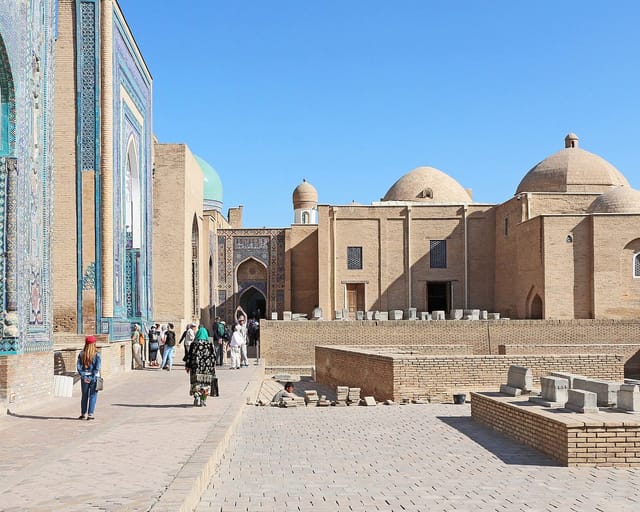
Image: Bgag, The Shah-i-Zinda necropolis, Samarkand, 2023. CC0, via Wikimedia Commons.. Image credits
