Was the Prophet Muhammad a real person?
Question 1113
Question
Is there historical evidence that the Prophet Muhammad existed, outside Muslim tradition?
Summary of answer
The Prophet Muhammad ﷺ was a real person, and historians of every background accept it. A Syriac chronicle by Thomas the Presbyter names 'the Arabs of Muhammad' in a battle of 634, two years after his death; Armenian and Syriac writers of the 660s describe his preaching; the Birmingham Quran manuscript is radiocarbon dated to 568–645; and a coin of 685–686 proclaims him the Messenger of Allah.
﴿وَإِنَّكَ لَعَلَىٰ خُلُقٍ عَظِيمٖ﴾
And you are truly of a magnificent character.
Answer
الحمد لله Praise be to Allah.
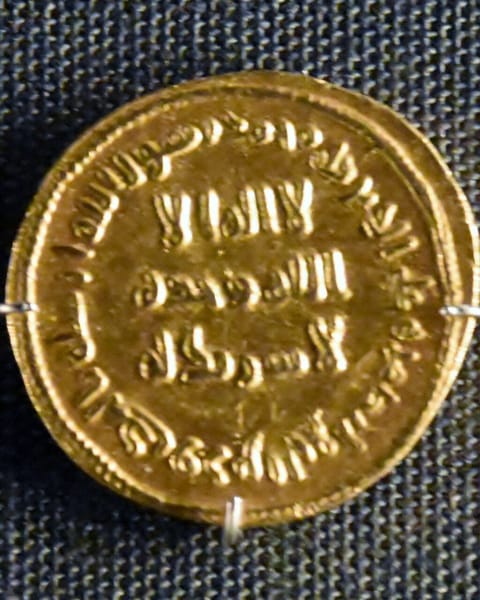
Yes, the Prophet Muhammad ﷺ was a real person. Historians of every faith and of none agree that he lived in Arabia in the late sixth and early seventh centuries, preached in Mecca, migrated to Medina, and died there in 632. The evidence is unusually rich for a figure of that age: Christian writers named him within a few years of his death, a Quran manuscript is dated close to his lifetime, coins and inscriptions proclaimed him within two generations, and a whole community preserved his words and his ways.
What do historians say about whether Muhammad existed?
Scholars in the modern academic study of Islam debate the details of his early biographies, which were written down more than a century after his death. On his existence they agree. The historian Fred Donner, in Muhammad and the Believers (2010), treats his life and mission as the starting point of Islamic history, and Robert Hoyland’s Seeing Islam as Others Saw It (1997) gathered the Christian, Jewish, and Zoroastrian writings that mention him and the early Muslims. A handful of writers have claimed that he never lived, and historians have not been persuaded.
What do non-Muslim sources from the seventh century say?
The most striking evidence comes from people who did not follow him, some of whom opposed him:
- The Doctrina Jacobi, a Greek Christian tract written between about 634 and 640, reports news from Palestine that “a prophet has appeared, coming with the Saracens.”
- Thomas the Presbyter, a Syriac Christian writing around 640, records a battle near Gaza in February 634 between the Romans and “the Arabs of Muhammad” (ṭayyāyē d-Mḥmṭ). This is the earliest known non-Muslim text to name him, written about two years after his death.
- The Khuzistan Chronicle, a Syriac work of the 660s, names Muhammad as the leader of the sons of Ishmael.
- Sebeos, an Armenian bishop writing in the 660s, describes a merchant named “Mahmet” who preached to the Arabs about the God of Abraham and forbade them carrion, wine, lying, and fornication.
- John bar Penkaye, a Syriac monk writing around 687, calls Muhammad the Arabs’ guide and teacher, whose laws they kept faithfully.
These writers knew of him as a real man who taught the worship of the God of Abraham and gave his followers laws. Their descriptions match what Muslims themselves remembered.
How old is the oldest Quran manuscript?
In July 2015 the University of Birmingham announced that two parchment leaves in its Mingana Collection, containing parts of suras 18 to 20 in early Hijazi script, had been radiocarbon dated to between 568 and 645, with 95.4 percent probability. The Prophet ﷺ lived from about 570 to 632, so the animal whose skin became this page was very likely alive in his lifetime or soon after. The text matches the Quran recited today. For how the Quran was gathered into one book, see How was the Quran compiled?
What other early evidence is there?
- Coins. A silver drachm minted at Bīshāpūr in Iran in 66 AH (685–686) by the governor ʿAbd al-Malik ibn ʿAbd Allāh carries the words “In the name of Allah, Muhammad is the Messenger of Allah.” It is the earliest dated Muslim text known to name him, and it is held in the British Museum.
- Inscriptions. The Dome of the Rock in Jerusalem, completed in 691–692, carries long Quranic inscriptions that name Muhammad and call for blessings upon him.
- A calendar. Papyri from Egypt dated in the twenties of the hijri era, among them a receipt from 643 dated “year twenty-two”, show that within a generation the community counted its years from his migration to Medina.
Alongside this evidence stands the Muslims’ own record: the Quran memorized and written down, the biography of Ibn Isḥāq (d. 767) preserved by Ibn Hishām, thousands of hadith with named chains of narrators, and the lives of the Companions who knew him. Our answer on whether all hadith are authentic explains how scholars tested those reports.
What does the Quran say about Muhammad ﷺ?
The Quran names him four times. It speaks to a real man in real places and times: it recalls his flight to Medina with a companion hidden in a cave (9:40), the battles of Badr and Hunayn (3:123, 9:25), and his household. It even corrects him, in the opening of Sūrat ʿAbasa, for turning away from a blind man who came to learn while he spoke with the notables of Quraysh (80:1–10). Legends do not record their hero’s mistakes, and the Quran does so with tenderness. It also reminds his followers that he was a mortal man:
وَمَا مُحَمَّدٌ إِلَّا رَسُولٞ قَدۡ خَلَتۡ مِن قَبۡلِهِ ٱلرُّسُلُۚ
“Muhammad is only a messenger; messengers have passed away before him.”
What kind of man was he?
The Quran praises his character (68:4), and those closest to him described it the same way. When Aisha was asked about it, she answered:
«فَإِنَّ خُلُقَ نَبِيِّ اللَّهِ صلى الله عليه وسلم كَانَ الْقُرْآنَ»
“The character of the Prophet of Allah ﷺ was the Quran.”
He was an orphan who became a trusted merchant, the husband of Khadija for twenty-five years, a father who stood when his daughter Fatima entered the room, and a leader who forgave the people of Mecca when he returned to them. For the story of his life, see Who was the Prophet Muhammad?, and for the meaning of the blessing Muslims say after his name, Why do Muslims say peace be upon him?
A closing word
The evidence of history tells us that he lived. The Quran invites us to know him and love him, and it tells believers how to greet him:
إِنَّ ٱللَّهَ وَمَلَـٰٓئِكَتَهُۥ يُصَلُّونَ عَلَى ٱلنَّبِيِّۚ يَـٰٓأَيُّهَا ٱلَّذِينَ ءَامَنُواْ صَلُّواْ عَلَيۡهِ وَسَلِّمُواْ تَسۡلِيمًا
“Allah and His angels send blessings upon the Prophet. You who believe, send blessings upon him and greet him with peace.”
Allāhumma ṣalli ʿalā Muḥammad wa-ʿalā āli Muḥammad: O Allah, bless Muhammad and the family of Muhammad.
And Allah knows best. والله أعلم
Frequently asked questions
What is the earliest non-Muslim mention of Muhammad?
A Syriac chronicle attributed to Thomas the Presbyter, written around 640, records a battle near Gaza in February 634 between the Romans and 'the Arabs of Muhammad'. It is the earliest known non-Muslim text to name him.
How old is the oldest Quran?
The two leaves of the Birmingham Quran, containing parts of suras 18 to 20, were radiocarbon dated in 2015 to between 568 and 645 with 95.4 percent probability, placing the parchment close to the Prophet's lifetime.
When was the Prophet Muhammad born and when did he die?
He was born in Mecca around 570 and died in Medina in 632, after leading the Muslim community for twenty-three years of revelation.
Do historians doubt that Muhammad existed?
No. Historians debate details of the early biographies, and the very few writers who have denied his existence have not persuaded the field. Scholars such as Fred Donner and Robert Hoyland treat his life and mission as established history.
Related questions
Sources
- Robert G. Hoyland, Seeing Islam as Others Saw It: A Survey and Evaluation of Christian, Jewish and Zoroastrian Writings on Early Islam (Darwin Press, 1997)
- Fred M. Donner, Muhammad and the Believers: At the Origins of Islam (Harvard University Press, 2010)
- University of Birmingham, Birmingham Qur'an manuscript dated among the oldest in the world (22 July 2015)
- Islamic Awareness, Dated and datable texts mentioning Prophet Muḥammad from 1–100 AH
- Islamic Awareness, Drachm of ʿAbd al-Malik ibn ʿAbd Allāh, Bīshāpūr, 66 AH
- Ibn Isḥāq, Sīrat Rasūl Allāh, in the recension of Ibn Hishām
Image: Richard Mortel, Gold dinar of ʿAbd al-Malik ibn Marwan, dated AH 78 (697–698), 2017. David Collection, Copenhagen. CC BY 2.0, via Wikimedia Commons.. Image credits
,_The_David_Collection,_Copenhagen_(36240895662).jpg)