Who was the Prophet Muhammad?
Question 1226
Question
Who was the Prophet Muhammad, what are the main events of his life, and why do Muslims love and follow him?
Summary of answer
Muhammad ibn ʿAbd Allāh ﷺ was born in Mecca around 570, orphaned young, and known for his honesty. At forty he received the first revelation of the Quran in the cave of Ḥirāʾ. After thirteen years of preaching and persecution in Mecca he migrated to Medina in 622, built a community there, and in 630 entered Mecca with a general amnesty. He died in 632. The Quran calls him the seal of the prophets and a mercy to all the worlds (21:107).
Answer
الحمد لله Praise be to Allah.
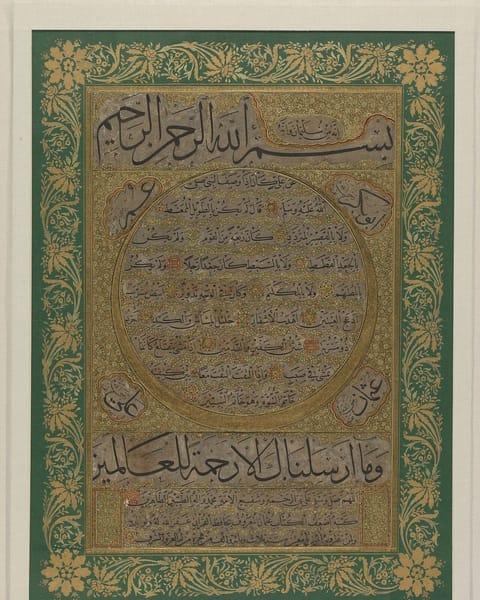
Muhammad ibn ʿAbd Allāh ﷺ is the Prophet of Islam, the final messenger in the line that runs through Noah, Abraham, Moses, and Jesus (peace be upon them). Muslims believe that Allah revealed the Quran to him over twenty-three years, and that his life, the Sunnah, shows how to live it. Muslims across the world love him and send blessings on him every day. The Quran sums up his mission in one line:
وَمَآ أَرۡسَلۡنَٰكَ إِلَّا رَحۡمَةٗ لِّلۡعَٰلَمِينَ
“We have sent you only as a mercy to all the worlds.”
Where and when was the Prophet Muhammad ﷺ born?
He was born in Mecca, in western Arabia, around the year 570, into the clan of Hāshim of the tribe of Quraysh. His father ʿAbd Allāh died before he was born, and his mother Āmina died when he was a small child. He was raised by his grandfather ʿAbd al-Muṭṭalib and then by his uncle Abū Ṭālib. The Quran later reminded him: “Did He not find you an orphan and give you shelter? Did He not find you searching and guide you? Did He not find you in need and make you sufficient?” (Quran 93:6–8).
As a young man he herded sheep for the people of Mecca (Sahih al-Bukhari 2262) and later worked as a merchant, and he was known for his honesty and trustworthiness. At about twenty-five he married Khadija, a widowed merchant of Mecca, and he married no one else as long as she lived (Sahih Muslim 2436).
How did Muhammad ﷺ become a prophet?
He loved to spend nights alone in the cave of Ḥirāʾ above Mecca in prayer and reflection. There, at the age of forty, around 610, the angel Jibril came to him with the first words of the Quran:
ٱقۡرَأۡ بِٱسۡمِ رَبِّكَ ٱلَّذِي خَلَقَ خَلَقَ ٱلۡإِنسَٰنَ مِنۡ عَلَقٍ ٱقۡرَأۡ وَرَبُّكَ ٱلۡأَكۡرَمُ ٱلَّذِي عَلَّمَ بِٱلۡقَلَمِ عَلَّمَ ٱلۡإِنسَٰنَ مَا لَمۡ يَعۡلَمۡ
“Read in the name of your Lord who created, created the human being from a clinging cell. Read, for your Lord is the Most Generous, who taught by the pen, taught the human being what he did not know.”
He came home trembling, and Khadija wrapped him in a cloak and comforted him with a description of his character:
«كَلاَّ وَاللَّهِ مَا يُخْزِيكَ اللَّهُ أَبَدًا، إِنَّكَ لَتَصِلُ الرَّحِمَ، وَتَحْمِلُ الْكَلَّ، وَتَكْسِبُ الْمَعْدُومَ، وَتَقْرِي الضَّيْفَ، وَتُعِينُ عَلَى نَوَائِبِ الْحَقِّ»
“Never! By Allah, Allah will never disgrace you. You keep the ties of kinship, you carry the burdens of the weak, you earn for the destitute, you honor the guest, and you stand by people in true hardship.”
She became the first person to believe in him.
What happened in Mecca and Medina?
For thirteen years he called the people of Mecca to worship the One God, to free slaves and feed the hungry (90:12–16), care for orphans, and abandon the burial of infant daughters (81:8–9). The leaders of Quraysh mocked, boycotted, and persecuted the believers. In a single year he lost both Khadija and Abū Ṭālib. When the people of Taif drove him out with stones, he refused the angel’s offer to destroy them and prayed that their descendants would worship Allah (Sahih al-Bukhari 3231).
In 622 he migrated to Yathrib, which became Madīnat al-Nabī, “the city of the Prophet.” This migration, the Hijra, marks the start of the Islamic calendar. In Medina he joined the emigrants and the people of Medina in brotherhood, built a simple mosque, and agreed a pact, known as the Constitution of Medina, that bound Muslims, Jews, and others into one community for the city’s defense. Years of conflict with Quraysh followed, including the battles of Badr and Uḥud (Did the Prophet fight wars?), until the truce of al-Ḥudaybiya opened a period of peace.
In 630 he returned to Mecca at the head of ten thousand people (Bukhari 4276). The city that had persecuted him for years expected revenge. He announced:
«مَنْ دَخَلَ دَارَ أَبِي سُفْيَانَ فَهُوَ آمِنٌ وَمَنْ أَلْقَى السِّلاَحَ فَهُوَ آمِنٌ وَمَنْ أَغْلَقَ بَابَهُ فَهُوَ آمِنٌ»
“Whoever enters the house of Abū Sufyān is safe, whoever lays down his weapons is safe, and whoever shuts his door is safe.”
How did the Prophet Muhammad ﷺ die?
In 632 he made his only pilgrimage. On the Day of Sacrifice he told the crowd, “Your blood, your property, and your honor are sacred to one another, as sacred as this day, in this city, in this month” (Sahih al-Bukhari 1739). A few months later he fell ill in Medina and died in the room of his wife Aisha, with his head resting on her. His last words were “O Allah, the highest companion” (Sahih al-Bukhari 4463).
What was the Prophet Muhammad ﷺ like?
The Quran says to him, “You are of a tremendous character” (68:4), and it names the gentleness that drew people to him:
فَبِمَا رَحۡمَةٖ مِّنَ ٱللَّهِ لِنتَ لَهُمۡۖ وَلَوۡ كُنتَ فَظًّا غَلِيظَ ٱلۡقَلۡبِ لَٱنفَضُّواْ مِنۡ حَوۡلِكَ
“By a mercy from Allah you were gentle with them. Had you been harsh and hard of heart, they would have scattered from around you.”
His wife Aisha said that at home he was busy serving his family until the call to prayer (Sahih al-Bukhari 676). He always chose the easier of two options when no sin was involved, and he never took revenge for a wrong done to himself (Bukhari 3560). He mended his own sandals (al-Adab al-Mufrad 541), joked with children (Bukhari 6129), stood to welcome his daughter Fatima when she visited (Sunan Abi Dawud 5217), and wept at the death of his infant son Ibrahim (Bukhari 1303). For the historical evidence of his life, see Was Muhammad a real person?, and for his family, How many wives did the Prophet have?
How do Muslims follow the Prophet ﷺ today?
Muslims learn his words and ways, the Sunnah, and try to bring his mercy into their own homes and work (What is the Sunnah?). They send blessings on him whenever his name is mentioned. Generations of Muslim artists in Persia, Turkey, and India painted his life with reverence (Is it haram to depict Muhammad?).
To know him is to love him, and to love him is to learn mercy. Allāhumma ṣalli ʿalā Muḥammad wa-ʿalā āli Muḥammad: O Allah, send Your blessings upon Muhammad and the family of Muhammad.
And Allah knows best. والله أعلم
Frequently asked questions
When was the Prophet Muhammad born and when did he die?
He was born in Mecca around 570 and died in Medina in 632. Ibn ʿAbbās reported that he received revelation at forty, stayed thirteen years in Mecca, ten in Medina, and died at sixty-three (Sahih al-Bukhari 3902).
Could the Prophet Muhammad read and write?
The Quran calls him al-nabī al-ummī, the unlettered Prophet (7:157). Muslims see in this a sign that the Quran came from Allah and was not composed from books he had read.
What were the Prophet Muhammad's last words?
Aisha reported that as he died, with his head resting on her, his last words were 'O Allah, the highest companion' (Sahih al-Bukhari 4463).
Is Muhammad worshipped in Islam?
No. Muslims love and honor him as Allah's servant and messenger and worship Allah alone. The Quran reminds believers that he was a mortal man (3:144).
Related questions
Sources
- Sahih al-Bukhari 3 (the beginning of revelation)
- Sahih al-Bukhari 3902 (his age at revelation and at death)
- Sahih Muslim 1780c (the amnesty at the conquest of Mecca)
- Ibn Isḥāq, Sīrat Rasūl Allāh, ed. Ibn Hishām; trans. A. Guillaume, The Life of Muhammad (Oxford, 1955)
- Martin Lings, Muhammad: His Life Based on the Earliest Sources (1983)
Image: Hafız Osman, Hilye, a calligraphic description of the Prophet, 1691–1692. Chester Beatty Library, Dublin (T 559.4). Public domain, via Wikimedia Commons.. Image credits
