Who was Khadija?
Question 1228
Question
Who was Khadija, the first wife of the Prophet Muhammad, and why do Muslims honor her so highly?
Summary of answer
Khadija bint Khuwaylid was a respected merchant of Mecca who employed the young Muhammad ﷺ, proposed marriage to him herself, and was his only wife for twenty-five years. When the first revelation came, she comforted him and became the first person to believe. Allah sent her His greeting of peace through Gabriel, and the Prophet ﷺ named her among the best women who ever lived.
Answer
الحمد لله Praise be to Allah.
Khadija bint Khuwaylid (may Allah be pleased with her) stands at the very beginning of Islam. She was a merchant of Mecca, the young Muhammad’s employer before she became his wife, the woman who proposed to him, and the first human being to believe in the message he brought. Who was Khadija to the Prophet ﷺ? In his own words, she was a love that Allah had given him as provision.
Who was Khadija bint Khuwaylid?
Khadija came from the Quraysh, the leading tribe of Mecca, through the clan of Asad. She was a woman of wealth and sound judgment who ran her own caravan trade and hired men to carry her goods north to Syria. The early biographies, from Ibn Ishaq onward, report that she employed the young Muhammad ﷺ to trade on her behalf, and that her servant Maysara, who traveled with him, came home full of praise for his honesty and character.
She then sent her friend Nafīsa to ask whether he would consider marrying her. He accepted. A woman making the first approach toward marriage was part of the Prophet’s own story from the start, and the scholars have always treated it as honorable (Is dating haram?).
How did Khadija comfort the Prophet ﷺ at the first revelation?
Aisha (may Allah be pleased with her) narrated the night everything began. The Prophet ﷺ used to withdraw to the cave of Ḥirāʾ for nights of worship, and Khadija would prepare his provisions for each stay. There the angel came to him with the first words of the Quran:
ٱقۡرَأۡ بِٱسۡمِ رَبِّكَ ٱلَّذِي خَلَقَ
“Recite in the name of your Lord who created.”
He came home with his heart pounding and said, “Wrap me up, wrap me up.” When the fear had passed, he told her, “I feared for myself.” Her answer is one of the most beloved sentences in the Sunnah:
«كَلاَّ وَاللَّهِ مَا يُخْزِيكَ اللَّهُ أَبَدًا، إِنَّكَ لَتَصِلُ الرَّحِمَ، وَتَحْمِلُ الْكَلَّ، وَتَكْسِبُ الْمَعْدُومَ، وَتَقْرِي الضَّيْفَ، وَتُعِينُ عَلَى نَوَائِبِ الْحَقِّ»
“Never, by Allah. Allah will never disgrace you. You keep the ties of kinship, you carry the burdens of the weak, you earn for those who have nothing, you honor your guests, and you stand by people through the trials of life.”
Khadija read the moment through the man she knew. Someone who lived with such mercy would never be abandoned by his Lord. Then she took him to her cousin Waraqa ibn Nawfal, an elderly man who had become a Christian and used to copy the Gospel in Hebrew. Waraqa recognized in the story the same angelic messenger whom Allah had sent to Moses (peace be upon him).
Was Khadija the first person to accept Islam?
Yes. Before any friend, relative, or Companion, Khadija believed. Imam al-Tirmidhi recorded the early debate over who came first among the men, Abu Bakr or the young Ali, together with the scholars’ statement that the first among the women was Khadija (Jami’ al-Tirmidhi 3734).
How much did the Prophet ﷺ love Khadija?
For about twenty-five years she was his only wife. Aisha reported that “the Prophet ﷺ did not marry anyone else until Khadija died” (Sahih Muslim 2436). She bore him all his children except Ibrāhīm; their daughters were Zaynab, Ruqayya, Umm Kulthum, and Fāṭima. Years later, when Zaynab sent a necklace that had been her mother’s to ransom her husband after Badr, the Prophet ﷺ was overcome with tenderness at the sight of it (Sunan Abi Dawud 2692, graded hasan by al-Albani).
His love outlived her. He slaughtered sheep and sent the meat to Khadija’s friends, and he spoke of her so often that Aisha said she was jealous of no woman as she was of Khadija, though she had never met her (Sahih al-Bukhari 3818). When Khadija’s sister Hāla asked permission to enter, her voice sounded like Khadija’s, and he started up at the memory (Sahih al-Bukhari 3821). Once, when Aisha teased him about her, he answered:
«إِنِّي قَدْ رُزِقْتُ حُبَّهَا»
“Her love was given to me as provision.”
The full account of his later marriages is in How many wives did the Prophet have?
What honor did Allah give Khadija?
One day Gabriel came to the Prophet ﷺ as Khadija was approaching with a dish of food and drink. He told him to greet her with peace from her Lord and from Gabriel himself, and to give her the good news of a house in Paradise of hollowed pearl, “with no noise in it and no toil” (Sahih al-Bukhari 3820). Few human beings have received a greeting of peace from Allah by name.
The Prophet ﷺ placed her beside Mary, the mother of Jesus: “The best of its women is Mary daughter of ʿImrān, and the best of its women is Khadija” (Sahih al-Bukhari 3432). In another sound hadith he named four women as enough for anyone to follow among the women of all the worlds: Mary, Khadija, Fāṭima, and Āsiya the wife of Pharaoh (Jami’ al-Tirmidhi 3878, graded sahih by al-Albani). Mary’s own story is told in What does the Quran say about Mary?
Khadija died in Mecca three years before the Hijra (Sahih al-Bukhari 3896), around 619. Her husband’s uncle and protector Abu Talib died in the same season, and Muslims remember it as the Year of Sorrow.
What can Muslims learn from Khadija today?
Khadija earned and spent her own wealth, and Muslim women who work, trade, and lead walk in her footsteps (Can women work in Islam?). She chose her husband for his character and said so. She met fear with faith and reminded a frightened man of the good he had done. And her marriage shows the partnership the Quran describes, where each spouse is a place of rest for the other (What does the Quran say about women?).
A closing duʿāʾ
The Quran names the bond Khadija and the Prophet ﷺ shared as one of Allah’s signs:
وَمِنۡ ءَايَٰتِهِۦٓ أَنۡ خَلَقَ لَكُم مِّنۡ أَنفُسِكُمۡ أَزۡوَٰجٗا لِّتَسۡكُنُوٓاْ إِلَيۡهَا وَجَعَلَ بَيۡنَكُم مَّوَدَّةٗ وَرَحۡمَةً
“Among His signs is that He created for you spouses from among yourselves, so that you may find rest in them, and He placed between you love and mercy.”
May Allah be pleased with Khadija, the mother of the believers, and grant every believer a companion who answers fear with faith and sees the good in them before the world does.
And Allah knows best. والله أعلم
Frequently asked questions
How old was Khadija when she married the Prophet?
The biographers differ. The best-known report makes her forty and the Prophet ﷺ twenty-five, and another report gives her age as twenty-eight. All agree that she was older than him and that their marriage was one of deep love.
Was Khadija the first Muslim?
Yes. She was the first person to believe in the message, before any man. The scholars cited by al-Tirmidhi debated who came first among the men, Abu Bakr or Ali, and named Khadija first among the women (Jami' al-Tirmidhi 3734).
Did the Prophet have other wives while married to Khadija?
No. Aisha reported that he married no one else until Khadija died (Sahih Muslim 2436). For about twenty-five years she was his only wife.
When did Khadija die?
She died in Mecca three years before the Hijra (Sahih al-Bukhari 3896), around 619, in the same season as the Prophet's uncle Abu Talib. Muslims remember it as the Year of Sorrow (ʿĀm al-Ḥuzn).
Related questions
Sources
- Sahih al-Bukhari 3, 3432, 3818, 3820, 3821, 3896
- Sahih Muslim 2435b, 2436
- Jami' al-Tirmidhi 3734, 3878
- Ibn Ishaq, Sīrat Rasūl Allāh, trans. A. Guillaume, The Life of Muhammad (1955)
- Martin Lings, Muhammad: His Life Based on the Earliest Sources (1983)
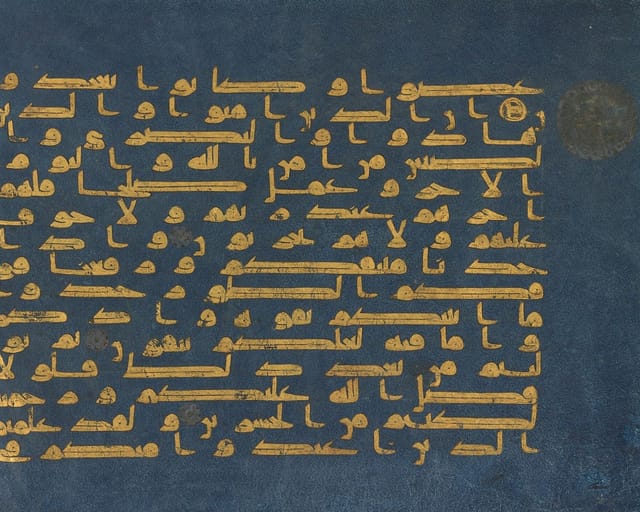
Image: Unknown calligrapher, Folio from the Blue Qurʾan (Sūrat al-Baqara 2:62), c. 950. Chester Beatty Library, Dublin (Is 1405A). Public domain, via Wikimedia Commons.. Image credits
.jpg)