What does the Quran say about Mary?
Question 1230
Question
What does the Quran teach about Mary, the mother of Jesus, and how do Muslims regard her?
Summary of answer
The Quran honors Mary (Maryam) as a woman Allah chose and purified above the women of all the worlds (3:42). She is the only woman it names, thirty-four times, and Sūrat Maryam bears her name. It tells of her dedication before birth, her worship in the sanctuary, the angel's announcement, and the virgin birth of Jesus beneath a palm tree, and it holds her up as an example for every believer (66:12).
Answer
الحمد لله Praise be to Allah.
Mary (Maryam), the mother of Jesus (peace be upon them both), holds a place in the Quran that surprises many readers. What does the Quran say about Mary? It says that Allah chose her, purified her, and raised her above the women of all the worlds. She is the only woman the Quran calls by name, a whole sura is named after her, and her story is told with a tenderness that has made her beloved to Muslims for fourteen centuries.
Who is Mary in the Quran?
Her name appears thirty-four times in the Quran. Sūrat Maryam, the nineteenth sura, bears her name, and the third sura, Āl ʿImrān, is named after her family, the House of ʿImrān. The angels address her directly:
وَإِذۡ قَالَتِ ٱلۡمَلَـٰٓئِكَةُ يَٰمَرۡيَمُ إِنَّ ٱللَّهَ ٱصۡطَفَىٰكِ وَطَهَّرَكِ وَٱصۡطَفَىٰكِ عَلَىٰ نِسَآءِ ٱلۡعَٰلَمِينَ
“And when the angels said: Mary, Allah has chosen you and purified you, and chosen you above the women of all the worlds.”
The next verse tells her to pray: “Mary, be devoted to your Lord, prostrate, and bow with those who bow” (3:43). She worshipped in the sanctuary, among the worshippers, and the Quran describes her as “a woman of truth” (ṣiddīqa, 5:75).
How does the Quran tell the story of Mary’s birth?
The story begins before she was born. Her mother, the wife of ʿImrān, vowed the child in her womb to the service of Allah. When she gave birth to a daughter, she said, “My Lord, I have given birth to a girl,” and the Quran adds, “the male is not like the female” (Quran 3:36). Many readers have heard in these words that the girl Allah gave was greater than the boy she had hoped for. Her mother named her Maryam and asked Allah to protect her and her child from Satan. The Prophet ﷺ said that every child is touched by Satan at birth except Mary and her son (Sahih al-Bukhari 3431).
Allah “accepted her with a beautiful acceptance and made her grow in goodness” and placed her in the care of the prophet Zechariah (3:37). Each time Zechariah entered her prayer chamber (miḥrāb), he found provision with her. When he asked where it came from, the young Mary answered, “It is from Allah. Allah provides for whom He wills without measure.” Her faith moved the old prophet to pray for a child of his own.
What does the Quran say about the annunciation?
Sūrat Maryam tells how she withdrew from her family to a place in the east, and Allah sent His spirit to her in the form of a man. He said, “I am only a messenger of your Lord, to give you a pure son.” She asked, “How can I have a son when no man has touched me?” He answered that it is easy for Allah, who would make the child “a sign for people and a mercy from Us” (Quran 19:19–21). Muslims affirm the virgin birth without hesitation. What Muslims believe about her son is explained in What do Muslims believe about Jesus?
What happened under the palm tree?
The Quran describes Mary’s labor with great intimacy. Alone, in pain, she came to the trunk of a palm tree and cried out, “I wish I had died before this and been forgotten.” Then a voice called to her from below, telling her not to grieve, for her Lord had placed a stream beneath her:
وَهُزِّيٓ إِلَيۡكِ بِجِذۡعِ ٱلنَّخۡلَةِ تُسَٰقِطۡ عَلَيۡكِ رُطَبٗا جَنِيّٗا فَكُلِي وَٱشۡرَبِي وَقَرِّي عَيۡنٗا
“Shake the trunk of the palm tree toward you, and it will drop fresh ripe dates upon you. So eat, drink, and let your eyes be glad.”
Muslim women in labor have long taken comfort from these verses, and many families give a mother dates after birth in memory of Mary. When her people accused her, she kept a fast of silence and pointed to the child, and the infant Jesus spoke from the cradle in her defense (19:27–33).
Was Mary a prophet?
The Prophet ﷺ placed her at the summit of human excellence:
«كَمَلَ مِنَ الرِّجَالِ كَثِيرٌ، وَلَمْ يَكْمُلْ مِنَ النِّسَاءِ إِلاَّ آسِيَةُ امْرَأَةُ فِرْعَوْنَ، وَمَرْيَمُ بِنْتُ عِمْرَانَ»
“Many men reached perfection, and among women none reached it except Āsiya the wife of Pharaoh and Mary daughter of ʿImrān.”
He also named her first among the four best women of all the worlds, with Khadija, Fāṭima, and Āsiya (Jami’ al-Tirmidhi 3878). Because angels spoke to her and brought her Allah’s word, some classical scholars, among them Ibn Hazm (d. 1064) and al-Qurṭubī (d. 1273), held that she was a prophetess (nabiyya). Most scholars reserved prophethood for men, while agreeing on her unique rank. The Quran’s own portrait of women is gathered in What does the Quran say about women?
How do Muslims and Christians share their love of Mary?
Mary is a meeting place for the two largest faiths in the world. Muslims and Christians both honor her purity, her faith, and the miraculous birth of her son. They differ about who her son is, and the Quran asks that neither Jesus nor his mother be worshipped beside Allah (5:116). Within that difference there is wide room for shared devotion. Since 2010, Lebanon has kept the Feast of the Annunciation on 25 March as a national holiday shared by Muslims and Christians. More on this shared ground is in Do Muslims and Christians worship the same God?
Mary as an example for every believer
The Quran ends Sūrat al-Taḥrīm by holding up two women as the example for all who believe, men and women alike. The second is Mary:
وَمَرۡيَمَ ٱبۡنَتَ عِمۡرَٰنَ ٱلَّتِيٓ أَحۡصَنَتۡ فَرۡجَهَا فَنَفَخۡنَا فِيهِ مِن رُّوحِنَا وَصَدَّقَتۡ بِكَلِمَٰتِ رَبِّهَا وَكُتُبِهِۦ وَكَانَتۡ مِنَ ٱلۡقَٰنِتِينَ
“And Mary, daughter of ʿImrān, who guarded her chastity, so We breathed into her of Our spirit. She believed in the words of her Lord and His scriptures, and she was among the devout.”
May Allah give us Mary’s trust in Him in our hardest hours, provide for us as He provided for her in the sanctuary, and let our eyes be glad, as hers were, with the mercy He sends.
And Allah knows best. والله أعلم
Frequently asked questions
How many times is Mary mentioned in the Quran?
Her name, Maryam, appears thirty-four times in the Quran, in thirty-one verses, often in the title of her son, ʿĪsā ibn Maryam, Jesus son of Mary. She is also described without her name, as in 21:91.
Do Muslims believe in the virgin birth?
Yes. The Quran tells how Mary asked how she could have a son when no man had touched her, and the angel answered that it is easy for Allah (19:20–21; 3:47). Every Muslim affirms the virgin birth of Jesus.
Why does the Quran call Mary the sister of Aaron?
Christians of Najran asked this question in the Prophet's lifetime. He explained that people used to name themselves after the prophets and righteous people who came before them (Sahih Muslim 2135).
Was Mary a prophet in Islam?
The scholars differed. Most held that prophethood was given to men, while some, among them Ibn Hazm of Córdoba and the exegete al-Qurṭubī, held that Mary was a prophetess, because angels spoke to her directly with a message from Allah. All agree that she is among the greatest of women.
Related questions
Sources
- The Quran, Sūrat Āl ʿImrān (3:33–47) and Sūrat Maryam (19:16–34)
- Sahih al-Bukhari 3411, 3431, 3432; Sahih Muslim 2135
- Jami' al-Tirmidhi 3878
- Ibn Hazm, al-Fiṣal fī al-Milal wa-l-Ahwāʾ wa-l-Niḥal
- al-Qurṭubī, al-Jāmiʿ li-Aḥkām al-Qurʾān, on 3:42
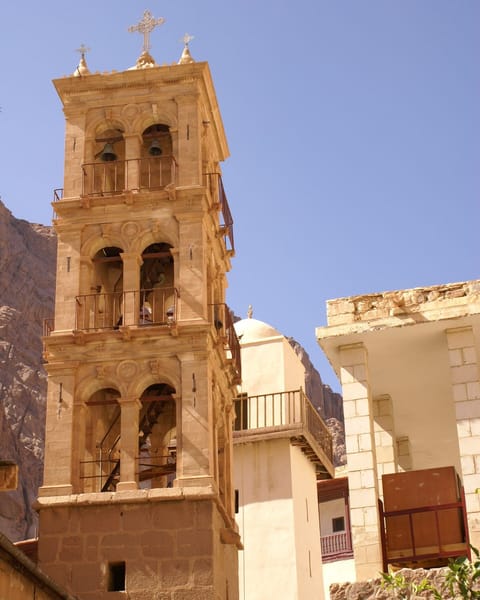
Image: Florian Prischl, Bell tower and minaret, Saint Catherine's Monastery, Sinai, 2007. CC BY-SA 3.0, via Wikimedia Commons.. Image credits
