Did Jesus die on the cross according to Islam?
Question 1038
Question
What does the Quran teach about the crucifixion of Jesus, and do Muslims believe he died on the cross?
Summary of answer
The Quran says that those who boasted of killing Jesus never killed or crucified him, that it was only made to appear so to them, and that Allah raised him to Himself (4:157–158). Most classical commentators held that someone else was made to resemble him. Medieval Ismaili thinkers and modern scholars such as Mahmoud Ayoub read the verse as denying the killers' victory over the Messiah. All readings agree that Allah vindicated Jesus.
﴿بَل رَّفَعَهُ ٱللَّهُ إِلَيۡهِۚ وَكَانَ ٱللَّهُ عَزِيزًا حَكِيمٗا﴾
Rather, Allah raised him up to Himself. Allah is Mighty and Wise.
Answer
الحمد لله Praise be to Allah.
Did Jesus die on the cross according to Islam? The Quran speaks to this in two verses, and Muslims have read them in more than one way. What every reading shares is this: the men who boasted that they had killed the Messiah did not have the final word. Allah raised Jesus (peace be upon him) to Himself, and his enemies did not defeat him.
What does the Quran say about the crucifixion?
The verses come in Sūrat al-Nisāʾ, in a passage listing the wrongs of those who opposed the prophets. One of those wrongs was a boast:
وَقَوۡلِهِمۡ إِنَّا قَتَلۡنَا ٱلۡمَسِيحَ عِيسَى ٱبۡنَ مَرۡيَمَ رَسُولَ ٱللَّهِ وَمَا قَتَلُوهُ وَمَا صَلَبُوهُ وَلَٰكِن شُبِّهَ لَهُم
“And their saying, ‘We killed the Messiah, Jesus son of Mary, the messenger of Allah.’ They did not kill him, and they did not crucify him, but it was made to appear so to them.”
The verse continues: those who differ about it are in doubt, they follow only conjecture, and they certainly did not kill him. The next verse says: “Rather, Allah raised him up to Himself. Allah is Mighty and Wise” (4:158).
Everything turns on two short Arabic words, shubbiha lahum (شُبِّهَ لَهُمۡ): “it was made to appear so to them,” or “he was made to resemble [another] to them.” The Quran does not say what exactly appeared, or to whom. Muslims have filled that silence in three main ways.
How have Muslims understood “it was made to appear so to them”?
Another man was made to look like Jesus
Most classical commentators held that Allah cast the likeness of Jesus onto someone else, who was crucified in his place, while Jesus was lifted up alive. Al-Ṭabarī (d. 923), in his great commentary Jāmiʿ al-Bayān, collects several versions of this account: in some a disciple volunteered, in others the substitute was the man who betrayed him. This is the view most Muslims hold today. Its details come from early reports, and the Quran itself names no substitute.
Jesus survived the cross
A second reading holds that Jesus was placed on the cross but did not die there; he only seemed to die, and later recovered. This view is associated with the Ahmadiyya movement and with some modern writers. Most Muslim scholars have not accepted it.
His body was crucified, and his enemies did not win
A third reading, older than many people realize, takes the verse as a denial of the boast “We killed the Messiah.” Ismaili philosophers of the tenth and eleventh centuries, among them Abu Hatim al-Razi, Abu Yaʿqub al-Sijistani and al-Muʾayyad fi’l-Din al-Shirazi, held that the body of Jesus was truly crucified, while his real self, his soul and the divine light within him, could not be killed. Al-Muʾayyad argued that the crucifixion was a historical fact reported by Jews and Christians alike.
In the modern era the Lebanese-American scholar Mahmoud Ayoub (d. 2021) argued that the verse denies “the power of men to vanquish and destroy the divine Word.” The historian Todd Lawson traced this whole range of interpretation in The Crucifixion and the Qur’an (Oneworld, 2009), and observed that the Quran itself says only that the Jews did not crucify Jesus. Those who hold this reading point to the way the Quran speaks of martyrs:
وَلَا تَحۡسَبَنَّ ٱلَّذِينَ قُتِلُواْ فِي سَبِيلِ ٱللَّهِ أَمۡوَٰتَۢاۚ بَلۡ أَحۡيَآءٌ عِندَ رَبِّهِمۡ يُرۡزَقُونَ
“Never think of those killed in the way of Allah as dead. They are alive with their Lord, receiving provision.”
On this reading, to say that the Messiah’s killers “did not kill him” is like saying the martyrs are not dead. Each of these three readings is held by sincere Muslims, and each takes the words of the verse seriously.
Did Jesus die? What does mutawaffīka mean?
A second verse, in Sūrat Āl ʿImrān, records what Allah said to Jesus:
إِذۡ قَالَ ٱللَّهُ يَٰعِيسَىٰٓ إِنِّي مُتَوَفِّيكَ وَرَافِعُكَ إِلَيَّ وَمُطَهِّرُكَ مِنَ ٱلَّذِينَ كَفَرُواْ
“When Allah said: Jesus, I will take you back to Me, and raise you to Myself, and clear you of those who disbelieve.”
The word mutawaffīka (متوفيك) comes from the verb tawaffā, to take something back in full. The Quran uses it both for death (39:42) and for sleep (6:60). Al-Ṭabarī lists the early explanations: that Allah took Jesus in sleep, that He took him up whole in body and soul, or that He caused him to die, a meaning reported from Ibn ʿAbbās. On Judgment Day, Jesus himself will say to Allah, “When You took me back (tawaffaytanī), You were the watcher over them” (5:117).
Most Muslims believe Jesus was raised alive, will return before the end of time, and will die then. In 1942 Shaykh Mahmud Shaltut, who later became Grand Imam of al-Azhar, issued a fatwa reading these verses as describing a natural death followed by the raising of Jesus in rank, and he concluded that belief in his bodily return is not a required part of faith. The hadith reports about the return, and how scholars weigh such reports, are discussed in Are all hadith authentic?
Why does this question matter?
For Christians the cross is the center of faith; for Muslims Jesus is a beloved prophet and the Messiah (What do Muslims believe about Jesus?). The two faiths will continue to differ here. They also share more than they often notice. Both affirm that Jesus was wronged by powerful men, that God did not abandon him, and that God lifted him up. Christians speak of resurrection and Muslims of being raised to Allah, and both say the story of Jesus ends in vindication and life.
The range of Muslim readings is also a lesson in how the Quran has been interpreted: carefully, with attention to every word, and with room for more than one sound reading (How should the Quran be interpreted?). Conversations with Christian friends about the cross go best when Muslims know this range, and when both sides remember that “our God and your God is one” (29:46). See Do Muslims and Christians worship the same God? and What does the Quran say about Christians and Jews?
Peace upon him
The Quran gives Jesus words that every Muslim can say with love: “Peace be upon me the day I was born, the day I die, and the day I am raised to life” (19:33). Whatever a Muslim concludes about the cross, Jesus remains a messenger whom Allah protected, honored, and brought near.
And Allah knows best. والله أعلم
Frequently asked questions
Do Muslims believe Jesus was crucified?
Most Muslims believe Jesus was not crucified and that another person was made to look like him. Some Muslim thinkers, medieval and modern, hold that his body was crucified and that the Quran denies only his enemies' claim to have destroyed him.
Do Muslims believe Jesus died?
Most Muslims believe Jesus was raised alive and will return and die at the end of time. Others, including Mahmud Shaltut of al-Azhar, read 3:55 and 5:117 as describing his natural death followed by his exaltation.
What does mutawaffīka mean in Quran 3:55?
The verb tawaffā means to take something back in full. Classical commentators explained it as taking Jesus in sleep, taking him up whole, or causing him to die, the last reported from Ibn ʿAbbās.
Do Muslims believe in the resurrection of Jesus?
Muslims believe Allah raised Jesus up to Himself (4:158) and that he is honored in this world and the next. Belief in a resurrection on the third day is a Christian teaching that Islam does not share.
Related questions
Sources
- Todd Lawson, The Crucifixion and the Qur'an: A Study in the History of Muslim Thought (Oneworld, 2009)
- Mahmoud Ayoub, "Towards an Islamic Christology II: The Death of Jesus, Reality or Delusion", The Muslim World 70 (1980)
- Muhammad ibn Jarir al-Tabari, Jāmiʿ al-Bayān (commentary on 3:55 and 4:157)
- Mahmud Shaltut, fatwa on the death of Jesus (1942), in al-Fatāwā
- Gabriel Said Reynolds, "The Muslim Jesus: Dead or Alive?", Bulletin of SOAS 72 (2009)
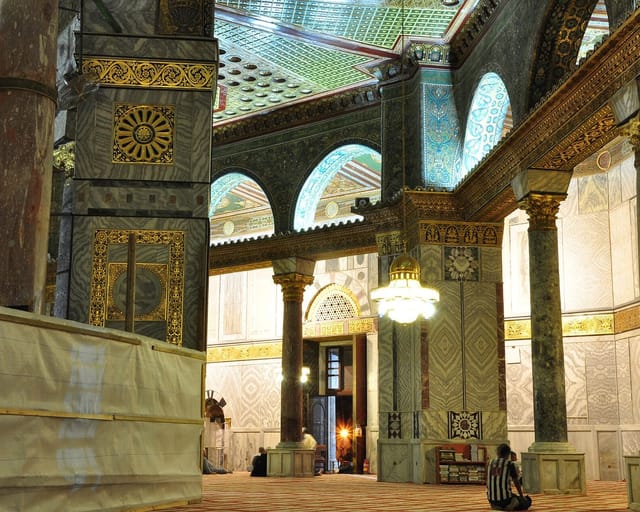
Image: Lazhar Neftien, Inside the Dome of the Rock, Jerusalem, 2009. CC BY 2.0, via Wikimedia Commons.. Image credits
