Why do Muslims say "peace be upon him"?
Question 1233
Question
Why do Muslims say "peace be upon him" after the name of the Prophet Muhammad, and what do the symbol and abbreviations such as PBUH and SAW mean?
Summary of answer
Muslims send blessings and peace on the Prophet Muhammad ﷺ because Allah commands it: Allah and His angels bless the Prophet, and believers are told to bless him and greet him with peace (33:56). The symbol ﷺ stands for ṣallā Allāhu ʿalayhi wa sallam, "may Allah bless him and grant him peace." The Quran sends peace on all the prophets, so Muslims also say "peace be upon him" after Jesus, Moses, Abraham, and every messenger.
Answer
الحمد لله Praise be to Allah.
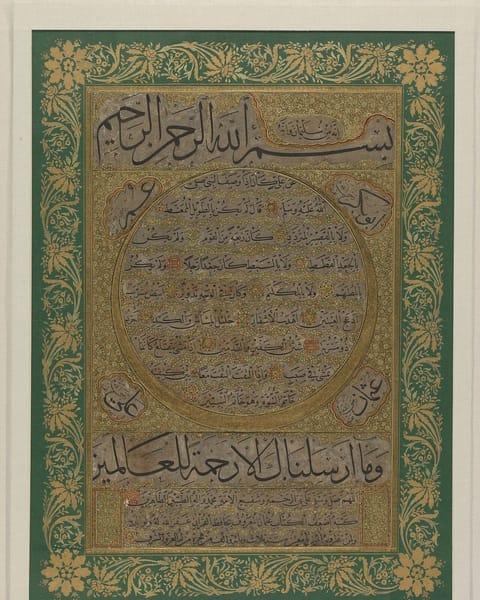
Whenever Muslims speak or write the name of the Prophet Muhammad ﷺ, they add a short prayer: ṣallā Allāhu ʿalayhi wa sallam, “may Allah bless him and grant him peace.” Why do Muslims say “peace be upon him”? Because Allah Himself blesses the Prophet ﷺ and commands the believers to do the same. The words are an act of love, a duʿāʾ that brings blessing back to the one who says it.
Why do Muslims say “peace be upon him” after the Prophet’s name?
The command comes from the Quran:
إِنَّ ٱللَّهَ وَمَلَـٰٓئِكَتَهُۥ يُصَلُّونَ عَلَى ٱلنَّبِيِّۚ يَـٰٓأَيُّهَا ٱلَّذِينَ ءَامَنُواْ صَلُّواْ عَلَيۡهِ وَسَلِّمُواْ تَسۡلِيمًا
“Allah and His angels send blessings on the Prophet. You who believe, send blessings on him and greet him with abundant peace.”
The verse uses one word, ṣalāh (صلاة), for three acts. The scholars of tafsir explained that Allah’s blessing on the Prophet ﷺ is His mercy and His praise of him before the angels, the angels’ blessing is their prayer for him, and the believers’ blessing is a duʿāʾ asking Allah to honor him further. When a Muslim says ṣallā Allāhu ʿalayhi wa sallam, they join a prayer that Allah and the angels are already making.
What does ﷺ mean?
The symbol ﷺ is the Arabic phrase ṣallā Allāhu ʿalayhi wa sallam (صلى الله عليه وسلم) written as a single calligraphic ligature. It has its own place in the Unicode standard, U+FDFA, so it appears in books, websites, and messages across the world. In English it is often rendered “peace be upon him” and abbreviated PBUH. Other common forms are SAW or SAWS, from the initials of the Arabic, and SAAS. The words in full are the best of all: they are a prayer, and saying them is worship.
Do Muslims say “peace be upon him” for other prophets?
Yes. The Quran sends peace on many prophets by name. In Sūrat al-Ṣāffāt it says, “Peace be upon Noah among all the worlds” (Quran 37:79), “Peace be upon Abraham” (37:109), and “Peace be upon Moses and Aaron” (37:120), and it closes with peace upon them all:
وَسَلَٰمٌ عَلَى ٱلۡمُرۡسَلِينَ
“And peace be upon the messengers.”
The Quran sends peace on John the Baptist on the day he was born, the day he dies, and the day he is raised (19:15), and Jesus says the same of himself (19:33). Muslims follow this courtesy and say ʿalayhi al-salām, “peace be upon him,” after every prophet, including Jesus, Moses, and Abraham (What do Muslims believe about Jesus?; Who are the prophets in Islam?). For Mary they say ʿalayhā al-salām. For the Companions they say raḍiya Allāhu ʿanhu, “may Allah be pleased with him,” and for the scholars, raḥimahu Allāh, “may Allah have mercy on him.”
What is the reward for sending blessings on the Prophet ﷺ?
The Prophet ﷺ promised that every blessing returns multiplied:
«مَنْ صَلَّى عَلَىَّ وَاحِدَةً صَلَّى اللَّهُ عَلَيْهِ عَشْرًا»
“Whoever sends a blessing on me once, Allah sends blessings on him ten times.”
He asked his community to send many blessings on him on Fridays, telling them their blessings are presented to him (Sunan Abi Dawud 1047, graded sahih by al-Albani). He also said that whenever anyone greets him with peace, Allah returns his soul to him so that he can return the greeting (Sunan Abi Dawud 2041, graded hasan). And he gently called the one who hears his name without blessing him “the miser” (Jami’ al-Tirmidhi 3546, graded sahih by al-Albani).
Muslims in many lands gather to recite blessings on the Prophet ﷺ together, in Friday circles, at weddings, and at the Mawlid (Is celebrating Mawlid allowed?). In South Asia these blessings are known as durūd sharīf.
Is it obligatory to say ṣallā Allāhu ʿalayhi wa sallam?
All the scholars agree that the verse commands believers to bless the Prophet ﷺ. They differed (ikhtalafa al-ʿulamāʾ) on how often it is required. Some held that once in a lifetime fulfills the command, and others that it is due whenever his name is mentioned. Inside the ṣalāh, the Shafiʿi and Hanbali schools count the blessing in the final sitting as a required part of the prayer, while the Hanafi and Maliki schools hold it a firm sunna. Every school teaches it in each prayer (How to pray in Islam). Outside the prayer it is a beloved practice and a light on the tongue, and the more often it is said, the better.
The prayer the Prophet ﷺ taught
When the Companions asked how they should send blessings on him, the Prophet ﷺ taught them the words Muslims still say at the end of every prayer:
«اللَّهُمَّ صَلِّ عَلَى مُحَمَّدٍ، وَعَلَى آلِ مُحَمَّدٍ، كَمَا صَلَّيْتَ عَلَى إِبْرَاهِيمَ وَعَلَى آلِ إِبْرَاهِيمَ، إِنَّكَ حَمِيدٌ مَجِيدٌ»
“O Allah, send blessings on Muhammad and on the family of Muhammad, as You sent blessings on Abraham and on the family of Abraham. You are the Praiseworthy, the Glorious.”
The prayer joins the last Prophet to the first friend of Allah, Abraham, and their families together. May Allah fill our tongues with blessings on His beloved ﷺ, and return each one to us tenfold in mercy (How to make duʿāʾ).
And Allah knows best. والله أعلم
Frequently asked questions
What does PBUH mean?
PBUH stands for "peace be upon him," a short English form of the Arabic ṣallā Allāhu ʿalayhi wa sallam. Other abbreviations include SAW and SAWS (from the Arabic words) and SAAS. Many Muslims prefer to write or say the phrase in full.
Do non-Muslims have to say peace be upon him?
No. The blessing is a prayer that Muslims offer out of love for the Prophet ﷺ. Non-Muslim writers and speakers are under no obligation, and Muslims welcome the courtesy when others choose to use it.
Why do Shia Muslims say 'and his family'?
When the Companions asked how to send blessings on the Prophet ﷺ, he taught them to bless "Muhammad and the family of Muhammad" (Sahih al-Bukhari 3370). Shia Muslims, and many Sunnis, therefore say ṣallā Allāhu ʿalayhi wa ālihi wa sallam, "may Allah bless him and his family and grant them peace."
Is it a sin to forget to say peace be upon him?
Forgetting is forgiven. The Prophet ﷺ called the one who hears his name and does not bless him a miser (Jami' al-Tirmidhi 3546), which is an encouragement to remember, and the blessing can be said whenever you recall it.
Related questions
Sources
Image: Hafız Osman, Hilye, a calligraphic description of the Prophet, 1691–1692. Chester Beatty Library, Dublin (T 559.4). Public domain, via Wikimedia Commons.. Image credits
