How to pray in Islam: a step-by-step guide to salah
Question 1102
Question
How do Muslims perform the daily prayer (salah), what do they say in each position, and how can a new Muslim who does not know Arabic begin?
Summary of answer
Salah is the prayer Muslims offer five times a day: Fajr (2 units), Dhuhr (4), Asr (4), Maghrib (3), and Isha (4). After wudu, you face the qibla, say Allāhu akbar, recite al-Fātiḥa, bow, stand, prostrate twice, and close with the testimony and the greeting of peace. Allah asks no soul beyond its capacity (2:286), and a beginner who cannot yet recite may praise Allah with simple words the Prophet ﷺ taught.
﴿لَا يُكَلِّفُ ٱللَّهُ نَفۡسًا إِلَّا وُسۡعَهَاۚ﴾
Allah does not burden any soul beyond what it can bear.
Answer
الحمد لله Praise be to Allah.
Salah is the meeting with Allah that Muslims keep five times a day. The Prophet ﷺ said that the coolness of his eyes was placed in prayer (Sunan al-Nasaʾi 3939), and he compared the five prayers to a river at your door in which you wash five times a day, so that no dirt is left on you (Sahih al-Bukhari 528). This guide walks through how to pray in Islam step by step. If you are new, take it slowly: Allah asks no soul for more than it can bear (2:286), and the prayer of a beginner who stumbles is beloved to Him.
What do you need before you pray?
- Wudu. Wash in the way described in How to make wudu, step by step.
- Clean clothes and a clean place. A prayer mat is customary but any clean surface will do. Wear modest clothes; many women pray in a scarf or a loose prayer garment, as the classical schools teach.
- The qibla. Face the Kaaba in Mecca (Quran 2:144). A compass app will show the direction.
- The time. Each prayer has a window: Fajr from dawn to sunrise, Dhuhr after midday, Asr in the afternoon, Maghrib after sunset, and Isha at night.
- Intention (niyya). Know in your heart which prayer you are about to pray. Nothing needs to be said aloud.
How to pray, step by step
The steps below describe a two-unit (rakʿa) prayer such as Fajr.
- Stand and say “Allāhu akbar” (Allah is greatest), raising your hands to your ears or shoulders. This opening takbīr begins the prayer.
- Recite al-Fātiḥa. Most Sunnis rest the right hand over the left on the chest or below the navel; Malikis and Shia let the arms hang at their sides. Then recite the opening chapter of the Quran:
بِسۡمِ ٱللَّهِ ٱلرَّحۡمَٰنِ ٱلرَّحِيمِ ٱلۡحَمۡدُ لِلَّهِ رَبِّ ٱلۡعَٰلَمِينَ ٱلرَّحۡمَٰنِ ٱلرَّحِيمِ مَٰلِكِ يَوۡمِ ٱلدِّينِ إِيَّاكَ نَعۡبُدُ وَإِيَّاكَ نَسۡتَعِينُ ٱهۡدِنَا ٱلصِّرَٰطَ ٱلۡمُسۡتَقِيمَ صِرَٰطَ ٱلَّذِينَ أَنۡعَمۡتَ عَلَيۡهِمۡ غَيۡرِ ٱلۡمَغۡضُوبِ عَلَيۡهِمۡ وَلَا ٱلضَّآلِّينَ
“In the name of Allah, the All-Merciful, the Most Merciful. Praise belongs to Allah, Lord of all the worlds, the All-Merciful, the Most Merciful, Master of the Day of Judgment. You alone we worship, and from You alone we seek help. Guide us on the straight path, the path of those You have blessed, not of those who have earned anger, nor of those who have gone astray.”
- Recite a short passage, such as Sūrat al-Ikhlāṣ (112), in the first two units.
- Bow (rukūʿ). Say “Allāhu akbar,” bend with your hands on your knees and your back level, and say “Subḥāna rabbiya l-ʿaẓīm” (Glory to my Lord, the Magnificent) three times.
- Rise. Stand up saying “Samiʿa llāhu li-man ḥamidah” (Allah hears the one who praises Him), then “Rabbanā wa laka l-ḥamd” (Our Lord, to You belongs all praise). These are the words the Prophet ﷺ used in his night prayer (Sahih Muslim 772).
- Prostrate (sujūd). Say “Allāhu akbar” and place your forehead, nose, palms, knees, and toes on the ground. Say “Subḥāna rabbiya l-aʿlā” (Glory to my Lord, the Most High) three times.
- Sit briefly, then prostrate a second time in the same way.
- Stand for the second unit and repeat steps 2 to 7.
- Sit for the testimony (tashahhud). Recite “at-taḥiyyātu lillāh…”, the words of greeting and testimony the Prophet ﷺ taught his Companions (Sahih al-Bukhari 831), followed by the blessing on the Prophet ﷺ and Abraham.
- Close with peace. Turn your face to the right and say “As-salāmu ʿalaykum wa raḥmatu llāh,” then to the left and say it again.
In a three- or four-unit prayer, sit for the testimony after the second unit, stand for the remaining units reciting only al-Fātiḥa, and finish with the testimony and greeting at the end.
The Prophet ﷺ told one hurried worshiper to pray again and again, then taught him the heart of it: recite what is easy for you, and in every bowing, standing, prostration, and sitting, stay until you are at rest (Sahih al-Bukhari 757). Calm (ṭumaʾnīna) matters more than speed.
Prostration: the nearest point to Allah
«أَقْرَبُ مَا يَكُونُ الْعَبْدُ مِنْ رَبِّهِ وَهُوَ سَاجِدٌ فَأَكْثِرُوا الدُّعَاءَ»
“A servant is nearest to his Lord while prostrating, so make much supplication there.”
After the set words, you may speak to Allah in sujūd in any language, about anything.
What if I don’t know Arabic yet?
The Prophet ﷺ met this situation with ease. A man came to him and said he could not learn any of the Quran, and asked what would suffice him:
«قُلْ سُبْحَانَ اللَّهِ وَالْحَمْدُ لِلَّهِ وَلاَ إِلَهَ إِلاَّ اللَّهُ وَاللَّهُ أَكْبَرُ وَلاَ حَوْلَ وَلاَ قُوَّةَ إِلاَّ بِاللَّهِ»
“Say: Glory be to Allah, all praise is Allah’s, there is no god but Allah, Allah is greatest, and there is no power and no strength except through Allah.”
Sunan Abi Dawud 832 (graded hasan by al-Albani)
Imam Abu Hanifa (d. 767) went further and held that the Quran’s meaning could be recited in Persian during prayer. His students Abu Yusuf and Muhammad al-Shaybani limited this to someone unable to recite Arabic, and later Hanafi texts report that he came round to their view, which became the school’s position: the person who cannot yet recite may pray in their own language while they learn. More on this in Can you pray in English?
Learn al-Fātiḥa first, a few words at a time, and let the rest come.
What if I make a mistake or miss a prayer?
If you forget a part of the prayer, add two prostrations of forgetfulness (sujūd al-sahw) before or after the final greeting. If you miss a prayer, pray it when you can, as explained in What if I miss prayers or struggle to pray? Work, illness, and travel bring their own ease, such as shortening and combining prayers.
A closing word
When Allah first spoke to Moses (peace be upon him) beside the fire in the sacred valley of Ṭuwā, He told him what prayer is for:
إِنَّنِيٓ أَنَا ٱللَّهُ لَآ إِلَٰهَ إِلَّآ أَنَا۠ فَٱعۡبُدۡنِي وَأَقِمِ ٱلصَّلَوٰةَ لِذِكۡرِيٓ
“I am Allah; there is no god but Me. So worship Me, and establish the prayer to remember Me.”
If you have just come to Islam, the first prayer you complete is a great day (How do you become Muslim?). The prayer will feel strange at first and then, slowly, like home. Bring to it whatever you carry, and remember that the One you face is nearer to you than your jugular vein (50:16).
And Allah knows best. والله أعلم
Frequently asked questions
How many rakats are in each prayer?
Fajr has 2 obligatory units (rakʿas), Dhuhr 4, Asr 4, Maghrib 3, and Isha 4, seventeen in all. Travelers may shorten the four-unit prayers to two.
Do women pray differently from men?
The prayer is the same in every essential. The Hanafi school describes a few small differences in posture for women, and the other schools teach almost no difference at all.
Can I pray from a phone or a card while I learn?
The schools differ on reading from a text during prayer. A gentle path is to memorize al-Fātiḥa first and, until then, praise Allah with the short phrases the Prophet ﷺ taught for those who could not yet recite.
How do Shia Muslims pray?
Shia Muslims pray the same five prayers with the same units, usually with their hands at their sides, prostrating on natural earth such as a clay tablet (turba), and often combining Dhuhr with Asr and Maghrib with Isha.
Related questions
Sources
- Sahih al-Bukhari 528, 631, 757, 831
- Sahih Muslim 482, 772
- Sunan Abi Dawud 832
- Ibn ʿAbidin, Radd al-Muḥtār (on recitation in Persian)
- SeekersGuidance, Is it permissible to not pray in Arabic according to the Hanafi school?
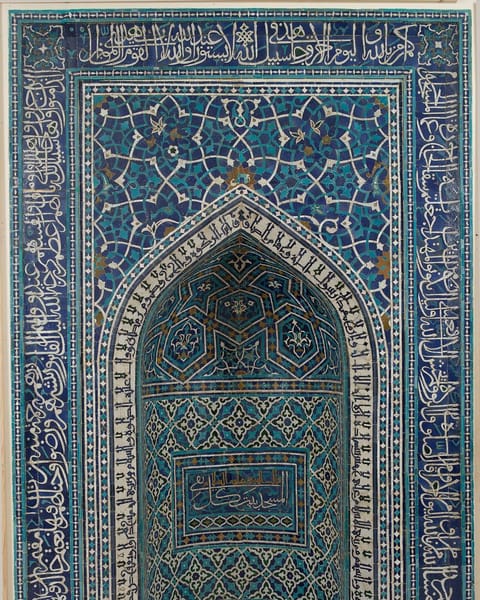
Image: Unknown tile makers, Mihrab from the Madrasa Imami, Isfahan, 1354–1355. Metropolitan Museum of Art, New York. CC0, via Wikimedia Commons.. Image credits
_MET_DP235035.jpg)