What breaks your fast in Ramadan?
Question 1106
Question
What breaks the fast during Ramadan, and what about brushing teeth, swimming, injections, eye drops, or eating by mistake?
Summary of answer
The fast is broken by eating, drinking, and sexual intercourse done knowingly between dawn and sunset (2:187), and by deliberate vomiting and menstruation. Eating or drinking by mistake does no harm, since 'Allah fed you and gave you drink' (Bukhari 1933). Brushing teeth, showering, eye drops, non-nutritive injections, and blood tests leave the fast intact. The ill, travelers, and pregnant and nursing women may postpone, for Allah wants ease for you (2:185).
Answer
الحمد لله Praise be to Allah.
The fast of Ramadan is simple at its core: from the first light of dawn until sunset, a fasting person does not eat, drink, or have sexual intercourse. Almost every question about what breaks your fast comes back to these three, and the Sunnah treats the edges with great gentleness. Eating by mistake does not count, a shower or a toothbrush does no harm, and most modern medicine leaves the fast whole. Those for whom fasting is a hardship are told by the Quran itself to fast later.
What breaks your fast in Islam?
The Quran sets the limits of the fasting day:
وَكُلُواْ وَٱشۡرَبُواْ حَتَّىٰ يَتَبَيَّنَ لَكُمُ ٱلۡخَيۡطُ ٱلۡأَبۡيَضُ مِنَ ٱلۡخَيۡطِ ٱلۡأَسۡوَدِ مِنَ ٱلۡفَجۡرِۖ ثُمَّ أَتِمُّواْ ٱلصِّيَامَ إِلَى ٱلَّيۡلِ
“Eat and drink until the white thread of dawn becomes clear to you from the black thread, then complete the fast until nightfall.”
The same verse permits intimacy between spouses during the nights of Ramadan. From these texts and the Sunnah, the scholars agree that the following break the fast when done knowingly and by choice:
- Eating and drinking, including anything swallowed on purpose, and smoking or vaping (Is smoking or vaping haram?).
- Sexual intercourse during the fasting hours.
- Deliberate vomiting. The Prophet ﷺ said that someone overcome by vomiting owes nothing, and someone who makes himself vomit makes up the day (Sunan Abi Dawud 2380, graded sahih by al-Albani).
- Menstruation and postnatal bleeding. A woman stops fasting and makes up the days later (Can women pray or read the Quran on their period?).
- Nutritive injections and drips, which feed the body as food does.
What does not break your fast?
Eating or drinking by mistake
«إِذَا نَسِيَ فَأَكَلَ وَشَرِبَ فَلْيُتِمَّ صَوْمَهُ، فَإِنَّمَا أَطْعَمَهُ اللَّهُ وَسَقَاهُ»
“If someone forgets and eats or drinks, let him complete his fast, for it was Allah who fed him and gave him drink.”
The meal you forgot was a gift. Stop when you remember and carry on.
Daily life
Swallowing your own saliva, showering, swimming without swallowing water, brushing your teeth without swallowing, smelling food, and wearing perfume leave the fast intact. Waking up after intimacy in a state of major impurity is no problem either: the Prophet ﷺ would sometimes rise for Fajr in that state, bathe, and fast (Sahih al-Bukhari 1925). He was cupped while fasting (Sahih al-Bukhari 1938), and he would kiss and embrace his wives while fasting (Sahih al-Bukhari 1927).
Medicine and medical tests
The International Islamic Fiqh Academy examined medical questions in detail. In its tenth session (resolution 93, 1997) it ruled that the following do not break the fast: eye drops, ear drops, and nasal sprays if nothing is swallowed; tablets placed under the tongue for angina; injections into the skin, muscle, or veins other than nutritive ones; oxygen and anesthetic gases; creams and patches; mouthwash and dental treatment if nothing is swallowed; and endoscopies and biopsies without fluids. In 2018 (resolution 219) it added asthma inhalers (though not dry-powder capsules), blood tests, blood donation, and cupping. The Academy also advised doctors to schedule treatment that can wait until after iftar.
Who does not have to fast?
The verses that command the fast also give its exemptions:
- The ill and the traveler fast an equal number of days later (2:184–185). When the Companions traveled with the Prophet ﷺ in Ramadan, some fasted and some did not, and neither group found fault with the other (Sahih Muslim 1116a).
- Pregnant and nursing women. The Prophet ﷺ said that Allah has lifted fasting from the traveler, the nursing mother, and the pregnant woman (Sunan Abi Dawud 2408, graded hasan sahih by al-Albani). The schools differ on whether she later makes up the days, pays a ransom (fidya), or both; choose what fits your health.
- The elderly and the chronically ill, who cannot make up the days, feed a poor person for each day missed (2:184).
- Women during menstruation and after childbirth, who make up the days later.
If your doctor tells you fasting will harm you, as with some kinds of diabetes, kidney disease, or eating disorders, then not fasting is what Allah asks of you. The Quran forbids harming oneself (4:29).
What if I break my fast?
If you broke a fast by mistake, nothing is owed. If you broke it on purpose without an excuse, repent and make up the day. Intercourse during a Ramadan day brings an expiation (kaffāra) as well, and the way the Prophet ﷺ handled it says much about the spirit of the law. A man came to him saying “I am ruined,” and admitted what he had done. The Prophet ﷺ asked whether he could free a slave, fast two months, or feed sixty poor people; he could do none of them. Then a basket of dates arrived, and the Prophet ﷺ told him to give it in charity. The man said there was no family in Medina poorer than his own. The Prophet ﷺ laughed until his teeth showed and said, “Feed it to your family” (Sahih al-Bukhari 1936).
A closing word
Allah explained the purpose of the exemptions in the middle of the verses on fasting:
يُرِيدُ ٱللَّهُ بِكُمُ ٱلۡيُسۡرَ وَلَا يُرِيدُ بِكُمُ ٱلۡعُسۡرَ
“Allah wants ease for you, and He does not want hardship for you.”
When the sun sets, break your fast as the Prophet ﷺ did, with the words “The thirst is gone, the veins are moistened, and the reward is certain, if Allah wills” (Sunan Abi Dawud 2357). For the meaning of the month itself, see What is Ramadan, and why do Muslims fast? and What is Laylat al-Qadr?, and if this is your first Ramadan, How can a new Muslim fast Ramadan?
And Allah knows best. والله أعلم
Frequently asked questions
Can you brush your teeth while fasting?
Yes. The International Islamic Fiqh Academy ruled that the tooth-stick (siwāk), a toothbrush, and dental treatment do not break the fast as long as nothing is swallowed. Many people use a little toothpaste, or none, to be careful.
Does swallowing saliva break your fast?
No. Swallowing your own saliva is part of being alive and has no effect on the fast.
Can you kiss your spouse while fasting?
Yes, for someone who can keep control of himself. Aisha reported that the Prophet ﷺ would kiss and embrace while fasting (Sahih al-Bukhari 1927). Intercourse during the day breaks the fast.
Does smoking or vaping break your fast?
Yes. Drawing smoke or vapor into the body on purpose breaks the fast, according to contemporary scholars of all schools.
What breaks the fast in Shia fiqh?
Jaʿfari fiqh agrees on eating, drinking, and intercourse, and adds a few items, such as deliberately putting the whole head under water and remaining in a state of major impurity until dawn on purpose.
Related questions
Sources
- Sahih al-Bukhari 1925, 1927, 1933, 1936, 1938
- Sunan Abi Dawud 2380, 2408, 2357
- International Islamic Fiqh Academy, Resolution 93 (1/10) on fast-breakers in medical treatment, 1997
- International Islamic Fiqh Academy, Resolution 219 (3/23), Invalidators of Fasting in the Field of Therapeutics, 2018
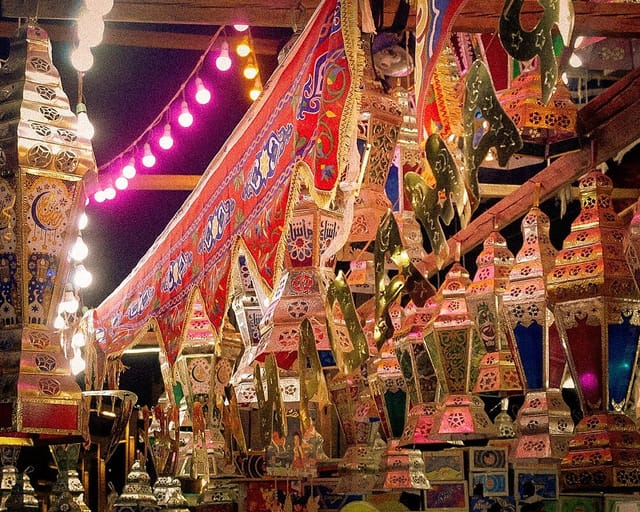
Image: Alaazzpov, Ramadan lanterns for sale in the Sayyida Zaynab district, Cairo, 2026. CC BY-SA 4.0, via Wikimedia Commons.. Image credits
