Can women pray or read the Quran on their period?
Question 1059
Question
During menstruation, may a Muslim woman pray, recite the Quran, touch the muṣḥaf, make duʿāʾ, or go to the mosque?
Summary of answer
During her period a woman sets aside the ritual prayer and does not make it up, and she makes up missed fasts later. The stronger view is that she may recite the Quran: the hadith forbidding it is weak, and Malik's school, Ibn Hazm, Ibn Taymiyya, and Ibn al-Qayyim allowed it. Duʿāʾ, dhikr, and listening to the Quran are open to her by agreement, and her menstruation, the Prophet ﷺ said, 'is not in your hand.'
Answer
الحمد لله Praise be to Allah.
Menstruation is part of the way Allah made women, and the sharia meets it with ease. During her period a woman sets aside the five ritual prayers and does not make them up, and she postpones fasting and makes up those days later. Everything else in her life with Allah stays open. She may make duʿāʾ, remember Allah, listen to the Quran, attend Eid, and on the stronger view (al-rājiḥ) recite the Quran itself. Her period takes nothing from her nearness to her Lord.
Why don’t women pray during their period?
The break from ṣalāh is a mercy and a relief, given by the Lord who says:
يُرِيدُ ٱللَّهُ بِكُمُ ٱلۡيُسۡرَ وَلَا يُرِيدُ بِكُمُ ٱلۡعُسۡرَ
“Allah wants ease for you, and He does not want hardship for you.”
A woman who is bleeding, often in pain and tired, is spared the repeated washing and standing of five prayers a day. She is also spared the burden of making them up. When a woman asked Aisha (may Allah be pleased with her) why a menstruating woman makes up her fasts but not her prayers, Aisha answered from experience: “That would happen to us, and we were told to make up the fasts and were never told to make up the prayers” (Sahih Muslim 335c). The Quran calls menstruation adhan, a discomfort (2:222), and the law answers the discomfort with relief. Missed fasts are made up after Ramadan at her own pace (What breaks your fast?).
The Prophet ﷺ spoke of menstruation with tenderness. When Aisha began her period on the way to the Hajj and sat weeping at Sarif, he came to her and said:
«إِنَّ هَذَا أَمْرٌ كَتَبَهُ اللَّهُ عَلَى بَنَاتِ آدَمَ، فَاقْضِي مَا يَقْضِي الْحَاجُّ، غَيْرَ أَنْ لاَ تَطُوفِي بِالْبَيْتِ»
“This is something Allah has decreed for the daughters of Adam. Do everything the pilgrim does, except circling the House.”
She stood at ʿArafa, called out the talbiya, and remembered Allah through the greatest days of the year. The one rite she postponed was the ṭawāf around the Kaʿba.
Can a woman read the Quran on her period?
The scholars differed (ikhtalafa al-ʿulamāʾ). The Hanafi, Shafi’i, and Hanbali schools forbid a menstruating woman to recite the Quran, allowing only short phrases said as duʿāʾ or remembrance. Their main text is a report that “the menstruating woman and the person in major impurity should not recite anything of the Quran.” Imam al-Tirmidhi recorded it together with al-Bukhari’s criticism of its narrator, Ismāʿīl ibn ʿAyyāsh, whose reports from the people of the Hijaz were unreliable, and al-Albani graded it weak (Jami’ al-Tirmidhi 131).
Many great scholars allowed her to recite. The Maliki school permits it, reasoning that a period lasts many days and a woman who knows the Quran by heart could lose it. The same view is reported from al-Shafiʿi in his early teaching, in one narration from Ahmad ibn Hanbal, and from al-Ṭabarī. Ibn Hazm (d. 1064) wrote in al-Muḥallā that reading the Quran, prostrating at its verses of prostration, touching the muṣḥaf, and remembering Allah are all permitted, “with wudu or without it, for the person in major impurity and for the menstruating woman.” Ibn Taymiyya (d. 1328) observed that no clear, sound text forbids a menstruating woman to recite, and his student Ibn al-Qayyim agreed.
The Sunnah points the same way. Aisha reported that the Prophet ﷺ would rest his head in her lap while she was menstruating and recite the Quran (Sahih al-Bukhari 297). Imam al-Bukhari, in a chapter heading of his Sahih, recorded that Ibn ʿAbbās saw no harm in reciting while in major impurity and that the Prophet ﷺ remembered Allah in all his states.
The stronger view, then, is that a woman on her period may recite the Quran, from memory or from a screen, in prayer circles, classes, and her own nightly reading. A teacher may teach it, a student may revise it, and a girl preparing for a recitation competition need not stop for a week.
Can a woman touch the muṣḥaf on her period?
The majority forbid touching the Arabic muṣḥaf directly, reading the verse “none touch it except the purified” (56:79) as a rule for people. The early commentators often read that verse about heaven: al-Ṭabarī reports from Ibn ʿAbbās and Saʿīd ibn Jubayr that “the purified” are the angels. Ibn Hazm, as quoted above, allowed touching the muṣḥaf in any state.
A woman who follows the majority still has many ways to read. She can hold the muṣḥaf with a separate cloth or through its cover, read from a phone or tablet, or use a printed translation with commentary. The details of touching the Quran without wudu are in Can you touch the Quran without wudu?
Can a woman go to the mosque on her period?
For Eid, the Prophet ﷺ told women on their periods to come out with everyone else “to witness the good and the supplications of the believers,” keeping apart only from the rows of prayer (Sahih al-Bukhari 324). He also asked Aisha to hand him a mat from the mosque, and when she said she was menstruating, he answered:
«إِنَّ حَيْضَتَكِ لَيْسَتْ فِي يَدِكِ»
“Your menstruation is not in your hand.”
Her body was not impure to touch, and her hand could reach into the house of Allah. Scholars differ about staying in the prayer hall during menstruation; a woman can always attend classes, gatherings, and events held in the mosque’s other rooms (Can women go to the mosque?). When her period ends she takes a full bath (How to perform ghusl) and returns to prayer.
How can I stay close to Allah during my period?
- Make duʿāʾ freely. Every school agrees that supplication, dhikr, and blessings on the Prophet ﷺ are open to you (How to make duʿāʾ).
- Keep your Quran routine on the stronger view, or listen to recitation if you follow the majority.
- Keep the times of prayer. Some women keep their prayer mat out and spend a few minutes in remembrance at each prayer time, keeping the rhythm of the day.
- Rest without guilt. Allah decreed this for the daughters of Adam. It is part of His design.
A closing duʿāʾ
The last verse of Sūrat al-Baqara teaches a prayer for every believer who carries a weight:
رَبَّنَا وَلَا تُحَمِّلۡنَا مَا لَا طَاقَةَ لَنَا بِهِۦۖ وَٱعۡفُ عَنَّا وَٱغۡفِرۡ لَنَا وَٱرۡحَمۡنَآ
“Our Lord, do not burden us with what we cannot bear. Pardon us, forgive us, and have mercy on us.”
May Allah make every season of a woman’s life a season of nearness to Him.
And Allah knows best. والله أعلم
Frequently asked questions
Can I touch the Quran on my period?
The majority of jurists forbid touching the Arabic muṣḥaf directly during menstruation, while Ibn Hazm and others allowed it. Many who forbid it still allow holding it with a separate cloth or reading from a phone, so no woman need be cut off from the Quran.
Can I make duʿāʾ and dhikr on my period?
Yes, by agreement of all the schools. A woman on her period may make duʿāʾ, say the words of remembrance, send blessings on the Prophet ﷺ, and listen to the Quran at any time.
Do I have to make up the prayers I missed on my period?
No. Aisha said that when their periods came, the women around the Prophet ﷺ were told to make up missed fasts and were never told to make up missed prayers (Sahih Muslim 335c).
What is the Shia view on reading the Quran during menstruation?
In Jaʿfari fiqh a menstruating woman may recite the Quran, except for the four verses that require a prostration of recitation. Some jurists consider long recitation during menstruation disliked, which lessens the reward without forbidding it.
Can I listen to the Quran on my period?
Yes. No school forbids listening to the Quran during menstruation, and it is a good way to stay close to the Book.
Related questions
Sources
- Sahih al-Bukhari 294, 297, 324; Sahih Muslim 298a, 335c
- Jami' al-Tirmidhi 131 (the weak report on reciting during menstruation)
- Ibn Hazm, al-Muḥallā
- Ibn Taymiyya, Majmūʿ al-Fatāwā
- al-Ṭabarī, Jāmiʿ al-Bayān, on Quran 56:79
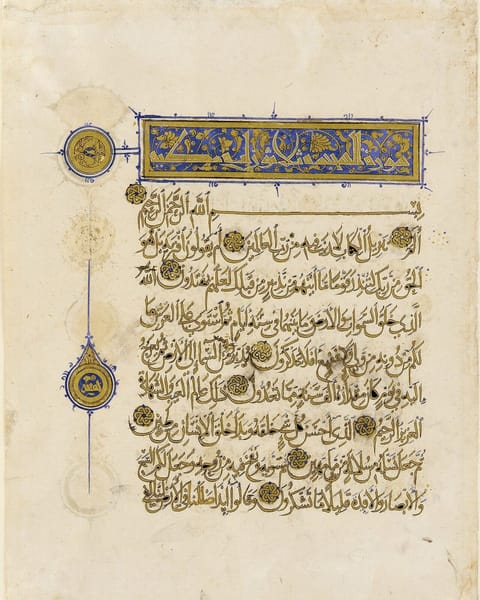
Image: Shadhi ibn Muhammad ibn Ayyub (calligrapher); Aydughdi ibn ʿAbdallah al-Badri (illuminator), Folio from a Mamluk Qurʾan (Sūrat al-Sajda), Cairo, 1313–1314. Freer Gallery of Art, Smithsonian Institution, Washington (F1938.15). Public domain, via Wikimedia Commons.. Image credits
.jpg)