Is feminism compatible with Islam?
Question 1056
Question
Can a Muslim be a feminist, and does Islam support the full equality of women and men?
Summary of answer
Feminism, understood as the equal dignity, rights, and moral worth of women and men, is part of Islam. The Quran created both from one soul and promised them the same reward (16:97, 33:35). Khadija ran her own trade, Aisha taught and corrected senior Companions, and Muslim scholars from Fatima Mernissi to Amina Wadud and the Musawah movement have drawn on the Quran's justice to renew Muslim family law.
Answer
الحمد لله Praise be to Allah.
A Muslim can be a feminist with a whole heart. If feminism means that women and men share equal dignity, equal rights, and equal moral worth, then it rests on ground the Quran laid: both sexes were created from one soul, both carry the trust of faith, and both are judged by the same measure. The sound position is that the equality of women and men is part of Islam, and that working for justice toward women is an act of faith (ʿibāda) in its own right.
What does the Quran say about women and men?
The Quran promises the same life and the same reward to every believer who does good:
مَنۡ عَمِلَ صَٰلِحٗا مِّن ذَكَرٍ أَوۡ أُنثَىٰ وَهُوَ مُؤۡمِنٞ فَلَنُحۡيِيَنَّهُۥ حَيَوٰةٗ طَيِّبَةٗۖ وَلَنَجۡزِيَنَّهُمۡ أَجۡرَهُم بِأَحۡسَنِ مَا كَانُواْ يَعۡمَلُونَ
“Whoever does good, whether male or female, and is a believer, We will give them a good life, and We will reward them according to the best of what they did.”
Elsewhere it names women beside men in ten pairs of virtues (33:35), calls believing men and women protecting friends of one another (9:71), and gives each sex ownership of what it earns (4:32). Read as a whole, the Book speaks to women as full moral persons, as explained in What does the Quran say about women?
Were there women who claimed their rights in the time of the Prophet ﷺ?
The first Muslim community was full of them. Khadija (may Allah be pleased with her), a merchant of Mecca, employed the young Muhammad ﷺ in her trade, proposed marriage to him herself, and was the first person to believe in his message (Who was Khadija?). Umm Salama asked why Allah did not mention women in the emigration, and a verse came down in answer (3:195). Umm ʿUmāra, Nusayba bint Kaʿb, complained that the Quran seemed to speak only to men, and the verse naming “Muslim men and Muslim women” followed (33:35); the same woman fought to protect the Prophet ﷺ at Uḥud.
The women of Medina also asked for their share of his teaching. Abu Saʿīd al-Khudrī reported that they came to the Prophet ﷺ and said:
«غَلَبَنَا عَلَيْكَ الرِّجَالُ، فَاجْعَلْ لَنَا يَوْمًا مِنْ نَفْسِكَ»
“The men have taken all your time from us, so set aside a day of your own for us.”
He promised them a day, met them, and taught them. He did not tell them to wait for their husbands to pass his lessons on.
After his death, Aisha (may Allah be pleased with her) became one of the great teachers of the community. She corrected senior Companions, including Abu Hurayra and Ibn ʿUmar, when she held that they had misremembered or misunderstood the words of the Prophet ﷺ. Imam Badr al-Dīn al-Zarkashī (d. 1392) gathered her corrections into a whole book, al-Ijāba li-Īrād mā Istadrakathu ʿĀʾisha ʿalā al-Ṣaḥāba, partly translated and studied by Sofia Rehman in 2024. The tradition of women scholars that followed her is vast.
What have Muslim scholars written about women’s equality?
In the modern era, Muslim women have argued for their rights from within the faith for more than a century. Huda Shaarawi founded the Egyptian Feminist Union in 1923. The Moroccan sociologist Fatima Mernissi, in Le Harem politique (1987; in English, The Veil and the Male Elite, 1991), went back to the hadiths most often used to keep women from public life and examined who narrated them, when, and why.
Amina Wadud and Asma Barlas reread the Quran itself and found in it a consistent message of equal creation and equal accountability. Ziba Mir-Hosseini, in Islam and Gender (1999) and later work, has drawn on the classical distinction between sharia, the path Allah reveals, and fiqh, the jurists’ human understanding of it. Fiqh was always marked by disagreement (ikhtilāf) and by attention to custom (ʿurf), so it can be renewed when its rulings no longer serve justice. Kecia Ali’s Sexual Ethics and Islam (2006) applied the same care to marriage and divorce law.
In February 2009 about 250 people from 47 countries gathered in Kuala Lumpur to launch Musawah, a global movement for equality and justice in the Muslim family, of which Mir-Hosseini is a founding member. Its work is rooted in the Quran, the Sunnah, and the jurists’ own methods.
Is Islamic feminism a Western idea?
The claim that women’s equality was imported from the West overlooks the Quran itself. Muslim women were arguing their cases before the Prophet ﷺ, and winning, fourteen centuries ago: Khawla bint Thaʿlaba’s complaint against her husband gave Sūrat al-Mujādila its name (58:1). Muslim women have owned property in their own names since the first generation, long before married women in England could. The scholars who renew fiqh today use the tools the tradition has always used: the objectives of the sharia (maqāṣid al-sharīʿa), public benefit (maṣlaḥa), and fresh reasoning (ijtihād).
Equality also takes forms that were once unusual and are now found across the Muslim world: women who lead prayer, women judges and muftis, and women who work and lead in every field.
Does Muslim feminism mean rejecting hijab or family life?
It means choice. A woman who covers her hair out of love for Allah honors her faith, and so does a woman who does not; covering is a personal decision, beautiful when chosen freely (Is hijab mandatory in Islam?). Marriage, motherhood, and a career are each open to her. The Prophet ﷺ told a man who had come to ask about joining a military campaign to stay with his mother instead, “for Paradise is beneath her feet” (Sunan al-Nasa’i 3104). Honoring the work of mothers and opening every other door to women belong to the same justice.
A duʿāʾ for justice
The Quran’s answer to envy between the sexes is an invitation to both:
لِّلرِّجَالِ نَصِيبٞ مِّمَّا ٱكۡتَسَبُواْۖ وَلِلنِّسَآءِ نَصِيبٞ مِّمَّا ٱكۡتَسَبۡنَۚ وَسۡـَٔلُواْ ٱللَّهَ مِن فَضۡلِهِۦٓ
“Men have a share of what they have earned, and women have a share of what they have earned. And ask Allah of His bounty.”
May Allah open His bounty to women and men alike, and make us people who give every soul its due.
And Allah knows best. والله أعلم
Frequently asked questions
Can a Muslim woman be a feminist?
Yes. Working for the equal dignity and rights of women follows from the Quran's teaching that women and men come from one soul and are judged by one standard, and many devout Muslim women and men call themselves feminists.
What is Islamic feminism?
Islamic feminism is the work of reading the Quran, the Sunnah, and fiqh in light of the Quran's own principles of justice and equality, and reforming family law and community life to match. Musawah, launched in Kuala Lumpur in 2009, is its best-known global network.
Did the Prophet ﷺ support women's rights?
He set aside a day to teach women when they asked for one, annulled a marriage a father forced on his daughter, never struck a woman, and answered women's questions in public. The Quran itself came down in reply to women's complaints.
Why do some scholars call feminism haram?
Some scholars reject the word because they associate it with movements hostile to religion or to family life. The substance, equal dignity and justice for women, is affirmed by the Quran, and the stronger view welcomes it by whatever name.
Related questions
Sources
- Fatima Mernissi, The Veil and the Male Elite: A Feminist Interpretation of Women's Rights in Islam (1991; French original Le Harem politique, 1987)
- Ziba Mir-Hosseini, Islam and Gender: The Religious Debate in Contemporary Iran (Princeton University Press, 1999)
- Kecia Ali, Sexual Ethics and Islam: Feminist Reflections on Qur'an, Hadith, and Jurisprudence (Oneworld, 2006)
- Sofia Rehman, Gendering the Ḥadīth Tradition: Recentring the Authority of Aisha, Mother of the Believers (Oxford University Press, 2024)
- Musawah: Global Movement for Equality and Justice in the Muslim Family
- Sahih al-Bukhari 101 (the women's request for a day of teaching)
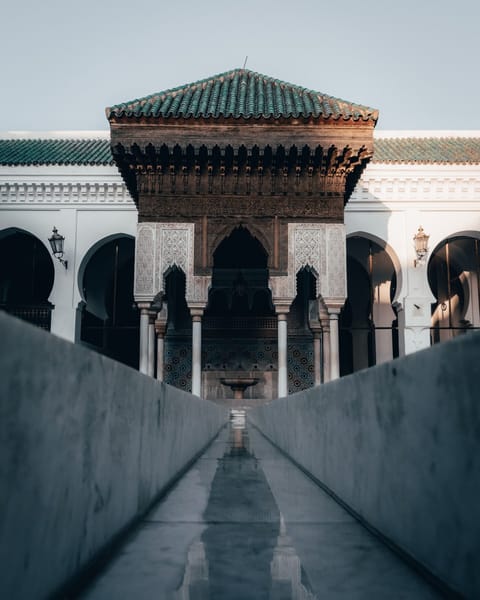
Image: Reda.bnhd, Courtyard of the Qarawiyyin Mosque, Fez, 2019. CC BY-SA 4.0, via Wikimedia Commons.. Image credits
