Does the Quran allow a husband to hit his wife?
Question 1060
Question
Does Quran 4:34 permit a husband to hit his wife, and is domestic violence ever allowed in Islam?
Summary of answer
Hitting a wife is haram. The Quran commands husbands to live with their wives in kindness (4:19) and forbids holding them in marriage to harm them (2:231). The Prophet ﷺ never struck a woman, said that men who beat their wives are not the best of the community, and taught that the best of people are the best to their families. The word in 4:34 has many meanings, and scholars from ʿAṭāʾ to AbuSulayman read it without violence.
Answer
الحمد لله Praise be to Allah.
If you are being hurt at home, call your local emergency number. In the US, the National Domestic Violence Hotline answers at 1-800-799-7233 (or text START to 88788); in the UK, the free 24-hour National Domestic Abuse Helpline is 0808 2000 247.
Hitting a wife is haram. The Quran describes marriage as a bond of love and mercy and commands husbands to live with their wives in kindness. The Prophet ﷺ never once struck a woman, and he said in clear words that men who beat their wives are not the best of his community. One verse, Quran 4:34, has long been read as permitting a husband to strike his wife, and that reading deserves a careful answer. Read alongside the rest of the Quran and the Prophet’s ﷺ own conduct, the verse gives no one license to harm a wife.
What does the Quran say about how husbands treat their wives?
The Quran sets the terms of marriage in verses that leave no room for violence:
وَعَاشِرُوهُنَّ بِٱلۡمَعۡرُوفِۚ فَإِن كَرِهۡتُمُوهُنَّ فَعَسَىٰٓ أَن تَكۡرَهُواْ شَيۡـٔٗا وَيَجۡعَلَ ٱللَّهُ فِيهِ خَيۡرٗا كَثِيرٗا
“Live with them in kindness. If you dislike them, it may be that you dislike something in which Allah has placed much good.”
The word maʿrūf means what every decent person recognizes as right. Even a husband who has come to dislike his wife is told to treat her well. Another verse forbids keeping a wife in a marriage in order to hurt her:
وَلَا تُمۡسِكُوهُنَّ ضِرَارٗا لِّتَعۡتَدُواْۚ وَمَن يَفۡعَلۡ ذَٰلِكَ فَقَدۡ ظَلَمَ نَفۡسَهُۥ
“Do not hold on to them to harm them and so transgress. Whoever does that has wronged his own soul.”
And the Quran names the purpose of marriage: that spouses “find rest in one another,” with “love and mercy” placed between them (30:21).
How did the Prophet ﷺ treat his wives?
Aisha (may Allah be pleased with her) gave the clearest testimony:
«مَا ضَرَبَ رَسُولُ اللَّهِ صلى الله عليه وسلم شَيْئًا قَطُّ بِيَدِهِ وَلاَ امْرَأَةً وَلاَ خَادِمًا»
“The Messenger of Allah never struck anything with his hand, neither a woman nor a servant.”
He made kindness at home the measure of a person:
«خَيْرُكُمْ خَيْرُكُمْ لأَهْلِهِ وَأَنَا خَيْرُكُمْ لأَهْلِي»
“The best of you is the one who is best to his family, and I am the best of you to my family.”
He told the men of Medina, “Do not beat the female servants of Allah.” ʿUmar then complained that wives had grown bold with their husbands, and the Prophet ﷺ allowed it; soon many women came to his household complaining of their husbands, and he said, “Many women have come to the family of Muhammad complaining about their husbands. Those men are not the best of you” (Sunan Abi Dawud 2146, graded sahih by al-Albani). He also asked how a man could whip his wife as one whips a slave and then lie with her at the end of the day (Sahih al-Bukhari 5204).
When the Prophet ﷺ was displeased with his wives, he vowed to stay away from them for a month (Sahih al-Bukhari 1910) and raised his hand against no one. His own response to marital discord was distance and time.
What does Quran 4:34 mean?
Quran 4:34 speaks of a wife’s nushūz, a serious breakdown in the marriage, and lists three responses: counsel, separate beds, and a third expressed by the verb wa-ḍribūhunna. The next verse calls on both families to send arbitrators to reconcile the couple (4:35).
The root ḍ-r-b carries many meanings in the Quran. It means to travel (“when you travel in the land,” 4:101), to set forth a parable (“Allah sets forth an example,” 66:11), and to strike. The scholars differed (ikhtalafa al-ʿulamāʾ) over its meaning here.
The classical reading and its limits
Most classical jurists read the word as striking, and then hedged it with limits that empty it of violence. Al-Ṭabarī reports that Ibn ʿAbbās, asked what a strike “that is not severe” meant, answered: with a siwāk, a small tooth-cleaning twig, or the like. Imam al-Shafiʿi is reported to have said that striking is permitted and not striking is better. The Meccan scholar ʿAṭāʾ ibn Abī Rabāḥ, one of the Successors, went further: “He does not strike her, even if he tells her something and she ignores him; he shows her his displeasure.” Ibn al-ʿArabi (d. 1148) quoted this in his Aḥkām al-Qurʾān and commented, “This is from the deep understanding of ʿAṭāʾ.”
Readings of separation
Many modern scholars read the verb as a call to separate. AbdulHamid AbuSulayman argued in Marital Discord (2003) that the word here points to a longer separation between husband and wife as a way to resolve the dispute, in line with the Prophet’s ﷺ own month of withdrawal. Laleh Bakhtiar rendered it “go away from them” in The Sublime Quran (2007).
The sound position
The sound position is that striking a wife is haram. On the separation reading, the verse never mentions hitting. On the classical reading, it grants at most a reluctant permission that ʿAṭāʾ and al-Shafiʿi already advised against, and that the Prophet ﷺ never once used. Such a permission, which harms the body and the trust between spouses, cannot stand against the commands to live in kindness and not to keep a wife for harm. The objectives of the sharia (maqāṣid al-sharīʿa) protect life, body, and dignity, and the Prophet’s ﷺ example is the Quran lived. Reading a verse through the whole Book in this way is explained in How should the Quran be interpreted?
What can a woman do if her husband hits her?
- Get safe first. Call your local emergency number or a domestic violence hotline, and go to family, friends, or a shelter.
- Know your rights. Harm (ḍarar) is grounds for ending a marriage. The Maliki school gave a wife the right to a judicial divorce for harm, and every school recognizes khulʿ. See Can a Muslim woman divorce her husband?
- Seek merciful counsel. An imam who tells you to endure abuse is contradicting the Sunnah. More guidance is in What does Islam say about domestic violence?
The same principles apply to every member of a household; Islam’s teaching on children is set out in Can Muslim parents hit their children?
A marriage of love and mercy
وَمِنۡ ءَايَٰتِهِۦٓ أَنۡ خَلَقَ لَكُم مِّنۡ أَنفُسِكُمۡ أَزۡوَٰجٗا لِّتَسۡكُنُوٓاْ إِلَيۡهَا وَجَعَلَ بَيۡنَكُم مَّوَدَّةٗ وَرَحۡمَةً
“Among His signs is that He created spouses for you from among yourselves, so that you might find rest in them, and He placed love and mercy between you.”
May Allah make every home a place of rest, protect every wife and husband from harm, and fill our marriages with the love and mercy He placed there.
And Allah knows best. والله أعلم
Frequently asked questions
Is it haram to hit your wife in Islam?
Yes. Striking a wife harms a person Allah commanded her husband to treat with kindness and mercy, and the Prophet ﷺ never struck a woman. Domestic violence is also a crime in most countries, including many Muslim-majority ones.
What does wa-ḍribūhunna in 4:34 mean?
The verb ḍaraba has many meanings in the Quran, including to travel, to set forth an example, and to strike. Classical jurists who read it as striking limited it to a symbolic touch and preferred that husbands avoid it; modern scholars such as AbdulHamid AbuSulayman and Laleh Bakhtiar read it as separating from or leaving the wife.
What should I do if my husband hits me?
Your safety comes first: call your local emergency number or a domestic violence hotline. Islamic law gives you the right to end a harmful marriage through a judge, an Islamic council, or khulʿ, and no one may tell you to stay and endure abuse.
Can a wife hit her husband?
No. The Quran's command to live together in kindness binds both spouses, and violence by either one is a wrong.
Related questions
Sources
- Sahih Muslim 2328a; Jami' al-Tirmidhi 3895; Sunan Abi Dawud 2146; Sahih al-Bukhari 5204
- Ibn al-ʿArabi, Aḥkām al-Qurʾān (on Quran 4:34, the view of ʿAṭāʾ)
- al-Ṭabarī, Jāmiʿ al-Bayān, on Quran 4:34
- AbdulHamid A. AbuSulayman, Marital Discord: Recapturing the Full Islamic Spirit of Human Dignity (IIIT, 2003)
- Laleh Bakhtiar, The Sublime Quran (2007)
- National Domestic Violence Hotline (US)
- National Domestic Abuse Helpline (UK)
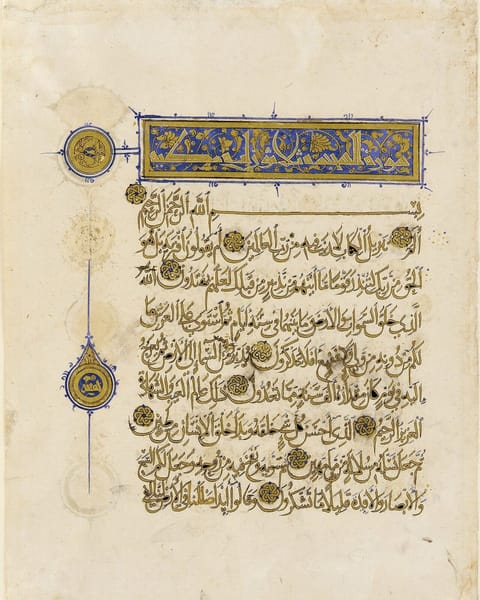
Image: Shadhi ibn Muhammad ibn Ayyub (calligrapher); Aydughdi ibn ʿAbdallah al-Badri (illuminator), Folio from a Mamluk Qurʾan (Sūrat al-Sajda), Cairo, 1313–1314. Freer Gallery of Art, Smithsonian Institution, Washington (F1938.15). Public domain, via Wikimedia Commons.. Image credits
.jpg)