Is hijab mandatory in Islam?
Question 1011
Question
Is it obligatory for a Muslim woman to cover her hair, and is it a sin if she does not wear hijab?
Summary of answer
Covering the hair is a woman's own choice. The Quran asks believing women to draw their head-cloths over their bosoms (24:31) and to wear an outer garment so they are recognized and left unharmed (33:59); neither verse names the hair. Classical law tied head covering to free status, and scholars such as Khaled Abou El Fadl hold it optional where uncovered hair is not immodest. Worn freely, the hijab is a beautiful act of devotion.
﴿وَلِبَاسُ ٱلتَّقۡوَىٰ ذَٰلِكَ خَيۡرٞ﴾
And the garment of God-consciousness: that is the best.
Answer
الحمد لله Praise be to Allah.
Many Muslim women have been told that the headscarf is the sign of faith itself, and that a woman without it has fallen short before Allah. The stronger view (al-rājiḥ) is that hijab, in the sense of covering the hair, is optional. The Quran asks believers of both sexes for modesty, and it asks women to draw their cloths over their bosoms. It never names the hair.
Covering the hair is therefore a woman’s own choice. Made freely, out of love for Allah, it is a beautiful act of devotion; a woman who chooses otherwise remains a full believer whose modesty lives in her character and her dress.
What does the Quran say about hijab?
The word ḥijāb (حجاب) appears in the Quran several times, and in none of them does it mean a headscarf. It means a barrier or a curtain. The verse usually cited tells the believers that when they ask the wives of the Prophet ﷺ for something, they should ask “from behind a curtain” (Quran 33:53).
The verse most often quoted for head covering is in Sūrat al-Nūr. After telling believing men to lower their gaze and guard their chastity (24:30), it gives the same command to believing women and adds:
وَلۡيَضۡرِبۡنَ بِخُمُرِهِنَّ عَلَىٰ جُيُوبِهِنَّ
“Let them draw their head-cloths over their bosoms.”
The khimār (خمار) was a cloth that women in Arabia already wore. The verse takes it for granted and gives one instruction about it: let it cover the jayb, the opening of the garment at the chest. Scholars who hold hijab optional, Khaled Abou El Fadl among them, point out that the one clear command in the verse concerns the bosom. More on how the Quran speaks to women is in What does the Quran say about women?
Sūrat al-Aḥzāb tells the Prophet ﷺ to ask his wives, his daughters and the believing women to draw their outer garments (jalābīb) around them, and it gives the reason:
ذَٰلِكَ أَدۡنَىٰٓ أَن يُعۡرَفۡنَ فَلَا يُؤۡذَيۡنَ
“That makes it likelier that they will be recognized and not harmed.”
The purpose named is safety from harassment in the streets of Medina. The classical commentators explain that some men accosted women at night and excused themselves by claiming they had taken them for enslaved women. The outer garment marked a woman as free, so that she would be left alone.
Why did the classical schools require covering the hair?
The four Sunni schools and the Jaʿfari school held that a free woman’s hair is ʿawra (عورة), the part of the body to be covered before men outside her family. They read khimār as a head-cloth, and they cited the report of ʿAisha (may Allah be pleased with her) that when 24:31 was revealed, the women of Medina cut their wraps and covered themselves with them (Sahih al-Bukhari 4759). This is a recognized opinion held by great scholars, and many women follow it with love.
The same jurists drew the line by social status. In the Hanafi school, the ʿawra of an enslaved woman was the area from the navel to the knee together with her back and belly, so her hair was uncovered. ʿUmar ibn al-Khaṭṭāb is reported in Ibn Abi Shayba’s al-Muṣannaf to have stopped enslaved women from covering their heads, telling them not to imitate free women. A covering that some believing women were forbidden to wear was a marker of rank in one society.
Khaled Abou El Fadl drew the conclusion in a 2016 fatwa. Custom shaped the classical rules on ʿawra, he wrote, and so a woman may go without a head-covering in the United States, where uncovered hair carries no suggestion of immodesty. He added that the sharia never asks a woman to expose herself to harm.
Is there a hadith that makes hijab obligatory?
The hadith most often quoted says that the Prophet ﷺ told Asmāʾ bint Abī Bakr that once a girl reaches puberty, nothing of her should be seen except her face and hands (Sunan Abi Dawud 4104). Abu Dawud, who recorded it, noted beneath it that the chain is broken (mursal): its narrator Khālid ibn Durayk never met ʿAisha. Some later scholars strengthened it through other chains, and others did not. A ruling meant to bind every Muslim woman in every age needs firmer ground than a report its own compiler flagged as disconnected. On how scholars weigh such chains, see Are all hadith authentic?
Which scholars say hijab is optional?
- Khaled Abou El Fadl, the UCLA professor of Islamic law, in the fatwa described above.
- Gamal al-Banna (1920–2013), the Egyptian thinker and younger brother of Hassan al-Banna, held that the veil is no obligation of Islam.
- Javed Ahmad Ghamidi of Pakistan and his students read 24:31 as a command to cover the chest, and regard covering the hair as a commendable custom of Muslim culture that is not mandatory.
- Muhammad Shahrur (1938–2019) of Syria argued that the verse sets a minimum of covering, the intimate parts of the body, and leaves the rest to the custom of each time and place.
In 1923 the Egyptian feminist Huda Shaarawi, returning from a women’s suffrage congress in Rome, removed her face veil at a Cairo train station. Two generations later, Leila Ahmed of Harvard Divinity School studied the veil’s return across the Middle East and America, and found many women wearing it as a free act of faith. Both belong to the story of Muslim women’s equality, told in Is feminism compatible with Islam?
Is it haram if I don’t wear hijab?
A woman who dresses modestly without covering her hair has done what the Quran asks of her. Modesty is commanded to men first (24:30), and it lives in the gaze, in speech, and in the dignity with which one treats others. The same freedom covers trousers, colors, and the rest of a woman’s dress, as explained in Can Muslim women wear pants?
No one may force the headscarf on a woman, and no one may strip it from her. “There is no compulsion in religion” (Quran 2:256). Harassing a woman about her dress is itself haram; see Is it haram to harass women about hijab?
The law of most Muslim countries agrees. Only Iran and the Taliban government of Afghanistan require women to cover their hair. Saudi Arabia no longer requires it, and in Egypt, Pakistan, Turkey, Iraq and Morocco the choice belongs to each woman.
Why do many Muslim women choose to wear hijab?
Many women wear the headscarf with joy: as a daily act of devotion, a reminder of Allah each time they dress, a sign of belonging to the community of believers. That choice deserves full respect at work, at school, and in public life. Many other women of deep faith pray, fast, and serve their communities without it. Mosques such as the Ibn Rushd-Goethe Mosque in Berlin, founded in 2017 by Seyran Ateş, welcome both (Are there LGBTQ-friendly and inclusive mosques?).
The Quran places the measure of a person in the heart:
إِنَّ أَكۡرَمَكُمۡ عِندَ ٱللَّهِ أَتۡقَىٰكُمۡ
“The noblest of you in the sight of Allah is the most God-conscious of you.”
Whether you cover your hair or not, clothe yourself first in that God-consciousness. It is the garment Allah calls the best, and it is open to every one of His servants.
And Allah knows best. والله أعلم
Frequently asked questions
Is it haram if I don't wear hijab?
The stronger view is that covering the hair is a choice, and a woman who dresses modestly without a headscarf has done what the Quran asks of her. Modesty of gaze, speech and dress is the duty, for women and men alike.
Is hijab mandatory by law in Saudi Arabia, Egypt or Pakistan?
Iran requires it by law, and so does the Taliban government in Afghanistan. Saudi Arabia no longer requires it, and in Egypt, Pakistan, Turkey, Iraq and Morocco it is each woman's own decision.
Do I have to cover my hair to pray?
The four Sunni schools ask women to cover the hair in ṣalāh, and many women who do not wear hijab outside keep a prayer scarf for this. Javed Ahmad Ghamidi and his students class it among the etiquettes (ādāb) of prayer.
What is the Shia view of hijab?
Jaʿfari jurists, like the four Sunni schools, hold that a woman should cover her hair before men outside her family. The Quranic evidence discussed in this answer is the same for Sunni and Shia readers, and the case for choice rests on it.
Related questions
Sources
- Khaled Abou El Fadl, On Hijab (The Hair-covering of Women), fatwa, 2016
- Sahih al-Bukhari 4759
- Sunan Abi Dawud 4104, with Abu Dawud's note that the chain is mursal
- Ibn Abi Shayba, al-Muṣannaf (reports of ʿUmar on enslaved women's head covering)
- Muhammad Shahrur, al-Kitāb wa-l-Qurʾān: Qirāʾa Muʿāṣira (1990)
- Leila Ahmed, A Quiet Revolution: The Veil's Resurgence, from the Middle East to America (Yale University Press, 2011)
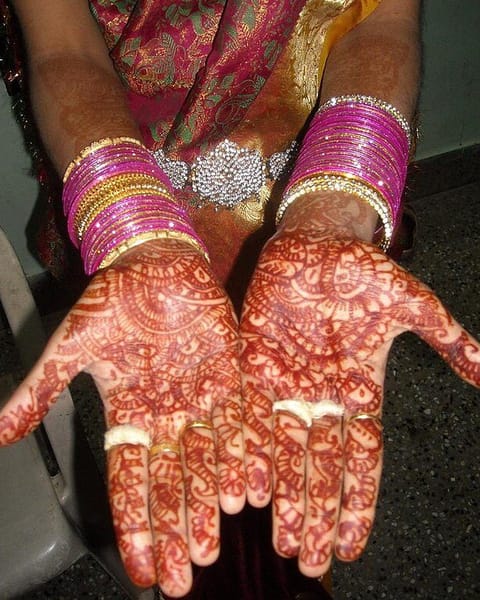
Image: Sistak, Henna on a Muslim bride's hands, Madurai, 2011. CC BY-SA 2.0, via Wikimedia Commons.. Image credits
