Are tattoos haram?
Question 1017
Question
Is it permissible for a Muslim to get a tattoo, and are wudu and prayer valid with a tattoo?
Summary of answer
Tattoos are permissible on the stronger view. The hadith cursing tattooing concerned specific practices of its time, such as false beauty marks and tattooed gums, and early authorities including Ibn ʿAbbas read the Quran's warning against changing Allah's creation as a warning against corrupting His religion. Ayatollah Sistani rules tattoos permissible, and all scholars agree that wudu, ghusl and prayer are valid with a tattoo.
Answer
الحمد لله Praise be to Allah.
Some Muslims carry tattoos from before they came to Islam, some want a design that marks a person or a moment they love, and many have heard that a tattoo makes their prayers worthless. The stronger view is that tattoos are permissible. Wudu, ghusl, and prayer are valid with a tattoo by the agreement of the scholars, and the hadith that condemns tattooing is best understood through the practices it named in its own time.
What does the hadith on tattoos say?
ʿAbd Allāh ibn Masʿūd (may Allah be pleased with him) reported that Allah cursed the women who tattoo (al-wāshimāt) and those who are tattooed, together with women who pluck their faces and file gaps between their teeth for beauty, “changing the creation of Allah” (Sahih al-Bukhari 5931). Ibn ʿUmar narrated a shorter form, and his student Nāfiʿ, who passed it on, explained the tattooing in question: “Tattooing is in the gums” (Sahih al-Bukhari 5937).
Abu Dawud recorded another version from Ibn ʿAbbās with an important qualification: the curse applies to these acts when they are done “without illness” (Sunan Abi Dawud 4170). Abu Dawud also explained what the wāshima did: she placed beauty marks (khīlān) on a woman’s face with kohl or ink. The hadith therefore had concrete practices in view: blackened gums, false moles and marks on the face, done to make a woman appear other than she was.
Does a tattoo change the creation of Allah?
The phrase in the hadith echoes a verse in which Satan vows to command people to “change the creation of Allah” (Quran 4:119). The early commentators differed on its meaning. Al-Ṭabarī (d. 923) records that some said castration, and al-Ḥasan al-Baṣrī said tattooing. Ibn ʿAbbās, Mujāhid, and Ibrāhīm al-Nakhaʿī said it means the religion of Allah, and al-Ṭabarī preferred their reading, supporting it with this verse:
فِطۡرَتَ ٱللَّهِ ٱلَّتِي فَطَرَ ٱلنَّاسَ عَلَيۡهَاۚ لَا تَبۡدِيلَ لِخَلۡقِ ٱللَّهِ
“The natural disposition Allah instilled in people: there is no altering the creation of Allah.”
On this reading, Satan’s goal is to corrupt the faith and moral nature (fiṭra) that Allah placed in every person. Al-Ṭabarī held that the verse covers every act of disobedience. Whether a given act is disobedience is decided by the evidence for that act.
The scholars never treated every change to the body as forbidden. Circumcision, haircuts, trimmed nails, and pierced ears all alter the body. The women of Medina wore earrings in pierced ears, and gave them away in charity when the Prophet ﷺ urged them on the day of Eid (Sahih al-Bukhari 5883). The question has always been the purpose and effect of a change. The same reasoning applies to shaping the eyebrows, explained in Is plucking eyebrows haram?
What do the scholars say about tattoos?
The four Sunni schools held tattooing forbidden, reading the hadith as a general rule. This is a recognized opinion, and many Muslims avoid tattoos out of respect for it.
Leading Shia authorities take a different view. The office of Ayatollah Sistani rules that tattooing beneath the skin “is permissible in and of itself,” for men and for women, provided the design promotes nothing false or forbidden. Sistani adds that it is generally better to avoid it, and that a woman should cover a tattoo that custom counts as adornment from men outside her family. On the wider differences between the traditions, see What is the difference between Sunni and Shia Islam?
Muslim practice has long been wider than the manuals. Amazigh women across Morocco, Algeria, Tunisia, and Libya wore facial tattoos marking engagement, marriage, and womanhood, a custom older than Islam that continued for centuries after it. Kurdish women in Iraq, Turkey, Syria, and Iran wore deq, tattoos of stars and plants, between the eyes and on the chin. Bedouin women and men of the Arabian deserts wore tribal tattoos. Many of these women were devout Muslims, and the custom lived for centuries alongside prayer and fasting, until stricter teaching and changing fashions made it fade in recent decades.
The stronger view joins these strands. The hadith condemned deceptive beauty marks and practices of its time. A tattoo chosen openly as art, memory, or identity deceives no one, and nothing in the Quran forbids it.
Do tattoos affect wudu and prayer?
No. Tattoo ink lies beneath the skin, so water reaches the skin’s surface in wudu and ghusl, and both are complete. Even scholars who forbid tattoos agree that a person with a tattoo prays, fasts, makes the pilgrimage, and is buried like every other Muslim. The steps of wudu are in How to make wudu.
New Muslims often worry about tattoos from their past. Islam wipes away what came before it, and no convert needs to remove a tattoo; see How to become Muslim.
What should I think about before getting a tattoo?
- The design. Choose something you will be glad to carry for life, and avoid images that mock faith or celebrate cruelty.
- Sacred words. Many Muslims avoid tattooing Quranic verses or the names of Allah, since the body enters places of impurity.
- Your health. Choose a licensed artist with sterile equipment. Protecting the body is one of the aims of the sharia.
- Temporary options. Henna and temporary tattoos are permitted by every view, and Sistani notes that a temporary tattoo does not affect wudu when it leaves color without a layer.
A closing word
Allah made the human being beautiful from the start:
لَقَدۡ خَلَقۡنَا ٱلۡإِنسَٰنَ فِيٓ أَحۡسَنِ تَقۡوِيمٖ
“We created the human being in the finest form.”
Whatever you choose for your skin, guard the inner form: the fiṭra of faith, mercy, and truthfulness that no ink can change.
And Allah knows best. والله أعلم
Frequently asked questions
Can you pray with a tattoo?
Yes. The ink lies beneath the skin, so water reaches the skin in wudu and ghusl, and your prayer is valid. Scholars who disapprove of tattoos agree on this.
Are tattoos haram in Shia Islam?
Ayatollah Sistani rules that tattooing beneath the skin is permissible in itself and does not affect wudu, ghusl, or prayer, for women and for men, as long as the design promotes nothing false or forbidden. He adds that it is generally better to avoid it.
Do I have to remove my tattoo if I become Muslim?
No. A convert's past is forgiven, and removal is painful and costly. Your tattoo does not affect your prayer or your place in the community.
Can I get a tattoo of a Quranic verse or the name of Allah?
Many Muslims prefer to avoid it out of respect, since the body enters the bathroom and the words cannot be kept apart from it. Calligraphy of other words, or designs from Islamic art, carry no such concern.
Related questions
Sources
- Sahih al-Bukhari 5931 and 5937
- Sunan Abi Dawud 4170
- al-Ṭabarī, Jāmiʿ al-Bayān, commentary on Quran 4:119
- Office of Ayatollah Sistani, questions on tattoos
- Middle East Eye, Partridge eyes and stars: Traditional tattoos of Amazigh, Bedouin and Kurdish women
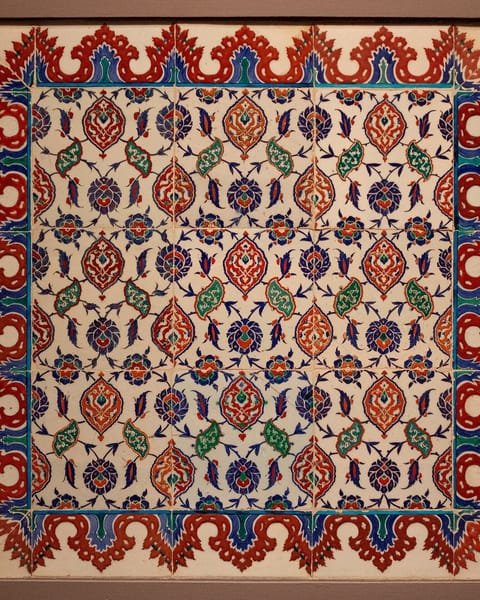
Image: Ottoman tile makers, Iznik tile panel, second half of the 16th century. Metropolitan Museum of Art, New York. CC0, via Wikimedia Commons.. Image credits
