How do you perform ghusl?
Question 1200
Question
How do Muslims perform ghusl, the full ritual bath, and when is it required?
Summary of answer
Ghusl is the full-body washing that restores ritual purity after intercourse, a sexual discharge, menstruation, or postnatal bleeding. Its essence is water reaching the whole body. The Prophet ﷺ washed his hands and private parts, made wudu, ran water through the roots of his hair, poured three handfuls over his head, and then let water flow over all his skin (Sahih al-Bukhari 248). A shower with this intention is a complete ghusl, and braids need not be undone.
Answer
الحمد لله Praise be to Allah.
Ghusl (غسل) is the full washing of the body that returns a Muslim to ritual purity before prayer. It takes a few minutes in a shower, and the Prophet ﷺ taught it with great ease: the essence of ghusl is water reaching the whole body, with the intention of purification. Here is how to perform ghusl step by step, when it is required, and the gentleness the Sunnah shows to people with long hair, braids, and busy mornings.
What does the Quran say about ghusl?
The verse of purification in Sūrat al-Māʾida, after describing wudu, adds:
وَإِن كُنتُمۡ جُنُبٗا فَٱطَّهَّرُواْ
“If you are in a state of major impurity, purify yourselves.”
The state is called janāba (جنابة), and the Quran mentions it again in Quran 4:43, telling believers not to approach the prayer in that state “until you have bathed”. Janāba is a ritual condition, and it carries no moral stain. The Prophet ﷺ himself bathed for it regularly, and his wives reported his method in detail so that every Muslim could learn it.
When is ghusl required?
Ghusl becomes due after:
- Sexual intercourse, whether or not there is ejaculation (Sahih al-Bukhari 291).
- An emission of sexual fluid, awake or in a dream. Umm Sulaym came to the Prophet ﷺ and said, “Allah is not shy of the truth: must a woman bathe if she has a wet dream?” He answered, “Yes, if she sees the fluid” (Sahih al-Bukhari 282). Women’s bodies and questions were spoken of openly in his presence.
- The end of menstruation and of postnatal bleeding, which the Quran links to purification (Quran 2:222). See Can women pray or read the Quran on their period?
- Embracing Islam. When Qays ibn ʿĀṣim came to accept Islam, the Prophet ﷺ told him to bathe with water and lote leaves (Sunan Abi Dawud 355, graded sahih by al-Albani). Some jurists held this bath obligatory for a new Muslim and others recommended it; either way it is a beautiful beginning (How do you become Muslim?).
Ghusl is also a sunna before the Friday prayer, the two Eids, and entering iḥrām for Hajj. For Friday, the Prophet ﷺ said that wudu is good and ghusl is better (Jamiʿ al-Tirmidhi 497).
How to perform ghusl step by step
Aisha (may Allah be pleased with her) described the Prophet’s bath:
«كَانَ إِذَا اغْتَسَلَ مِنَ الْجَنَابَةِ بَدَأَ فَغَسَلَ يَدَيْهِ، ثُمَّ يَتَوَضَّأُ كَمَا يَتَوَضَّأُ لِلصَّلاَةِ، ثُمَّ يُدْخِلُ أَصَابِعَهُ فِي الْمَاءِ، فَيُخَلِّلُ بِهَا أُصُولَ شَعَرِهِ ثُمَّ يَصُبُّ عَلَى رَأْسِهِ ثَلاَثَ غُرَفٍ بِيَدَيْهِ، ثُمَّ يُفِيضُ الْمَاءَ عَلَى جِلْدِهِ كُلِّهِ»
“When he bathed after major impurity, he began by washing his hands. Then he made wudu as he did for prayer. Then he dipped his fingers in the water and ran them through the roots of his hair, poured three handfuls of water over his head, and then let the water flow over all his skin.”
Following her description and that of Maymūna (Sahih al-Bukhari 249):
- Intend in your heart to purify yourself, and say “Bismillāh”.
- Wash your hands up to the wrists.
- Wash your private parts and anything on the body that needs cleaning.
- Make wudu as for prayer, rinsing the mouth and nose (How to make wudu). You may leave the feet until the end, as Maymūna saw him do.
- Run wet fingers through the roots of your hair so the water reaches the scalp.
- Pour water over your head three times.
- Let water flow over your whole body, the right side and then the left, reaching the armpits, the navel, behind the ears, and between the toes.
- Wash your feet if you left them for last.
What is the minimum for a valid ghusl?
The steps above are the Sunnah in full. The core is shorter. Every school agrees that water must reach the whole outer body, skin and hair. Some schools, among them the Hanafi, add rinsing the mouth and nose, and the Maliki, Shafiʿi, and Hanbali schools add the intention. A person who stands under a shower intending ghusl, rinses the mouth and nose, and lets the water reach everywhere has bathed validly.
Jaʿfari (Shia) fiqh knows two forms: an ordered ghusl (tartībī), washing the head and neck first and then the rest of the body, and ghusl by immersion (irtimāsī) in a body of water.
A complete ghusl includes wudu. Aisha said of the Prophet ﷺ that after bathing he prayed, “and I do not think he made wudu again after the bath” (Sunan Abi Dawud 250, graded sahih by al-Albani).
Do women have to undo their braids for ghusl?
Umm Salama (may Allah be pleased with her) asked the Prophet ﷺ this very question: she braided her hair tightly, and wanted to know whether she must undo it for ghusl. He said:
«لاَ إِنَّمَا يَكْفِيكِ أَنْ تَحْثِي عَلَى رَأْسِكِ ثَلاَثَ حَثَيَاتٍ ثُمَّ تُفِيضِينَ عَلَيْكِ الْمَاءَ فَتَطْهُرِينَ»
“No. It is enough for you to pour three handfuls of water over your head, then let the water flow over the rest of you, and you are pure.”
The same ease covers locs, twists, and other protective styles: wet the scalp well and let the water run. Hair dye and henna let water through, and polish is discussed in Is nail polish haram, and does it affect wudu?
A closing word
The verse that commands ghusl ends by naming its purpose:
وَلَٰكِن يُرِيدُ لِيُطَهِّرَكُمۡ وَلِيُتِمَّ نِعۡمَتَهُۥ عَلَيۡكُمۡ لَعَلَّكُمۡ تَشۡكُرُونَ
“He wishes to purify you and to complete His favor upon you, so that you may give thanks.”
Each time the water runs over you, it is a favor from Allah and a fresh start. Step out of the bath ready to stand before Him.
And Allah knows best. والله أعلم
Frequently asked questions
Do I need to make wudu after ghusl?
No. A complete ghusl includes wudu. Aisha reported that the Prophet ﷺ bathed and then prayed without making wudu again (Sunan Abi Dawud 250, graded sahih by al-Albani), as long as nothing that breaks wudu happens after the bath.
Can I do ghusl in the shower?
Yes. Make the intention, rinse your mouth and nose, and let the water reach every part of your body. A shower is the easiest way to follow the Prophet's own method of pouring water over the whole body.
How do I do ghusl after my period?
In the same way as any ghusl, once the bleeding has stopped. The Prophet ﷺ also told a woman to use a piece of cloth scented with musk afterward, for freshness (Sahih al-Bukhari 314); this is a kindness and optional.
Does nail polish or hair dye affect ghusl?
Hair dye and henna let water through. The majority hold that polish which blocks water from the nail should be removed first; breathable polish does not block it.
How do Shia Muslims perform ghusl?
Jaʿfari fiqh knows two forms: an ordered ghusl (tartībī), washing the head and neck first and then the rest of the body, and ghusl by immersion (irtimāsī) in a pool, river, or sea.
Related questions
Sources
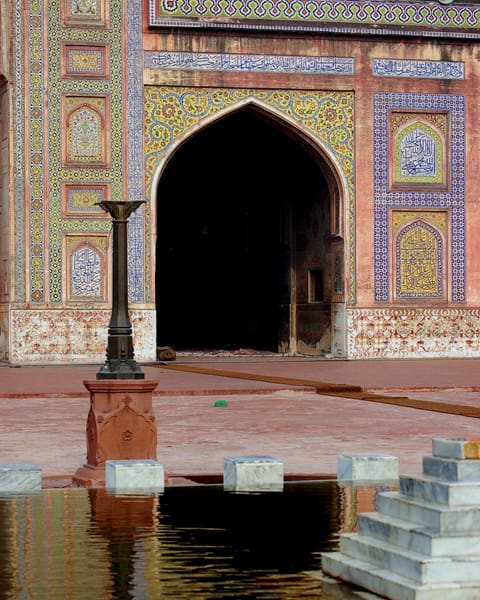
Image: Maham Bhatty, Ablution pool in the courtyard of the Wazir Khan Mosque, Lahore, 2011. CC BY-SA 3.0, via Wikimedia Commons.. Image credits
