What are Eid al-Fitr and Eid al-Adha?
Question 1208
Question
What are the two Eids in Islam, why are they celebrated, and how do Muslims observe them?
Summary of answer
Islam has two festivals. Eid al-Fitr, on the first of Shawwal, closes Ramadan with zakat al-fitr for the poor and a morning prayer. Eid al-Adha, on the tenth of Dhu al-Hijja, remembers Abraham's sacrifice during the Hajj with meat shared among family and the needy. The Prophet ﷺ called them two days Allah gave in place of older feasts, and he welcomed singing, play, and the whole community, women and children included, at the prayer.
Answer
الحمد لله Praise be to Allah.
Eid (ʿīd, عيد) means a festival that returns, a day of joy that comes back every year. Islam has two. Eid al-Fitr, the festival of breaking the fast, closes Ramadan. Eid al-Adha, the festival of the sacrifice, falls during the Hajj. Both open with a prayer in congregation, both carry a gift for the poor, and both are days of food, family, new clothes, and gladness. When the Prophet ﷺ arrived in Medina and found its people playing on two old holidays, he told them:
«إِنَّ اللَّهَ قَدْ أَبْدَلَكُمْ بِهِمَا خَيْرًا مِنْهُمَا يَوْمَ الأَضْحَى وَيَوْمَ الْفِطْرِ»
“Allah has given you in their place two days better than them: the day of sacrifice and the day of breaking the fast.”
Sunan Abi Dawud 1134 (graded sahih by al-Albani)
He did not take the people’s play away. He gave them better days to play in.
What is Eid al-Fitr?
Eid al-Fitr falls on the first day of Shawwal, the month after Ramadan, once the new crescent is sighted or the month is counted complete. It is the day the fast ends, and the Prophet ﷺ would eat a few dates, an odd number of them, before he set out for the prayer (Sahih al-Bukhari 953). The Quran ties the day to gratitude. At the close of the verses on fasting it says:
وَلِتُكۡمِلُواْ ٱلۡعِدَّةَ وَلِتُكَبِّرُواْ ٱللَّهَ عَلَىٰ مَا هَدَىٰكُمۡ وَلَعَلَّكُمۡ تَشۡكُرُونَ
“…so that you complete the number of days, proclaim Allah’s greatness for guiding you, and become grateful.”
So Muslims walk to the prayer saying the takbīr: Allāhu akbar, Allāhu akbar.
Before the prayer, every household pays zakāt al-fiṭr, a measure of staple food for each member of the family, young or old (Sahih al-Bukhari 1503). Ibn ʿAbbās (may Allah be pleased with him) reported that the Prophet ﷺ prescribed it as a purification for the one who fasted from idle and coarse talk, and as food for the poor (Sunan Abi Dawud 1609, graded hasan by al-Albani). The Hanafi school allows it to be given as money, as many Muslims in cities now do. The festival begins by making sure no one in town is hungry on it. See What is Ramadan? and How does zakat work?
What is Eid al-Adha?
Eid al-Adha falls on the tenth of Dhu al-Hijja, the day after the pilgrims stand at ʿArafa, followed by the three days of tashrīq. It remembers Abraham (peace be upon him), who was ready to give up what he loved most for his Lord, and whose son was spared: “We ransomed him with a great sacrifice” (Quran 37:107). Pilgrims in Mina and Muslims everywhere offer an animal in his memory, the uḍḥiya (أضحية), called qurbānī in South Asia. The pilgrimage itself is described in What is Hajj?
The Quran tells the believers what the sacrifice is for:
لَن يَنَالَ ٱللَّهَ لُحُومُهَا وَلَا دِمَآؤُهَا وَلَٰكِن يَنَالُهُ ٱلتَّقۡوَىٰ مِنكُمۡ
“Their flesh does not reach Allah, nor their blood. What reaches Him is your devotion.”
The meat goes to people: “eat from it, and feed the one who keeps from asking and the one who asks” (22:36). Many families divide it in thirds, for home, for friends, and for the poor, and many give through a charity so that it reaches families who rarely eat meat. The Hanafi school holds the sacrifice necessary for those who can afford it; the other Sunni schools hold it a strongly emphasized sunna. The Prophet ﷺ called the days of tashrīq “days of eating and drinking” (Sahih Muslim 1141a).
How is the Eid prayer performed?
The Eid prayer is two units (rakʿas) prayed in congregation after sunrise, with no call to prayer and no iqāma (Sahih Muslim 887). The imam adds extra takbīrs at the start of each rakʿa and gives the sermon after the prayer, as the Prophet ﷺ did in the open field outside Medina (Sahih al-Bukhari 956).
The whole community was called. Umm ʿAṭiyya (may Allah be pleased with her) reported:
«كُنَّا نُؤْمَرُ أَنْ نَخْرُجَ يَوْمَ الْعِيدِ، حَتَّى نُخْرِجَ الْبِكْرَ مِنْ خِدْرِهَا، حَتَّى نُخْرِجَ الْحُيَّضَ فَيَكُنَّ خَلْفَ النَّاسِ، فَيُكَبِّرْنَ بِتَكْبِيرِهِمْ، وَيَدْعُونَ بِدُعَائِهِمْ يَرْجُونَ بَرَكَةَ ذَلِكَ الْيَوْمِ وَطُهْرَتَهُ»
“We were told to come out on the day of Eid, even to bring the young women out of their rooms, and even the women in their periods. They stayed behind the rows, saying the takbīr with everyone and joining in the duʿāʾ, hoping for the blessing and the purity of that day.”
Even women who were not praying came for its blessing. No woman should be kept from the Eid (Can women go to the mosque?).
Is music allowed on Eid?
Yes. On an Eid day two girls were singing old songs of the Anṣār in Aisha’s house. Abu Bakr objected to “the pipes of Satan” in the Prophet’s home, and the Prophet ﷺ answered him:
«يَا أَبَا بَكْرٍ إِنَّ لِكُلِّ قَوْمٍ عِيدًا، وَهَذَا عِيدُنَا»
“Abu Bakr, every people has its festival, and this is our festival.”
On the same day Abyssinian men played with shields and spears, and the Prophet ﷺ stood with Aisha behind him, her cheek against his, watching until she had seen enough (Sahih al-Bukhari 950). Songs, drums, and dancing belong to Eid, as Is music haram? and Is dancing haram? set out.
How do Muslims celebrate Eid today?
The Sunnah of the day is simple: bathe, wear your best clothes and perfume, pray with the community, go home by a different road (Sahih al-Bukhari 986), and spend the day with family and neighbors. Around it every culture has built its own Eid: gifts of money for children, the sweets that give al-Fitr its Turkish name, Şeker Bayramı, and ketupat cooked for Hari Raya in Malaysia and Indonesia.
Eid is also a day to look for the lonely: the new convert with no Muslim family, the student far from home, the widow, the neighbor who would love to be invited.
A closing word
The Quran tells the believers where their joy should come from:
قُلۡ بِفَضۡلِ ٱللَّهِ وَبِرَحۡمَتِهِۦ فَبِذَٰلِكَ فَلۡيَفۡرَحُواْ هُوَ خَيۡرٞ مِّمَّا يَجۡمَعُونَ
“Say: in the bounty of Allah and in His mercy, in that let them rejoice. That is better than all they gather.”
May Allah accept from us and from you, and fill every Eid of your life with His bounty, His mercy, and the people you love.
And Allah knows best. والله أعلم
Frequently asked questions
What do you say to someone on Eid?
The common greeting is "Eid Mubarak," a blessed Eid. Many Muslims also say "Taqabbal Allāhu minnā wa minkum," may Allah accept from us and from you. Non-Muslim friends and neighbors are welcome to use either.
Is it haram to fast on the day of Eid?
Yes. The Prophet ﷺ forbade fasting on the day of al-Fitr and the day of sacrifice (Sahih al-Bukhari 1991). Eid is a day for eating, giving, and gathering.
Is the Eid prayer obligatory?
The Hanafi school holds it necessary (wājib), the Maliki and Shafiʿi schools a strongly emphasized sunna, and the Hanbali school a communal obligation. All agree that the Prophet ﷺ prayed it every year and called the whole community out to it.
Do Shia Muslims celebrate the same Eids?
Yes. Shia Muslims celebrate Eid al-Fitr and Eid al-Adha with the same prayer, charity, and sacrifice, and many also celebrate Eid al-Ghadir on the eighteenth of Dhu al-Hijja.
Related questions
Sources
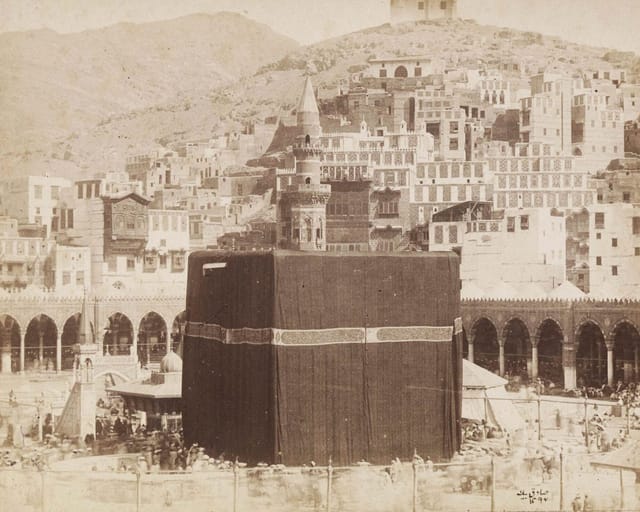
Image: Muhammad Sadiq Bey, The Kaaba, 1880. Khalili Collections (ARC.pp 211.4). Public domain, via Wikimedia Commons.. Image credits
