What are the five pillars of Islam?
Question 1205
Question
What are the five pillars of Islam, and what does each one ask of a Muslim?
Summary of answer
The Prophet ﷺ said that Islam is built on five: bearing witness that there is no god but Allah and that Muhammad is His Messenger, establishing the prayer, giving zakat, fasting in Ramadan, and pilgrimage to the House (Sahih al-Bukhari 8). Each pillar carries its own ease: prayer adapts to illness and travel, zakat falls only on savings above a threshold, fasting excuses the sick and the traveler, and Hajj is for those able to make it.
Answer
الحمد لله Praise be to Allah.
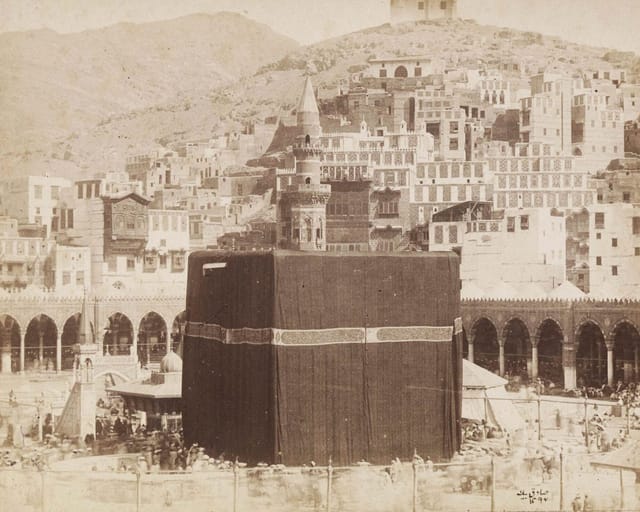
The five pillars of Islam (arkān al-Islām, أركان الإسلام) are the testimony of faith, the daily prayers, zakat, fasting in Ramadan, and the pilgrimage to Mecca. They are the practices that shape a Muslim’s day, year, and lifetime. The Prophet ﷺ described them as the foundation on which the house of Islam stands, and in each one Allah built a measure of mercy, so that every believer, healthy or ill, rich or poor, at home or on the road, can live within it.
Where do the five pillars come from?
The list comes from the Prophet ﷺ himself:
«بُنِيَ الإِسْلاَمُ عَلَى خَمْسٍ شَهَادَةِ أَنْ لاَ إِلَهَ إِلاَّ اللَّهُ وَأَنَّ مُحَمَّدًا رَسُولُ اللَّهِ، وَإِقَامِ الصَّلاَةِ، وَإِيتَاءِ الزَّكَاةِ، وَالْحَجِّ، وَصَوْمِ رَمَضَانَ»
“Islam is built on five: bearing witness that there is no god but Allah and that Muhammad is the Messenger of Allah, establishing the prayer, giving zakat, the pilgrimage, and fasting in Ramadan.”
The same five appear in the famous hadith of Jibrīl, when the angel came in human form and asked the Prophet ﷺ, “Tell me about Islam.” He answered with these pillars, adding of the pilgrimage, “if you are able to find a way there” (Sahih Muslim 8a). In the same conversation he described faith (īmān) and excellence (iḥsān); see What do Muslims believe? The six articles of faith.
1. The shahada: the testimony of faith
“I bear witness that there is no god but Allah, and I bear witness that Muhammad is the Messenger of Allah.” The shahada (شهادة) affirms the oneness of Allah (tawḥīd) and the prophethood of Muhammad ﷺ. Said once with conviction, it makes a person Muslim; there is no fee, ceremony, or witness required (How do you become Muslim?). Every other pillar is a way of living out these words.
2. Salah: the five daily prayers
Muslims pray five times a day: at dawn (Fajr), midday (Dhuhr), afternoon (Asr), sunset (Maghrib), and night (Isha). The prayer is a few minutes of standing, bowing, and prostrating before Allah, and it fits every body and situation. The Prophet ﷺ told a Companion who was in pain: “Pray standing; if you cannot, then sitting; and if you cannot, then on your side” (Sahih al-Bukhari 1117). Travelers shorten and combine, and women set the prayer aside during menstruation without making it up. The steps are in How to pray in Islam.
3. Zakat: the purifying alms
Once a year, a Muslim whose savings have stayed above a minimum, the nisab, for a full lunar year gives 2.5% of them. The Prophet ﷺ set the nisab at twenty gold dinars or two hundred silver dirhams (Sunan Abi Dawud 1573), about 85 grams of gold today. The Quran names eight groups who receive it, first among them the poor and the needy (9:60), and describes the believers as those “in whose wealth there is a known right for the one who asks and the one in need” (Quran 70:24–25). Zakat is the sharia’s standing institution of justice for the poor; see How does zakat work?
4. Sawm: fasting in Ramadan
During the month of Ramadan, Muslims fast from dawn to sunset, setting aside food, drink, and intimacy, so that they “may grow mindful of Allah” (2:183). The verse that commands the fast also excuses those for whom it would be a hardship:
وَمَن كَانَ مَرِيضًا أَوۡ عَلَىٰ سَفَرٖ فَعِدَّةٞ مِّنۡ أَيَّامٍ أُخَرَۗ يُرِيدُ ٱللَّهُ بِكُمُ ٱلۡيُسۡرَ وَلَا يُرِيدُ بِكُمُ ٱلۡعُسۡرَ
“Whoever is ill or traveling should make up the same number of other days. Allah wants ease for you, and He does not want hardship for you.”
Children, women during menstruation, and pregnant and nursing women who fear for their health are excused, and those who cannot fast at all because of age or chronic illness feed a poor person for each day. More in What is Ramadan?
5. Hajj: the pilgrimage to Mecca
Once in a lifetime, a Muslim who is able travels to Mecca in the month of Dhū al-Ḥijja to perform the rites of Hajj, following the footsteps of Abraham, Hagar, and Ishmael (peace be upon them). The Quran makes the duty conditional from the start:
وَلِلَّهِ عَلَى ٱلنَّاسِ حِجُّ ٱلۡبَيۡتِ مَنِ ٱسۡتَطَاعَ إِلَيۡهِ سَبِيلٗا
“Pilgrimage to the House is a duty owed to Allah by people, for whoever is able to find a way there.”
Ability means health, the money for the trip after one’s family is provided for, and a safe route. Whoever lacks these has no Hajj duty. See What is Hajj?
Do Shia Muslims have five pillars?
Shia Muslims keep the same practices and frame them differently. Twelver Shia theology speaks of five principles of belief (uṣūl al-dīn): the oneness of Allah, His justice, prophethood, the Imamate, and the Resurrection, alongside ten practices (furūʿ al-dīn) that include prayer, fasting, zakat, khums, and Hajj. Ismaili Muslims speak of seven pillars. The differences are of arrangement; the prayers, the fast, the alms, and the pilgrimage are shared by all.
A closing word
The pillars hold up a house, and a house is for living in. Allah asks of each person what that person can carry:
لَا يُكَلِّفُ ٱللَّهُ نَفۡسًا إِلَّا وُسۡعَهَا
“Allah does not burden a soul beyond its capacity.”
Build slowly, pillar by pillar, and let each one bring you a little closer to the One you are building for.
And Allah knows best. والله أعلم
Frequently asked questions
What is the most important pillar of Islam?
The shahada comes first, because the other pillars rest on it: it is the heart's turning to the One God. Among the practices, the daily prayer is the one the Prophet ﷺ placed at the center of a Muslim's life.
Is a Muslim who does not keep all five pillars still a Muslim?
Yes. A person enters Islam through the shahada, and a Muslim who struggles with prayer or fasting remains a Muslim, invited to grow step by step. Calling another Muslim an unbeliever is a grave matter the Prophet ﷺ warned against.
Do converts have to do all five pillars at once?
No. The Companions learned the practices gradually, and new Muslims are encouraged to begin with the shahada and the prayer, and to take on the rest with patience and joy.
Is the shahada a pillar for Shia Muslims?
Twelver Shia Muslims frame the religion as five principles of belief and ten practices, and the testimony of faith is the doorway to both. Ismaili Muslims speak of seven pillars, beginning with walāya, loyalty to Allah, the prophets, and the Imams.
Related questions
Sources
Image: Muhammad Sadiq Bey, The Kaaba, 1880. Khalili Collections (ARC.pp 211.4). Public domain, via Wikimedia Commons.. Image credits
