Can you combine prayers?
Question 1104
Question
Is it permissible to combine two prayers, such as Dhuhr and Asr or Maghrib and Isha, because of travel, work, illness, or other needs?
Summary of answer
Combining prayers is permitted. Ibn ʿAbbas reported that the Prophet ﷺ prayed Dhuhr with Asr and Maghrib with Isha in Medina with no fear, rain, or travel, so as not to burden his community (Sahih Muslim 705). Most schools allow combining when traveling and in rain or illness, a line of jurists allowed it for any real need at home, and Shia Muslims combine routinely. Fajr is never combined.
Answer
الحمد لله Praise be to Allah.
A nurse on a twelve-hour shift, a student sitting a long exam, a traveler on a delayed flight, a mother with a feverish child: many Muslims find that a prayer time arrives when they cannot stop. You can combine prayers. The Sunnah allows joining Dhuhr with Asr and Maghrib with Isha, praying the pair together in the time of the first or of the second. All the schools allow it in some circumstances, and the Prophet ﷺ himself did it at home in Medina so that his community would not be burdened.
What does the Quran say about prayer times?
The Quran tells the believers that prayer is “prescribed at set times”:
إِنَّ ٱلصَّلَوٰةَ كَانَتۡ عَلَى ٱلۡمُؤۡمِنِينَ كِتَٰبٗا مَّوۡقُوتٗا
“Prayer is a duty prescribed for the believers at set times.”
Another verse describes those times in three spans: from the sun’s decline to the dark of night, and the recitation at dawn.
أَقِمِ ٱلصَّلَوٰةَ لِدُلُوكِ ٱلشَّمۡسِ إِلَىٰ غَسَقِ ٱلَّيۡلِ وَقُرۡءَانَ ٱلۡفَجۡرِۖ إِنَّ قُرۡءَانَ ٱلۡفَجۡرِ كَانَ مَشۡهُودٗا
“Establish the prayer from the decline of the sun until the darkness of the night, and the recitation at dawn. The recitation at dawn is ever witnessed.”
Many commentators read this verse as pointing to the shared span of Dhuhr and Asr, the shared span of Maghrib and Isha, and the separate dawn prayer, which is why combining always joins those pairs and never touches Fajr.
Did the Prophet combine prayers at home?
The clearest evidence comes from Ibn ʿAbbas (may Allah be pleased with him):
«جَمَعَ رَسُولُ اللَّهِ صلى الله عليه وسلم بَيْنَ الظُّهْرِ وَالْعَصْرِ وَالْمَغْرِبِ وَالْعِشَاءِ بِالْمَدِينَةِ فِي غَيْرِ خَوْفٍ وَلاَ مَطَرٍ … كَىْ لاَ يُحْرِجَ أُمَّتَهُ»
“The Messenger of Allah ﷺ combined Dhuhr with Asr and Maghrib with Isha in Medina, when there was no fear and no rain… so that his community would not be put in hardship.”
Other narrations of the same report say “without fear or travel” (Sahih Muslim 705b), and al-Bukhari records that the Prophet ﷺ prayed eight units together and seven together in Medina (Sahih al-Bukhari 543).
When can you combine prayers?
The scholars differed (ikhtalafa al-ʿulamāʾ) on the occasions for combining.
Travel
The Maliki, Shafiʿi, and Hanbali schools allow a traveler to combine, and the Prophet ﷺ combined on the expedition to Tabuk, again “so as not to burden his community” (Sahih Muslim 705c). Travelers may also shorten the four-unit prayers; see How do you pray while traveling?
Rain and illness
The Maliki, Shafiʿi, and Hanbali schools allow combining Maghrib and Isha at the mosque on a night of heavy rain, so that worshipers need not walk home and back in the dark. Malikis and Hanbalis allow the sick to combine, and Imam al-Nawawi favored this view as well.
A real need at home
A line of jurists took the report of Ibn ʿAbbas at its word. Ibn Hajar (d. 1449), in his commentary on al-Bukhari, names among those who allowed combining at home for a need Ibn Sirin, Rabiʿa, the Maliki jurist Ashhab, Ibn al-Mundhir, and the Shafiʿi al-Qaffal al-Kabir. Al-Nawawi reports that Ibn Sirin allowed it for a need so long as it did not become a habit. Ibn Taymiyya and later Hanbali jurists allowed combining for workers such as bakers and cooks, who would otherwise see their own or others’ goods spoiled. In 2019 Egypt’s Dar al-Ifta applied these views to a baker who could not leave his ovens, and ruled that he may combine.
This is the view that best fits the Prophet’s own stated reason. Surgeons, nurses, factory workers, students in exams, caregivers, and people living through very long summer days in northern countries all meet the hardship he lifted.
Long summer nights
In Britain, Scandinavia, and Canada, Isha can fall close to midnight in high summer, with Fajr only a few hours later. Staying awake for Isha and rising again for Fajr, night after night, while working or studying, is the kind of hardship the Prophet ﷺ spared his community. Many Muslims in these lands pray Isha together with Maghrib through the summer months, and this is a sound use of the permission.
The Hanafi and Shia positions
The Hanafi school allows true combining only at ʿArafa and Muzdalifa during Hajj. Elsewhere Hanafis use “formal combining” (jamʿ ṣūrī): Dhuhr at the end of its time and Asr at the start of its own, so the two are prayed back to back, which is how the narrator Abu al-Shaʿthaʾ understood the Medina report (Sahih Muslim 705e).
Jaʿfari (Shia) jurists permit combining at any time, need or no need, and most Shia Muslims pray three times a day as a matter of course. More on the two traditions in What is the difference between Sunni and Shia Islam?
How do you combine two prayers?
- Choose early or late. In early combining (jamʿ al-taqdīm) you pray both in the time of the first; in late combining (jamʿ al-taʾkhīr) you pray both in the time of the second.
- Pray the first prayer in full, then the second straight after it, with only a short pause between them.
- Keep the order: Dhuhr before Asr, Maghrib before Isha.
At home the prayers keep their full length. The steps of each prayer are in How to pray in Islam.
A closing word
Combining is a gift for days that are too full, and it keeps you praying when you might otherwise miss a prayer altogether (What if I miss prayers or struggle to pray?). The Lord who set the times also said:
وَمَا جَعَلَ عَلَيۡكُمۡ فِي ٱلدِّينِ مِنۡ حَرَجٖ
“He has placed no hardship on you in religion.”
Take the ease He gives, and let the prayers you join be prayed with a present heart.
And Allah knows best. والله أعلم
Frequently asked questions
Can you combine Asr and Maghrib?
No. Combining joins Dhuhr with Asr and Maghrib with Isha only. Fajr is always prayed on its own, and Asr is not joined to Maghrib.
Can I combine prayers because of work?
Yes, when your work makes praying on time a real hardship, as with surgeons, nurses on long shifts, or workers who cannot leave a production line. Hanbali jurists allowed this for bakers and cooks, and Egypt's Dar al-Ifta confirmed it in 2019.
What is the Hanafi view on combining prayers?
The Hanafi school allows true combining only at ʿArafa and Muzdalifa during Hajj. Elsewhere Hanafis pray the first prayer at the end of its time and the second at the start of its own, so the two are prayed back to back.
Do I have to shorten the prayers when I combine?
No. Shortening the four-unit prayers to two is for travel. At home you combine the prayers in full.
Related questions
Sources
- Sahih Muslim 705a–705e; Sahih al-Bukhari 543
- Ibn Hajar al-ʿAsqalani, Fatḥ al-Bārī, on Sahih al-Bukhari 543
- al-Nawawi, al-Majmūʿ Sharḥ al-Muhadhdhab
- Dar al-Ifta al-Misriyyah, Fatwa 7904: Combining prayers while resident when needed (2019)
- Al-Islam.org, Why do Shia combine prayers?
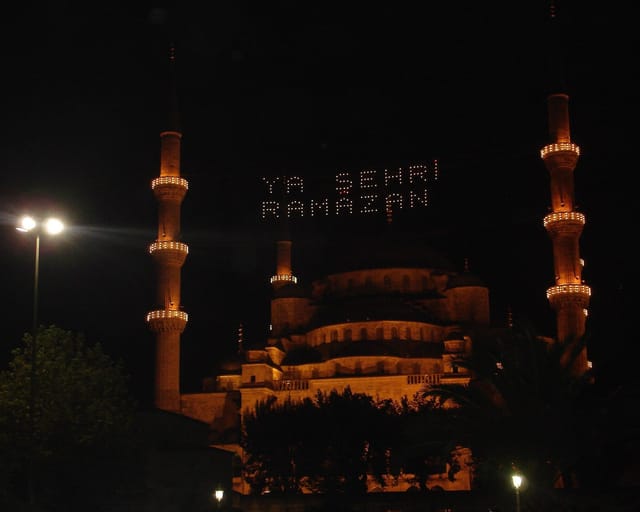
Image: Cem Topçu, Ramadan mahya lights at the Sultan Ahmed Mosque, Istanbul, 2006. CC BY 2.5, via Wikimedia Commons.. Image credits
