How do you pray while traveling?
Question 1202
Question
How should a Muslim pray when traveling, including shortening and combining prayers and praying on a plane, train, or in a car?
Summary of answer
A traveler shortens the four-unit prayers of Dhuhr, Asr, and Isha to two units, a concession the Prophet ﷺ called a charity from Allah to be accepted (Sahih Muslim 686a), and may combine Dhuhr with Asr and Maghrib with Isha. Fajr and Maghrib keep their length. On a plane, train, or bus, pray standing if you can and seated if you cannot, facing the qibla as best you are able.
Answer
الحمد لله Praise be to Allah.
Airports, highways, train platforms: prayer times arrive wherever a Muslim happens to be. The sharia makes praying while traveling light. A traveler shortens the four-unit prayers to two, may join two prayers together, and prays standing, sitting, or however the seat and the space allow. The Prophet ﷺ called this concession a charity from Allah, given to be accepted.
What does the Quran say about praying while traveling?
وَإِذَا ضَرَبۡتُمۡ فِي ٱلۡأَرۡضِ فَلَيۡسَ عَلَيۡكُمۡ جُنَاحٌ أَن تَقۡصُرُواْ مِنَ ٱلصَّلَوٰةِ إِنۡ خِفۡتُمۡ أَن يَفۡتِنَكُمُ ٱلَّذِينَ كَفَرُوٓاْ
“When you travel in the land, there is no blame on you for shortening the prayer, if you fear that the disbelievers may harm you.”
The verse came down in a time of danger, and the Companions noticed it. Yaʿlā ibn Umayya said to ʿUmar (may Allah be pleased with him) that people were now safe, so why still shorten? ʿUmar replied that he had wondered the same thing and had asked the Prophet ﷺ, who said:
«صَدَقَةٌ تَصَدَّقَ اللَّهُ بِهَا عَلَيْكُمْ فَاقْبَلُوا صَدَقَتَهُ»
“It is a charity Allah has given you, so accept His charity.”
Aisha added that the prayer was first prescribed as two units; the traveler’s prayer stayed that way, and the resident’s was lengthened (Sahih al-Bukhari 1090). The traveler’s two units are the prayer in its original form.
How do you shorten the prayer (qaṣr)?
Shortening (qaṣr, قصر) applies to the three four-unit prayers:
- Dhuhr, Asr, and Isha: two units each, prayed like Fajr (How to pray in Islam).
- Fajr: two units, as always.
- Maghrib: three units, as always.
The Hanafi school and Jaʿfari (Shia) fiqh make shortening the traveler’s duty. The Shafiʿi and Hanbali schools treat it as a concession that is better taken. All agree on the Prophet’s ﷺ own habit: he shortened on his travels.
If you pray behind an imam who is a resident, pray the full four units with him. ʿAbdullāh ibn ʿUmar shortened throughout a stay in Mecca, “except when he prayed with the imam, and then he prayed as the imam prayed” (Muwaṭṭaʾ Malik 344).
How far do you have to travel to shorten?
The jurists differed. Mālik reports that Ibn ʿAbbās shortened for trips like those from Mecca to Ṭāʾif, to ʿUsfān, or to Jeddah, and Mālik said this distance, four burud, was the one he preferred (Muwaṭṭaʾ Malik 342). Most jurists follow a measure of this kind, usually given today as about 80 kilometers (50 miles). Others held that no fixed distance exists, and that any trip people would call travel counts.
Mālik added that a traveler begins shortening once he has left the houses of his town, and prays in full again when he reaches them on return. A traveler is also excused from the Friday prayer and prays Dhuhr in its place (Is it a sin to miss Jummah?).
How long can you shorten when staying somewhere?
The Prophet ﷺ stayed nineteen days in one place, shortening the whole time, and Ibn ʿAbbās took that as his own limit (Sahih al-Bukhari 1080). Saʿīd ibn al-Musayyib held that a traveler who intends to stay four nights prays in full, and Mālik preferred this view (Muwaṭṭaʾ Malik 345). The Hanafi school sets the line at an intended stay of fifteen days.
Someone who does not know when he will leave, waiting on a visa, a repair, or a sick relative, keeps shortening until he settles. A student or worker who has moved to a city for months or years prays in full there.
Can you combine prayers while traveling?
Yes. The Prophet ﷺ joined Maghrib and Isha when he was pressing on with a trip (Sahih al-Bukhari 1106), and when he set out before midday he delayed Dhuhr and prayed it together with Asr (Sahih al-Bukhari 1111). A traveler may pray both in the time of the first or of the second, and shortens them too: two units of Dhuhr followed by two of Asr, or three of Maghrib followed by two of Isha. The schools’ views, including the Hanafi position, are set out in Can you combine prayers?
How do you pray on a plane, train, or in a car?
The rule for every situation is the one the Prophet ﷺ gave Imrān ibn Ḥuṣayn: “Pray standing; if you cannot, then sitting; and if you cannot, then on your side” (Sahih al-Bukhari 1117).
- On a plane or train, pray standing in an open space if the crew allows it. Otherwise pray in your seat, bowing by leaning forward and prostrating by leaning a little further.
- The qibla: estimate it with the flight map or a phone compass and face it at the start if you can. For voluntary prayers the Prophet ﷺ prayed on his mount in whatever direction it was heading (Sahih al-Bukhari 1094), and for every prayer the Quran’s promise holds:
وَلِلَّهِ ٱلۡمَشۡرِقُ وَٱلۡمَغۡرِبُۚ فَأَيۡنَمَا تُوَلُّواْ فَثَمَّ وَجۡهُ ٱللَّهِ
“To Allah belong the east and the west: wherever you turn, there is the face of Allah.”
- By car, stop at a rest area and pray beside the car, or combine the prayers so that one stop covers two. Clean shoes may stay on (Can you pray with shoes on?).
- Wudu on the road: wipe over socks, and use tayammum with clean earth when water is not available (How to make wudu).
A closing word
The verse that excuses the traveler from fasting in Ramadan states the principle behind every concession for the road:
يُرِيدُ ٱللَّهُ بِكُمُ ٱلۡيُسۡرَ وَلَا يُرِيدُ بِكُمُ ٱلۡعُسۡرَ
“Allah wants ease for you, and He does not want hardship for you.”
Accept His charity, pray your two units with a present heart, and let your travels be full of remembrance of Him.
And Allah knows best. والله أعلم
Frequently asked questions
Do I have to shorten my prayers when traveling?
The Hanafi school and Jaʿfari fiqh make shortening the traveler's duty, and the other schools treat it as a concession that is better taken. Following the Prophet's ﷺ own practice, shorten whenever you travel.
Can I pray sitting on a plane?
Yes, if you cannot stand. Pray standing in the galley or an open space when the crew allows it; otherwise pray in your seat, bowing and prostrating by leaning forward, with the prostration lower than the bow.
What if I do not know which way the qibla is on a plane?
Use the flight map or a phone compass to estimate the direction, face it at the start if you can, and then pray. If you cannot work it out, pray toward your best guess: wherever you turn, there is the face of Allah (2:115).
Do travelers have to pray Jummah?
No. A traveler has no Friday prayer duty and prays Dhuhr, shortened to two units. If you attend Jumuʿa while traveling, it counts in place of Dhuhr.
Related questions
Sources
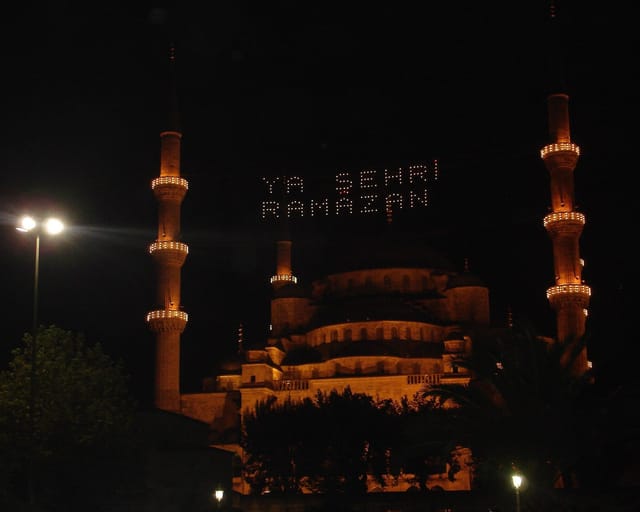
Image: Cem Topçu, Ramadan mahya lights at the Sultan Ahmed Mosque, Istanbul, 2006. CC BY 2.5, via Wikimedia Commons.. Image credits
