Can Muslim women travel alone?
Question 1064
Question
Is a Muslim woman allowed to travel without a mahram, for study, work, Hajj, or leisure?
Summary of answer
A Muslim woman may travel alone when the way is safe. The hadith requiring a mahram on long trips served her protection, and its distance changes from one narration to the next. The Prophet ﷺ foretold, as a sign of good times, a woman riding from Iraq to Mecca fearing no one but Allah. Malik, al-Shafiʿi, and Ibn Taymiyya let women travel for Hajj without a mahram, and Saudi Arabia itself now does.
Answer
الحمد لله Praise be to Allah.
A Muslim woman may travel alone when the way is safe. She may travel to study, to work, to visit family, to see the world, and to perform Hajj and Umrah. The hadith that asks a woman to travel with a mahram, a close male relative, was given for her protection on dangerous roads. The Prophet ﷺ himself described the day when a woman would ride across Arabia afraid of no one but Allah, and he counted it among the blessings to come. Where safety is secured, the rule’s purpose is met.
What does the Quran say about travel?
The Quran invites every believer to travel and learn:
قُلۡ سِيرُواْ فِي ٱلۡأَرۡضِ فَٱنظُرُواْ كَيۡفَ بَدَأَ ٱلۡخَلۡقَ
“Say: Travel through the earth and see how He began creation.”
هُوَ ٱلَّذِي جَعَلَ لَكُمُ ٱلۡأَرۡضَ ذَلُولٗا فَٱمۡشُواْ فِي مَنَاكِبِهَا وَكُلُواْ مِن رِّزۡقِهِۦ
“It is He who made the earth easy for you to travel, so walk through its regions and eat of His provision.”
These commands are addressed to all believers. Women were among the earliest Muslim travelers: they emigrated to Abyssinia and to Medina, and Umm Salama was among the first women to reach Medina as an emigrant.
What does the mahram hadith say?
The Prophet ﷺ said: “It is not lawful for a woman who believes in Allah and the Last Day to travel a day and a night’s distance without a mahram” (Sahih al-Bukhari 1088). The distance changes from one narration to the next. Another narration says two days (Sahih al-Bukhari 1197), another three days (Sahih al-Bukhari 1086), and another names no distance at all (Sahih al-Bukhari 1862). In that last report a man said his wife was setting out for Hajj while he was enlisted for a campaign, and the Prophet ﷺ told him to go with her.
The different distances suggest a rule shaped by circumstances. In seventh-century Arabia a woman crossing the desert faced robbers, slavers, and tribes at war. A male relative was her protection, and the hadith secured it for her.
Did the Prophet ﷺ foresee women traveling without fear?
He did, and he described it as a sign of the good that Islam would bring. A man complained to him of highway robbery, and the Prophet ﷺ turned to ʿAdī ibn Ḥātim, a chief of the tribe of Ṭayyiʾ, whose raiders were feared on that very road:
«فَإِنْ طَالَتْ بِكَ حَيَاةٌ لَتَرَيَنَّ الظَّعِينَةَ تَرْتَحِلُ مِنَ الْحِيرَةِ، حَتَّى تَطُوفَ بِالْكَعْبَةِ، لاَ تَخَافُ أَحَدًا إِلاَّ اللَّهَ»
“If you live long, you will see a woman riding in her litter from al-Ḥīra until she circles the Kaʿba, fearing no one but Allah.”
Al-Ḥīra lay in southern Iraq, many weeks’ travel from Mecca. ʿAdī later said, “I saw the woman riding from al-Ḥīra until she circled the Kaʿba, fearing no one but Allah.” The Prophet ﷺ named a woman crossing the desert unafraid as a mark of safety and justice, and he praised it.
What did the classical scholars say?
The scholars differed (ikhtalafa al-ʿulamāʾ), and many of the greatest among them allowed women to travel without a mahram once their safety was assured. The clearest case is Hajj. After the death of the Prophet ﷺ, ʿUmar sent the Mothers of the Believers on Hajj escorted by ʿUthmān ibn ʿAffān and ʿAbd al-Raḥmān ibn ʿAwf, neither of whom was related to them (Sahih al-Bukhari 1860).
- Malik allowed a woman to travel for the obligatory Hajj with a group of women.
- Al-Shafiʿi allowed it with a single trustworthy Muslim woman, and some Shafiʿi jurists, as Ibn Hajar and al-Nawawi record, allowed a woman to travel alone when the road was safe.
- Al-Awzāʿī allowed travel with a company of trustworthy people.
- Ibn Taymiyya (d. 1328) held that “every woman who is safe may perform Hajj without a mahram,” and he extended this to all travel undertaken in obedience to Allah, as Ibn Mufliḥ reports in al-Furūʿ.
- Ibn Hazm held that a woman who has neither husband nor mahram to travel with goes on Hajj all the same.
The classical Hanafi school was stricter, requiring a mahram for travel of three days or more. The stronger view (al-rājiḥ) follows the rule’s purpose: where travel is safe, a woman may travel alone.
What has changed today?
Travel today means trains, planes, hotels, phones, and laws that protect travelers. A woman flying to a conference is never alone in a desert. Muslim states have recognized this. Since August 2019, Saudi Arabia has allowed women over 21 to obtain passports and travel without a guardian’s permission, and since 2021 it has accepted Hajj registrations from women without a mahram.
Women today travel to study medicine, to work, to care for parents, and to perform Hajj. Their freedom to move is part of their freedom to work and to learn, and it follows from the Quran’s view of women as full moral persons (What does the Quran say about women?).
How can a woman travel safely and well?
- Plan for safety. Share your plans and location with family or friends, choose reputable transport and accommodation, and keep emergency numbers at hand.
- Use the concessions of travel. A traveler may shorten and combine her prayers (How to pray while traveling; Can you combine prayers?).
- Travel with company when you wish. Friends, colleagues, and Hajj groups are a blessing.
- Say the duʿāʾ of travel and place your trust in Allah.
The Prophet ﷺ used to begin his travel with a prayer that calls Allah “the Companion on the road and the One who looks after the family left behind” (Sahih Muslim 1342). May Allah be the Companion of every woman who sets out, protect her on the road, and return her safely to those who love her.
And Allah knows best. والله أعلم
Frequently asked questions
Can a woman go on Hajj or Umrah without a mahram?
Yes. Malik allowed a woman to travel for Hajj with a group of women, al-Shafiʿi with a trustworthy woman companion, and Ibn Taymiyya with no mahram whenever she is safe. Saudi Arabia has accepted Hajj registrations from women without a mahram since 2021.
Can a Muslim woman travel alone to study or work abroad?
Yes. Seeking knowledge and earning a living are honored in Islam, and the reason behind the mahram rule, her safety, can be met today by safe transport, trusted accommodation, and constant contact with family.
What does the Hanafi school say about women traveling?
Classical Hanafi jurists required a husband or mahram for travel of three days or more. The rule served safety on the roads of their time, and its purpose is fulfilled by the protections available to travelers now.
What is a mahram?
A mahram is a man a woman can never marry, such as her father, son, brother, uncle, or nephew; her husband is counted with them for travel. In the classical rule he accompanied her for protection.
Related questions
Sources
- Sahih al-Bukhari 3595 (ʿAdī ibn Ḥātim), 1088, 1197, 1086, 1862, 1860
- Ibn Mufliḥ, al-Furūʿ (on women's travel for Hajj, citing Ibn Taymiyya)
- Ibn Hajar al-ʿAsqalani, Fatḥ al-Bārī
- al-Nawawi, Sharḥ Ṣaḥīḥ Muslim
- Arab News, Saudi Arabia implements end to travel restrictions for Saudi women (20 August 2019)
- Arab News, Women can register for Hajj without male guardian (June 2021)
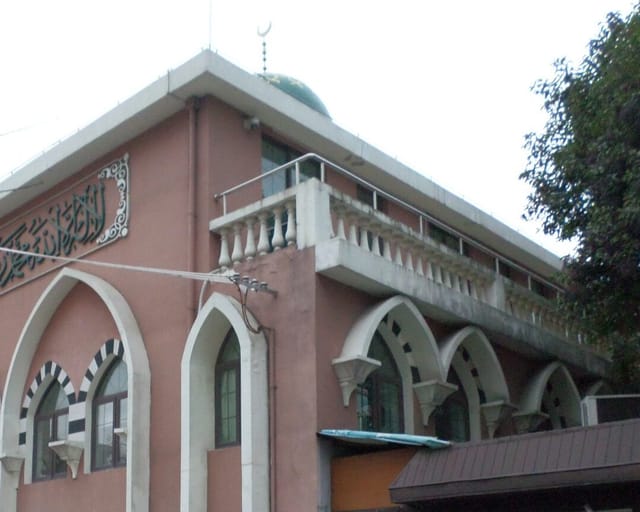
Image: Chongkian, Xiaotaoyuan Women's Mosque, Shanghai, 2015. CC BY-SA 4.0, via Wikimedia Commons.. Image credits
