Is hell eternal in Islam?
Question 1032
Question
Does the punishment of hell last forever in Islam, or will the fire one day come to an end?
Summary of answer
The stronger view is that hell is remedial and will come to an end. The Quran ties the fire's duration to Allah's will (11:107, 6:128) and speaks of the wrongdoers remaining there for long ages (78:23). Ibn Taymiyya and Ibn al-Qayyim argued that the fire will pass away, Ibn ʿArabi taught that its punishment turns to sweetness, and the Prophet ﷺ said that Allah holds back ninety-nine parts of His mercy for the Last Day.
Answer
الحمد لله Praise be to Allah.
Few questions weigh on the heart like this one. Is hell eternal in Islam? The answer that best fits the Quran and the mercy of Allah is that the fire is real and serious, and that it is not everlasting torment. The Quran ties its duration to Allah’s will, the Prophet ﷺ described Allah drawing people out of it by the handful, and some of the greatest scholars of the tradition argued that the fire itself will one day pass away.
What does the Quran say about how long hell lasts?
The Quran describes the people of the fire as abiding there (khālidīn, خالدين), and then, in two places, it adds a striking exception. Sūrat Hūd says:
خَٰلِدِينَ فِيهَا مَا دَامَتِ ٱلسَّمَٰوَٰتُ وَٱلۡأَرۡضُ إِلَّا مَا شَآءَ رَبُّكَۚ إِنَّ رَبَّكَ فَعَّالٞ لِّمَا يُرِيدُ
“They will remain there as long as the heavens and the earth endure, except as your Lord wills. Your Lord does whatever He wills.”
The same exception, “except as Allah wills,” closes the verse about the fire in Sūrat al-Anʿām (Quran 6:128). Readers have long noticed a difference within Sūrat Hūd itself. The verse about Paradise that follows also contains the exception, and then ends “a gift that will never be cut off” (11:108). The verse about the fire ends instead with Allah’s freedom to do as He wills.
Sūrat al-Nabaʾ describes the wrongdoers in the fire with a word of measured time:
لَّـٰبِثِينَ فِيهَآ أَحۡقَابٗا
“They will remain in it for long ages.”
An aḥqāb (أحقاب) is a span of ages: very long, and countable.
Did any classical scholars say hell will end?
Yes, and they include names that strict modern movements claim as their own. A saying attributed to the caliph ʿUmar ibn al-Khaṭṭāb (may Allah be pleased with him), preserved in an early Quran commentary, holds that even if the people of the fire stayed in it as long as the grains of sand in the desert of ʿĀlij, they would still have a day on which they come out.
Ibn Taymiyya (d. 1328) devoted a treatise, al-Radd ʿalā man qāla bi-fanāʾ al-janna wa-l-nār, to the question. He defended the eternity of Paradise and argued that the fire will pass away, because Allah’s mercy is overwhelming and every punishment He sends serves a wise purpose. He read the “long ages” of 78:23 as ages that end. His student Ibn al-Qayyim (d. 1350) set out the same arguments at length in Ḥādī al-Arwāḥ and again in Shifāʾ al-ʿAlīl, describing the fire as a treatment for souls, and closed by entrusting the matter to the verse “Your Lord does whatever He wills.”
Most Sunni and Shia theologians held the other view, that the fire is everlasting for those who reject faith, and many Muslims hold it today. It is a respected opinion. The view that the fire ends is the one that best fits the Quran’s exceptions and the overwhelming mercy described in the Sunnah.
What did Ibn ʿArabi say about the people of the fire?
The Andalusian master Ibn ʿArabi (d. 1240) went further still. In the Fuṣūṣ al-Ḥikam and al-Futūḥāt al-Makkiyya he observed that the Arabic word for punishment, ʿadhāb (عذاب), shares its root with ʿudhūba (عذوبة), sweetness. He taught that for those who remain in the fire, its punishment will turn into a state that suits them and becomes sweet, so that Allah’s mercy reaches even there. For Ibn ʿArabi, mercy is the first and last word of creation.
What do the hadith say about mercy on the Day of Judgment?
The Prophet ﷺ taught that the mercy we see in this world is a single share of Allah’s mercy:
«إِنَّ اللَّهَ خَلَقَ الرَّحْمَةَ يَوْمَ خَلَقَهَا مِائَةَ رَحْمَةٍ، فَأَمْسَكَ عِنْدَهُ تِسْعًا وَتِسْعِينَ رَحْمَةً، وَأَرْسَلَ فِي خَلْقِهِ كُلِّهِمْ رَحْمَةً وَاحِدَةً، فَلَوْ يَعْلَمُ الْكَافِرُ بِكُلِّ الَّذِي عِنْدَ اللَّهِ مِنَ الرَّحْمَةِ لَمْ يَيْأَسْ مِنَ الْجَنَّةِ»
“On the day Allah created mercy, He made it a hundred parts. He kept ninety-nine with Himself and sent one part among all His creatures. If the unbeliever knew all the mercy that is with Allah, he would never despair of Paradise.”
In Sahih Muslim the Prophet ﷺ adds that Allah has kept back those ninety-nine parts to show mercy to His servants on the Day of Resurrection (Sahih Muslim 2752c).
In the long hadith of intercession, after the angels, the prophets and the believers have interceded, Allah says that none remains but the Most Merciful of the merciful:
«فَيَقْبِضُ قَبْضَةً مِنَ النَّارِ فَيُخْرِجُ مِنْهَا قَوْمًا لَمْ يَعْمَلُوا خَيْرًا قَطُّ»
“Then He takes a handful from the fire and brings out of it people who never did any good at all.”
They are cast into the River of Life at the gate of Paradise, the hadith continues, and they spring up like a seed in the silt of a flood. The Prophet ﷺ also described the last man to leave the fire, who crawls out and is told to enter Paradise with ten times the world for his own. When the man asked whether Allah was laughing at him, the Prophet ﷺ himself laughed (Sahih al-Bukhari 6571).
Is hell a place of purification?
Many Muslims, classical and modern, read the fire as a picture of the soul’s purification, like gold in the smith’s furnace. The poet-philosopher Muhammad Iqbal (d. 1938), in The Reconstruction of Religious Thought in Islam, called hell “a corrective experience which may make a hardened ego once more sensitive to the living breeze of Divine Grace.”
This reading keeps the full seriousness of sin. The fire is also Allah’s justice for the wronged: the tyrant, the abuser and the thief will answer for every harm, and no victim’s tears are forgotten. Justice and mercy belong together, and Allah’s mercy is the greater (see Does Allah forgive all sins?). Believers who sin are not left in the fire forever, as explained in Will Muslims go to hell for their sins?, and the fate of people of other faiths is treated in Do non-Muslims go to hell?.
Living between fear and hope
The scholars taught that a believer walks between fear (khawf) and hope (rajāʾ), like a bird with two wings. Fear keeps us awake to the harm we do; hope keeps us turning back to the One who is waiting for us. Let the fire move you to repair what you have broken, and let the mercy of Allah, which “embraces all things” (Quran 7:156), be the last thought in your heart each night. For more on the life to come, see What happens after death in Islam?.
And Allah knows best. والله أعلم
Frequently asked questions
Do Muslims stay in hell forever?
No. The Sunni and Shia schools agree that every believer who enters the fire will leave it, and the Prophet ﷺ described the last person to come out and enter Paradise.
Did Ibn Taymiyya believe hell is not eternal?
In his treatise al-Radd ʿalā man qāla bi-fanāʾ al-janna wa-l-nār, Ibn Taymiyya set out the arguments that the fire will pass away while Paradise remains. His student Ibn al-Qayyim developed the same arguments in Ḥādī al-Arwāḥ and Shifāʾ al-ʿAlīl.
What does khālidīn (abiding) mean in the Quran?
Khulūd means a long, abiding stay. The Quran ties the khulūd of the fire to Allah's will (11:107, 6:128), and scholars who held that the fire ends read it as a very long stay that Allah brings to a close.
What is the majority view on hell?
Most Sunni and Shia theologians held that the fire is everlasting for those who reject faith. The view that it ends has a strong minority line that runs through Companions' reports, Ibn Taymiyya, Ibn al-Qayyim, Ibn ʿArabi, and modern scholars.
Related questions
Sources
- Ibn Taymiyya, al-Radd ʿalā man qāla bi-fanāʾ al-janna wa-l-nār
- Ibn Qayyim al-Jawziyya, Ḥādī al-Arwāḥ ilā Bilād al-Afrāḥ; Shifāʾ al-ʿAlīl
- Ibn ʿArabi, Fuṣūṣ al-Ḥikam; al-Futūḥāt al-Makkiyya
- Jon Hoover, "Islamic Universalism: Ibn Qayyim al-Jawziyya's Salafi Deliberations on the Duration of Hell-Fire", The Muslim World 99 (2009)
- Muhammad Iqbal, The Reconstruction of Religious Thought in Islam (1930)
- Sahih al-Bukhari 6469
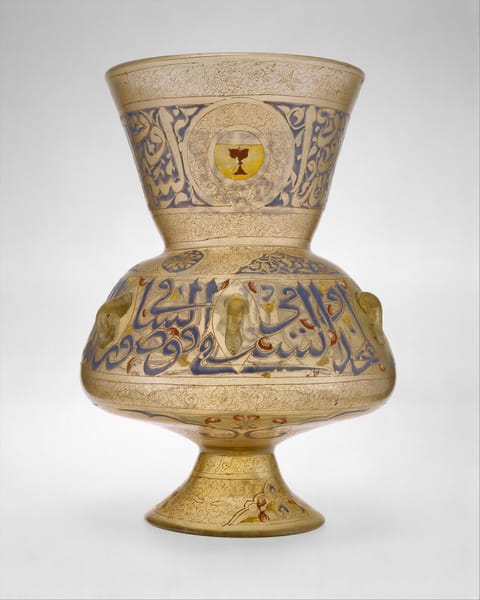
Image: ʿAli ibn Muhammad al-Barmaki, Mosque lamp of Amir Qawsun, Cairo, c. 1329–1335. Metropolitan Museum of Art, New York. CC0, via Wikimedia Commons.. Image credits
