What are jinn?
Question 1041
Question
What are jinn in Islam, can they harm people, and should Muslims be afraid of them?
Summary of answer
Jinn are beings Allah created from smokeless fire (55:15), hidden from human sight, and responsible for their choices as humans are: some of them believe and some do not (72:11). The Quran limits the power of evil ones among them to whispering (14:22). Scholars differed over possession, and rationalist readings reach back to the Muʿtazila, al-Jahiz, and Tafsīr al-Manār. A believer meets the unseen with trust in Allah.
﴿وَخَلَقَ ٱلۡجَآنَّ مِن مَّارِجٖ مِّن نَّارٖ﴾
And He created the jinn from a smokeless flame of fire.
Answer
الحمد لله Praise be to Allah.
What are jinn? In Islam, jinn are a creation of Allah, made from fire, hidden from human eyes, and gifted with free will as human beings are. Belief in them belongs to belief in the unseen (al-ghayb), which the Quran praises in its opening lines (2:3). The Quran speaks of jinn calmly and briefly, as fellow creatures who also pray, listen, choose, and answer to Allah. Nothing in the Quran asks a believer to live in fear of them.
What does the Quran say about jinn?
Sūrat al-Raḥmān sets the creation of jinn beside the creation of humankind:
خَلَقَ ٱلۡإِنسَٰنَ مِن صَلۡصَٰلٖ كَٱلۡفَخَّارِ وَخَلَقَ ٱلۡجَآنَّ مِن مَّارِجٖ مِّن نَّارٖ
“He created the human being from dry clay like pottery, and He created the jinn from a smokeless flame of fire.”
The word jinn comes from the Arabic root j-n-n, “to be hidden,” the same root as janna (a garden hidden by its trees), janīn (a child hidden in the womb), and junūn (a mind that is covered, madness). Jinn are, by name, the hidden ones. The Quran says they were created before human beings, “from the fire of a scorching wind” (15:27), and the Prophet ﷺ said that the angels were created from light, the jinn from a flame of fire, and Adam from what the Quran describes (Sahih Muslim 2996).
Iblis, who refused to bow to Adam, “was one of the jinn” (18:50). Satan is one jinn who chose rebellion. He does not represent all of them.
Do jinn have free will?
Jinn are addressed alongside humans throughout the Quran. “I created jinn and humankind only so that they would worship Me” (51:56), a verse explored in Why did Allah create us? Sūrat al-Raḥmān speaks to both with its refrain, “Which of your Lord’s favors will you two deny?” Messengers came to both (6:130).
A whole sūra is named after them. Sūrat al-Jinn tells of a group of jinn who heard the Prophet ﷺ reciting and said, “We have heard a wondrous Quran” (72:1). They describe their own community with candor:
وَأَنَّا مِنَّا ٱلصَّـٰلِحُونَ وَمِنَّا دُونَ ذَٰلِكَۖ كُنَّا طَرَآئِقَ قِدَدٗا
“Among us are the righteous and among us are others. We have followed different paths.”
In Sahih Muslim, ʿAbdullah ibn Masʿūd recounts a night when the Prophet ﷺ went out to recite the Quran to the jinn. Afterward he told his Companions not to clean themselves with bones, “for they are the food of your brothers” (Sahih Muslim 450a). Brothers: that is how the Prophet ﷺ spoke of the believing jinn.
Can jinn harm or possess people?
The Quran sets clear limits on the power of evil jinn. On the Day of Judgment, Satan himself will tell those who followed him:
وَمَا كَانَ لِيَ عَلَيۡكُم مِّن سُلۡطَٰنٍ إِلَّآ أَن دَعَوۡتُكُمۡ فَٱسۡتَجَبۡتُمۡ لِي
“I had no authority over you, except that I called you and you answered me.”
“The plotting of Satan is ever weak” (Quran 4:76), and Allah tells him, “Over My servants you have no authority” (15:42). Sūrat al-Nās describes the evil ones of jinn and humankind as whisperers (114:4–6): their work is suggestion, which a person is free to refuse.
Whether jinn can enter a human body is a question on which the scholars differed. Ibn Taymiyya (d. 1328) held that they can. In the same treatise he reports that a group of the Muʿtazila, among them Abu ʿAli al-Jubbāʾī (d. 915), denied it. The Muʿtazili commentator al-Zamakhsharī (d. 1144), explaining 2:275 in al-Kashshāf, called the idea that Satan strikes a person down in a seizure one of the Arabs’ own claims.
Whatever view a person holds, the Sharia’s rule of care comes first. The Prophet ﷺ said, “There is to be no harm and no returning harm” (Sunan Ibn Majah 2341, graded sahih by al-Albani). Seizures, voices, deep sadness, and sudden changes in behavior are matters for a doctor, and seeking treatment is itself a sunna. Any “exorcism” that beats, burns, starves, chokes, or restrains a person is haram. For more on mental illness and faith, see Is depression a lack of faith?
Are jinn real or a symbol?
Most scholars, Sunni and Shia, hold that jinn are real beings with their own existence. Alongside that view, Muslim thinkers have long been cautious about stories of jinn. The great Basran writer al-Jahiz (d. 868), discussing Bedouin tales of ghouls and jinn in his Book of Animals (Kitāb al-Ḥayawān), observed that when a person is lonely and afraid, small things take on the shape of large ones, and the mind grows suspicious and scattered.
In the modern era, Tafsīr al-Manār, the commentary begun by Muhammad Abduh (d. 1905) and completed by Rashid Rida, suggested that the word jinn, “the hidden ones,” could also cover the invisible living things discovered under the microscope, the microbes that cause disease. Rida also records that some scholars read the devils as inner forces that drive a person toward wrong. These readings show how much room the tradition gives for reflection, as discussed in How should the Quran be interpreted? The Quran tells us the essentials: jinn exist, Allah created them, they are accountable, and they have no power over a heart that turns to Allah.
How do Muslims protect themselves from jinn?
The protection the Sunnah teaches is simple and beautiful. Aisha (may Allah be pleased with her) described what the Prophet ﷺ did each night:
«جَمَعَ كَفَّيْهِ ثُمَّ نَفَثَ فِيهِمَا فَقَرَأَ فِيهِمَا {قُلْ هُوَ اللَّهُ أَحَدٌ} وَ{قُلْ أَعُوذُ بِرَبِّ الْفَلَقِ} وَ{قُلْ أَعُوذُ بِرَبِّ النَّاسِ} ثُمَّ يَمْسَحُ بِهِمَا مَا اسْتَطَاعَ مِنْ جَسَدِهِ»
“He would cup his hands, breathe into them, and recite into them Say: He is Allah, the One, and Say: I seek refuge with the Lord of the daybreak, and Say: I seek refuge with the Lord of humankind. Then he would wipe them over as much of his body as he could.”
Muslims also recite the Throne Verse (Āyat al-Kursī, 2:255) before sleep, begin their acts with Allah’s name, and keep up their prayer. None of this requires a specialist or a fee.
A closing word
The unseen world is wider than our eyes, and every part of it belongs to Allah, the One described in Who is Allah? The jinn who heard the Quran were moved by it as we are, and the ones who whisper have no hold on a heart that remembers its Lord. Sleep in peace, and say each night with the Prophet ﷺ:
قُلۡ أَعُوذُ بِرَبِّ ٱلۡفَلَقِ
“Say: I seek refuge with the Lord of the daybreak.”
And Allah knows best. والله أعلم
Frequently asked questions
Can jinn possess people?
The scholars differed. Ibn Taymiyya held that they can, and he himself reports that a group of the Muʿtazila, such as al-Jubbāʾī, denied it. The Quran describes Satan's power as calling and whispering only (14:22), and anyone suffering in mind or body should first see a doctor.
Are jinn evil?
No more than humans are. The jinn in Sūrat al-Jinn say, "Among us are the righteous and among us are others" (72:11). Iblis was one of the jinn (18:50), and many jinn believed in the Prophet ﷺ when they heard the Quran.
Can jinn see us?
The Quran says that Satan and his kind see humans from where humans do not see them (7:27). The same Quran says his plotting is weak (4:76) and that he has no authority over Allah's servants (15:42).
How do I protect myself from jinn?
The Prophet ﷺ recited Sūrat al-Ikhlāṣ, al-Falaq, and al-Nās into his cupped hands each night and wiped them over his body (Sahih al-Bukhari 5017). Remembrance of Allah, prayer, and trust in Him are protection enough.
Related questions
Sources
- Ibn Taymiyya, Īḍāḥ al-Dalāla fī ʿUmūm al-Risāla lil-Thaqalayn, in Majmūʿ al-Fatāwā, vol. 19
- al-Jahiz, Kitāb al-Ḥayawān (The Book of Animals)
- Muhammad Abduh and Rashid Rida, Tafsīr al-Manār
- al-Zamakhsharī, al-Kashshāf (on 2:275)
- Sahih Muslim 450a (the night of the jinn)
- Sahih Muslim 2996 (angels from light, jinn from fire)
- Sahih al-Bukhari 5017 (the three protecting sūras)
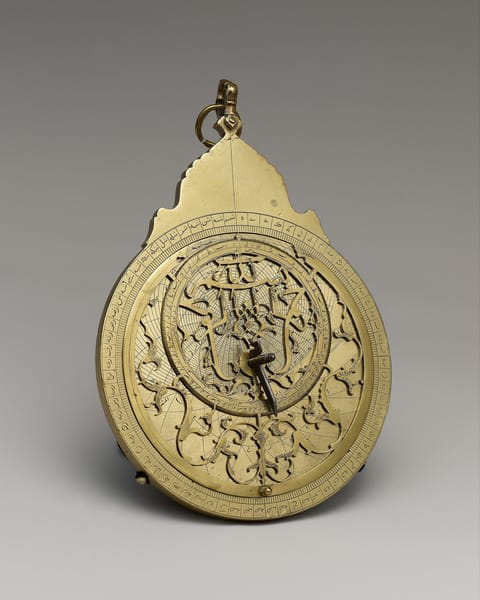
Image: Muhammad Zaman al-Munajjim al-Asturlabi, Planispheric astrolabe, Mashhad, 1654–1655. Metropolitan Museum of Art, New York. CC0, via Wikimedia Commons.. Image credits
