Will Muslims who sin go to hell?
Question 1119
Question
Will a Muslim who commits sins, even major ones, go to hell, and could they stay there forever?
Summary of answer
A Muslim's sins lie within Allah's mercy. Allah forgives every sin for whoever turns to Him (39:53), and everything less than shirk is open to His forgiveness even before repentance (4:48). The Prophet ﷺ said that whoever dies affirming that there is no god but Allah will enter Paradise, even if he committed adultery and theft (Bukhari 5827), and that his intercession is for the people of major sins. Sunni and Shia creeds agree that no believer remains in the fire.
Answer
الحمد لله Praise be to Allah.
Every Muslim who takes faith seriously has lain awake over this question: will my sins send me to hell? The Quran and the Sunnah answer with hope. A Muslim’s sins lie within Allah’s mercy. He forgives every sin for whoever turns back to Him, and everything less than shirk remains open to His forgiveness even for a servant who dies before repenting. The Prophet ﷺ promised Paradise to whoever dies affirming Allah’s oneness, and the scholars of Sunni and Shia Islam agree that no believer will remain in the fire.
Will a Muslim who sins go to hell?
The Companion Abu Dharr (may Allah be pleased with him) once heard the Prophet ﷺ promise Paradise to everyone who dies affirming that there is no god but Allah. He could hardly believe it, and asked three times whether it held even for someone who had committed adultery and theft. Each time the answer came back the same:
«وَإِنْ زَنَى وَإِنْ سَرَقَ عَلَى رَغْمِ أَنْفِ أَبِي ذَرٍّ»
“Even if he committed adultery and even if he stole, though Abu Dharr dislike it.”
Whenever Abu Dharr told this hadith afterwards, he repeated those last words against himself. The Quran draws the same line:
إِنَّ ٱللَّهَ لَا يَغۡفِرُ أَن يُشۡرَكَ بِهِۦ وَيَغۡفِرُ مَا دُونَ ذَٰلِكَ لِمَن يَشَآءُ
“Allah does not forgive that partners be set up beside Him, and He forgives anything less than that to whomever He wills.”
Every sin a believer commits lies under that second clause. And for anyone who turns back, the door is wider still: “Allah forgives all sins” (Quran 39:53), as explained in Does Allah forgive all sins?
What did the classical scholars teach about major sins?
The question divided the early community. The Kharijites held that a Muslim who commits a major sin becomes an unbeliever destined for the fire forever. The Muʿtazilites placed such a person in a “station between the two stations,” neither believer nor unbeliever, and also held that the unrepentant would stay in the fire forever.
The great body of the scholars rejected both views. The early creed known as al-Fiqh al-Akbar, attributed to Abu Hanifa (d. 767), states that no one is declared an unbeliever on account of a sin, and no one’s faith is denied because of it. Imam al-Ṭaḥāwī (d. 933), whose creed is still taught in Sunni seminaries, wrote that the people of major sins from the community of Muhammad ﷺ will not remain in the fire forever if they die affirming Allah’s oneness. They are under His will: if He wills, He forgives them by His grace, and if He wills, He punishes them by His justice and then brings them out by His mercy and the intercession of the intercessors. Shia theology reaches the same conclusion.
Can good deeds outweigh bad deeds?
The Quran answers in one line: “Good deeds wipe away bad deeds” (Quran 11:114). The Prophet ﷺ gave that line a picture. On the Day of Judgment, he said, Allah will call a man from his community before all creation and unroll ninety-nine scrolls of his sins, each stretching as far as the eye can see. Then a single card is brought out, bearing the words “I bear witness that there is no god but Allah, and that Muhammad is His servant and messenger.” The man asks what one card can do against all those scrolls, and he is told that he will not be wronged:
«فَطَاشَتِ السِّجِلاَّتُ وَثَقُلَتِ الْبِطَاقَةُ فَلاَ يَثْقُلُ مَعَ اسْمِ اللَّهِ شَيْءٌ»
“The scrolls flew up and the card weighed heavy, for nothing weighs heavy beside the name of Allah.”
Jamiʿ al-Tirmidhi 2639, graded sahih by al-Albani
Small mercies count for a great deal on that scale. The Prophet ﷺ told of a prostitute from the Children of Israel who saw a dog dying of thirst beside a well, drew water for it in her shoe, and was forgiven for it (Sahih al-Bukhari 3467).
What is the intercession of the Prophet ﷺ?
The Prophet ﷺ said: “My intercession is for the people of major sins in my community” (Sunan Abi Dawud 4739, graded sahih by al-Albani). In the long hadith of intercession, he describes falling in prostration before his Lord on the Day of Judgment and pleading, “My community, my community!” He is sent again and again to bring people out of the fire, first those with a grain of faith in their hearts, then those with less, and at last Allah declares that He Himself will bring out everyone who said there is no god but Allah (Sahih al-Bukhari 7510).
For any believer who does pass through the fire, the hadith describe it as a cleansing that ends at the gate of Paradise. The same mercy reaches further than the community of Muhammad ﷺ, as set out in Is hell eternal in Islam? and Do non-Muslims go to hell?
Should a Muslim live in fear of hell?
The scholars taught that a believer flies to Allah on two wings, fear (khawf) and hope (rajāʾ). Fear keeps the conscience awake to the harm we do; hope keeps us returning to the One who waits for us. When the scale tips into despair, the Prophet ﷺ offered this to set it right. Seeing a mother among the captives clasp a lost child to her breast, he asked his Companions whether she would ever throw her child into a fire. They said no. He said: “Allah is more merciful to His servants than this woman is to her child” (Sahih al-Bukhari 5999).
He also taught that no one is saved by their deeds alone, “not even I, unless Allah wraps me in His mercy,” and in the same breath he told his Companions to aim for what is right, come as near to it as they can, and keep to a steady middle course (Sahih al-Bukhari 6463). Growth, step by step, is what Allah asks. Pray what you can and build from there (Is it haram to miss prayers?), repent of what weighs on you (Can zina be forgiven?), and repair what you owe to others before the Day when every account is settled (What happens on the Day of Judgment?).
A closing duʿāʾ
Allah says in a hadith qudsi, “I am as My servant thinks of Me” (Sahih al-Bukhari 7405). Think well of Him, and pray with the people of understanding in Sūrat Āl ʿImrān:
رَبَّنَا فَٱغۡفِرۡ لَنَا ذُنُوبَنَا وَكَفِّرۡ عَنَّا سَيِّـَٔاتِنَا وَتَوَفَّنَا مَعَ ٱلۡأَبۡرَارِ
“Our Lord, forgive us our sins, wipe away our misdeeds, and take us to You in the company of the righteous.”
And Allah knows best. والله أعلم
Frequently asked questions
Do all Muslims go to Paradise eventually?
Yes. The Prophet ﷺ said that everyone who affirmed Allah's oneness and had even an atom's weight of good in their heart will be brought out of the fire (Sahih al-Bukhari 44), and Sunni and Shia creeds agree that no believer stays there forever.
Will a Muslim who does not pray go to hell?
Neglecting prayer is a serious matter, and the Hanbali school, following the best-known report from Imam Ahmad, held that abandoning it entirely puts a person outside Islam. The Hanafi, Maliki and Shafi'i schools held that a Muslim who neglects prayer out of laziness remains a Muslim, and the door back to prayer is always open.
Can a Muslim lose their faith by committing sins?
No. The early creed al-Fiqh al-Akbar, attributed to Abu Hanifa, says that no one is declared an unbeliever on account of a sin, and this is the position of Sunni theology as a whole.
What is the Shia view on Muslims who sin?
Twelver Shia theology also holds that a believer who dies in faith will not remain in the fire forever, and it gives a large place to the intercession of the Prophet ﷺ and his family.
Related questions
Sources
- Sahih al-Bukhari 5827 (even if he committed adultery and theft)
- Jamiʿ al-Tirmidhi 2639 (the hadith of the card, al-biṭāqa)
- Sunan Abi Dawud 4739 (my intercession is for the people of major sins)
- al-Fiqh al-Akbar, the early creed attributed to Abu Hanifa
- Abu Jaʿfar al-Ṭaḥāwī, al-ʿAqīda al-Ṭaḥāwiyya
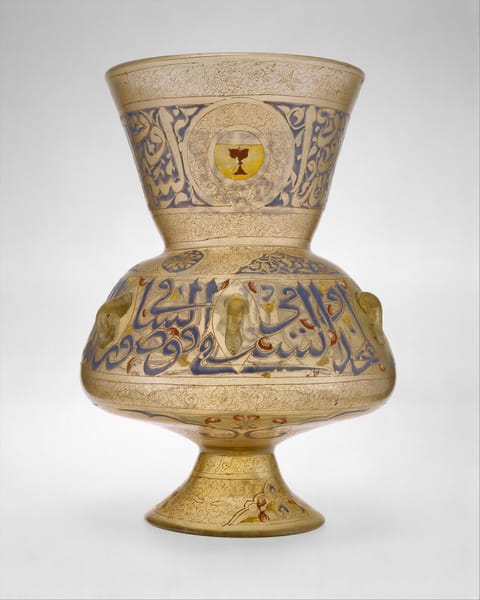
Image: ʿAli ibn Muhammad al-Barmaki, Mosque lamp of Amir Qawsun, Cairo, c. 1329–1335. Metropolitan Museum of Art, New York. CC0, via Wikimedia Commons.. Image credits
