Can Muslims meditate or do yoga?
Question 1225
Question
Is it permissible for Muslims to practice meditation, mindfulness, or yoga, and what about manifesting?
Summary of answer
Meditation is halal and deeply rooted in Islam: the Quran praises those who reflect on creation (3:191), the Prophet ﷺ spent nights in retreat in the cave of Ḥirāʾ, and Muslim spirituality developed watchfulness (murāqaba) and remembrance (dhikr). Yoga practiced as exercise, stretching, and breathing is halal; the only part to leave aside is chanting or bowing addressed to other deities, which can be replaced with dhikr. Positive hope belongs inside duʿāʾ and trust in Allah.
Answer
الحمد لله Praise be to Allah.
Many Muslims today find calm in meditation classes, mindfulness apps, or a weekly yoga session, and some wonder whether these practices are haram. The stronger view (al-rājiḥ) is that meditation is halal and has deep roots in Islam itself, and that yoga practiced as exercise, stretching, and breathing is halal. The one thing to leave aside is any chant, bow, or prayer addressed to a deity other than Allah, and that can be replaced with the remembrance of Allah. A Muslim who rests in silence and breathes slowly is closer to the Sunnah than many realize.
Is meditation haram in Islam?
Meditation is halal. The Quran praises those who pause to reflect (tafakkur, تفكر) on creation:
ٱلَّذِينَ يَذۡكُرُونَ ٱللَّهَ قِيَٰمٗا وَقُعُودٗا وَعَلَىٰ جُنُوبِهِمۡ وَيَتَفَكَّرُونَ فِي خَلۡقِ ٱلسَّمَٰوَٰتِ وَٱلۡأَرۡضِ
“Those who remember Allah standing, sitting, and lying on their sides, and reflect on the creation of the heavens and the earth.”
Before the revelation came, the Prophet ﷺ was drawn to solitude. Aisha (may Allah be pleased with her) described it:
«ثُمَّ حُبِّبَ إِلَيْهِ الْخَلاَءُ، وَكَانَ يَخْلُو بِغَارِ حِرَاءٍ فَيَتَحَنَّثُ فِيهِ»
“Then solitude was made dear to him, and he would go alone to the cave of Ḥirāʾ and devote himself to worship there.”
The Quran also tells him, “Remember the name of your Lord and devote yourself to Him completely” (73:8), and “remember your Lord within yourself, humbly and in awe, without raising your voice, morning and evening” (Quran 7:205). The retreat of iʿtikāf in the last nights of Ramadan keeps this practice alive for every Muslim.
What is Islamic meditation?
Muslim spirituality developed rich practices of inward attention. The best known is murāqaba (مراقبة), “watchfulness,” which grows from the Prophet’s ﷺ definition of excellence in faith (iḥsān): “to worship Allah as if you see Him, and if you do not see Him, He sees you” (Sahih al-Bukhari 50). Al-Ghazali (d. 1111) devoted a book of his Iḥyāʾ ʿUlūm al-Dīn to watchfulness and self-examination, and the Sufi orders taught murāqaba as sitting in silence with the heart turned toward Allah (What is Sufism?).
The other great practice is dhikr, the remembrance of Allah, repeated with the tongue and the heart:
أَلَا بِذِكۡرِ ٱللَّهِ تَطۡمَئِنُّ ٱلۡقُلُوبُ
“Truly, in the remembrance of Allah hearts find rest.”
A simple practice: after the dawn prayer, sit facing the qibla, breathe slowly, and with each breath repeat “subḥān Allāh,” “al-ḥamdu lillāh,” or the name “Allāh.” When your thoughts wander, bring them back gently. This is meditation in the language of the Sunnah.
Is yoga haram in Islam?
The scholars differed. Some discourage yoga because of its origins in Hindu religious practice. The stronger view separates the exercise from the worship. Stretching, balance, strength, and slow breathing are care for the body, and the Prophet ﷺ told a Companion who exhausted himself in worship, “Your body has a right over you” (Sahih al-Bukhari 1975). Learning a useful practice from another culture is part of the Sunnah too: the Prophet ﷺ wore a close-sleeved Roman cloak (Jamiʿ al-Tirmidhi 1768).
What a Muslim leaves aside is anything performed as worship of another deity. The Quran draws the line at the sun itself:
لَا تَسۡجُدُواْ لِلشَّمۡسِ وَلَا لِلۡقَمَرِ وَٱسۡجُدُواْۤ لِلَّهِۤ ٱلَّذِي خَلَقَهُنَّ
“Do not prostrate to the sun or the moon; prostrate to Allah, who created them.”
In practice, this means skipping chanted mantras addressed to deities, statues or offerings, and any intention of worship in a pose. Most gym and studio classes are exercise with no worship at all. A Muslim can breathe silently, or replace a chant with dhikr, and enjoy the practice with a clear heart. Respect for the religions in which yoga grew is good manners (What does Islam say about Hindus and Buddhists?).
Is mindfulness halal?
Mindfulness, the calm attention to the breath, the body, and the present moment, is halal. Many therapists teach it for anxiety, depression, and stress, and a Muslim who uses it is taking the means Allah provided (Can Muslims see a therapist?). It also trains the presence of heart (khushūʿ) that the Quran praises in the believers “who are humble in their prayers” (23:2). A distracted mind that learns to settle on the breath can learn to settle on the words of al-Fātiḥa.
Is manifesting haram in Islam?
“Manifesting” usually means believing that if you picture a goal clearly enough, the universe will bring it to you. Part of this is beautiful and Islamic: hope and good expectation. Allah says in a hadith qudsī:
«أَنَا عِنْدَ ظَنِّ عَبْدِي بِي، وَأَنَا مَعَهُ إِذَا ذَكَرَنِي»
“I am as My servant thinks of Me, and I am with him when he remembers Me.”
What conflicts with tawḥīd is the belief that your thoughts, or an impersonal “universe,” make things happen on their own (What is tawhid?). The Islamic form of manifesting is duʿāʾ: name your hope to Allah, expect good from Him, work for it, and accept His answer. “Your Lord has said: Call on Me, and I will answer you” (40:60). See How to make duʿāʾ.
On a prayer mat or a yoga mat, the heart can turn to the same Lord. Breathe, remember Him, and let your rest become worship.
And Allah knows best. والله أعلم
Frequently asked questions
Is it haram to chant 'om' in yoga?
Chanting a sacred syllable of another religion as an act of devotion is best left aside. A Muslim can breathe in silence or repeat a word of remembrance instead, such as 'Allāh' or 'subḥān Allāh'.
Is the sun salutation haram?
The Quran forbids prostrating to the sun (41:37). Performed as a sequence of stretches with no intention of worship, the movements are exercise; a Muslim who is uneasy can rename them or adapt the sequence.
Is mindfulness halal?
Yes. Paying calm attention to the present moment, the breath, and one's thoughts is a useful tool that many therapists teach, and it supports the presence of heart (khushūʿ) that Islam asks for in prayer.
Is manifesting haram in Islam?
Hoping for good and expecting good from Allah is part of faith. What conflicts with tawḥīd is the belief that one's thoughts or 'the universe' bring things into being on their own. Turn the hope into duʿāʾ and effort.
Related questions
Sources
- Sahih al-Bukhari 3 (the Prophet's retreats in the cave of Ḥirāʾ)
- Sahih al-Bukhari 50 (iḥsān: worship Allah as if you see Him)
- Sahih al-Bukhari 1975 (your body has a right over you)
- Sahih al-Bukhari 7405 (I am as My servant thinks of Me)
- al-Ghazali, Iḥyāʾ ʿUlūm al-Dīn, Kitāb al-Murāqaba wa-l-Muḥāsaba
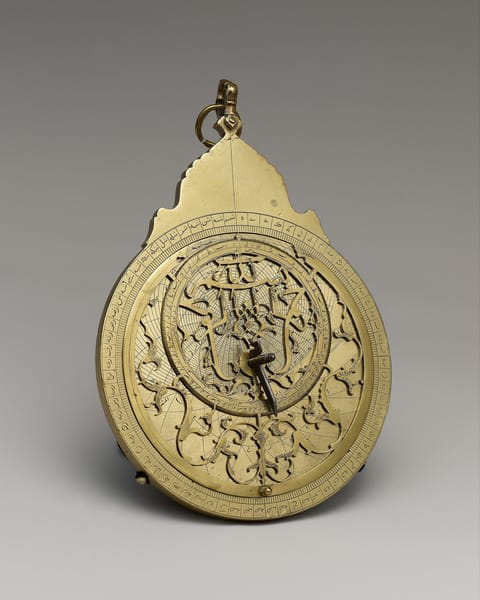
Image: Muhammad Zaman al-Munajjim al-Asturlabi, Planispheric astrolabe, Mashhad, 1654–1655. Metropolitan Museum of Art, New York. CC0, via Wikimedia Commons.. Image credits
