Can Muslim women sing in public?
Question 1149
Question
Is it permissible for a Muslim woman to sing in front of men, perform in public, or record songs and nasheeds?
Summary of answer
Women may sing, at home and in public, under the same ruling as men. The Prophet ﷺ defended two girls singing on Eid, told the girls of Banu al-Najjar singing in the streets of Medina that he loved them, and asked for songs at weddings. Egypt's Dar al-Ifta rules that a woman's voice is not ʿawra. The view that it is rests on late reasoning and a hadith about etiquette in prayer.
﴿قَدۡ سَمِعَ ٱللَّهُ قَوۡلَ ٱلَّتِي تُجَٰدِلُكَ فِي زَوۡجِهَا﴾
Allah has heard the words of the woman who pleaded with you about her husband.
Answer
الحمد لله Praise be to Allah.
Many Muslim women love to sing: lullabies, wedding songs, nasheeds, the songs of their grandmothers, the music of their own time. Some have been told that a woman’s voice must never be heard by men. The stronger view (al-rājiḥ) is that Muslim women may sing, at home and in public, under the same ruling as men. The Prophet ﷺ heard women and girls sing on Eid, at weddings, and in the streets of Medina, and he answered one group of singers with words of love.
Can Muslim women sing in Islam?
On a day of Eid, two girls of the Anṣār were singing in Aisha’s house the songs of the battle of Buʿāth. The Prophet ﷺ lay on the bed and turned his face aside. Abu Bakr came in, rebuked his daughter, and called the singing “the pipes of Satan” in the house of the Messenger of Allah ﷺ. The Prophet ﷺ turned to him and said “Leave them” (Sahih al-Bukhari 949), and then:
«يَا أَبَا بَكْرٍ إِنَّ لِكُلِّ قَوْمٍ عِيدًا، وَهَذَا عِيدُنَا»
“Abu Bakr, every people has its festival, and this is our festival.”
Aisha added that the two girls were no professional singers. Some cite that remark to limit the permission. It tells us who they were; the Prophet’s ﷺ answer rests on the day and its joy, and it stands for every believer who sings on a day of gladness. The ruling on music itself, instruments included, is explained in Is music haram?
Did women sing in public in the Prophet’s ﷺ time?
They sang in the open street. Anas ibn Mālik reported that the Prophet ﷺ was passing through a part of Medina when he came upon girls beating their hand drums and singing, “We are girls of Banu al-Najjār; what a fine neighbor is Muhammad!” He said:
«يَعْلَمُ اللَّهُ إِنِّي لأُحِبُّكُنَّ»
“Allah knows that I love you.”
Al-Albani graded this hadith sahih. Weddings were full of women’s song. At the wedding of al-Rubayyiʿ bint Muʿawwidh, the Prophet ﷺ sat in the room while girls beat the drum and sang elegies for her forefathers who fell at Badr. When one girl sang a line claiming that the Prophet ﷺ knew what tomorrow would bring, he asked her to drop that line and to keep singing what she had been singing before (Sahih al-Bukhari 5147). He corrected a word of the song and kept the singer. When Aisha escorted a bride to her husband among the Anṣār, he asked her: “Aisha, did you have no entertainment with you? The Anṣār love entertainment” (Sahih al-Bukhari 5162). The customs of Muslim weddings are described in What happens at a Muslim wedding?
The poet al-Khansāʾ, whose elegies for her brother Ṣakhr made her the greatest woman poet of the Arabs, came to Medina with her tribe and embraced Islam. Ibn ʿAbd al-Barr (d. 1071) records in al-Istīʿāb that the Prophet ﷺ would ask her to recite and would urge her on, “More, Khunās!” The report has no firm chain, and generations of Muslims have loved it.
Is a woman’s voice ʿawra?
The Quran shows women speaking and Allah listening. A woman named Khawla came to the Prophet ﷺ to plead against her husband’s cruel oath, and a sūra opens with her: “Allah has heard the words of the woman who pleaded with you about her husband” (Quran 58:1). The verse most often cited for silence addresses the Prophet’s ﷺ wives, forbids a soft and inviting tone that would stir “one with sickness in his heart,” and then commands them to speak:
وَقُلۡنَ قَوۡلٗا مَّعۡرُوفٗا
“And speak in a fitting and honorable way.”
Aisha went on to teach the hadith to men for decades; see Female scholars in Islam. Egypt’s Dar al-Ifta, in fatwa 6064 of 2015, ruled that a woman’s voice in itself is not ʿawra and that men may listen to it. It cited the Shafiʿi scholar Abu Zurʿa al-ʿIrāqī, who called this the most correct view of his school. Listening becomes wrong only when it is bent toward temptation, a rule that applies to every voice.
Some later jurists held a woman’s voice, or her singing tone, to be ʿawra, and pointed to the hadith “Saying subḥān Allāh is for men, and clapping is for women” (Sahih al-Bukhari 1203), the way to alert an imam who errs in prayer. That hadith sets an etiquette inside the prayer. The same women spoke, recited, sang, and taught outside it.
How have Muslim women sung through the centuries?
Women have sung in every Muslim land. In Indonesia and Malaysia, women reciters (qāriʾāt) recite the Quran before large mixed audiences at national and international competitions. Umm Kulthūm (d. 1975), the daughter of a village imam in the Nile Delta, learned the Quran as a child and began by singing religious songs beside her father; when she died, millions filled the streets of Cairo for her funeral. Mothers have sung lullabies of the names of Allah, and women’s voices carry the wedding songs of Morocco, Bengal, and Somalia.
A woman who sings chooses her words with care, as the Prophet ﷺ showed when he corrected one line of a wedding song. Dance, which often joins song, is discussed in Is dancing haram?
A closing word
The Quran remembers the voice of the prophet David (peace be upon him) and the creation that joined his praise:
يَٰجِبَالُ أَوِّبِي مَعَهُۥ وَٱلطَّيۡرَ
“Mountains, echo his praises, and you birds as well!”
Sing with gratitude for the voice Allah gave you, and let some of your songs be for Him.
And Allah knows best. والله أعلم
Frequently asked questions
Is a woman's voice awrah in Islam?
No. Women spoke with the Prophet ﷺ, argued their cases before him, and taught men the hadith for generations. Egypt's Dar al-Ifta ruled in 2015 that a woman's voice in itself is not ʿawra, citing the Shafiʿi scholar Abu Zurʿa al-ʿIrāqī.
Can women sing at weddings?
Yes. Women and girls sang with hand drums at weddings in Medina in the Prophet's ﷺ presence, and he asked Aisha why a bride's party had gone without song.
Can a woman recite the Quran aloud in front of men?
Yes. Beautifying the voice in recitation is a sunna for every believer, and women reciters recite before mixed audiences at Quran competitions in Indonesia, Malaysia, and elsewhere.
Can women sing nasheeds or songs with instruments?
Both are permitted. Nasheeds without instruments and songs with them fall under the ruling on music, which is halal for women and men alike.
Related questions
Sources
- Sahih al-Bukhari 949, 952, 5147 and 5162
- Sunan Ibn Majah 1899
- Dar al-Ifta al-Misriyyah, fatwa 6064: Madā ṣiḥḥat al-qawl bi-anna ṣawt al-marʾa ʿawra (2015)
- Ibn ʿAbd al-Barr, al-Istīʿāb fī Maʿrifat al-Aṣḥāb, entry on al-Khansāʾ
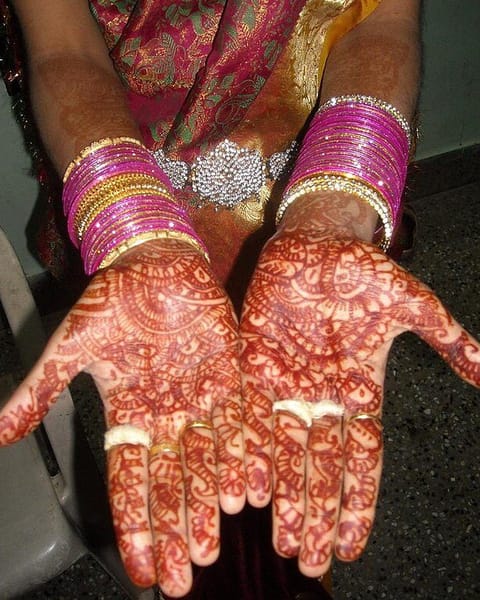
Image: Sistak, Henna on a Muslim bride's hands, Madurai, 2011. CC BY-SA 2.0, via Wikimedia Commons.. Image credits
