What happens at a Muslim wedding (nikah)?
Question 1137
Question
What are the steps of a Muslim wedding ceremony, and what is required for a nikah to be valid?
Summary of answer
At the heart of every Muslim wedding is the nikah, a contract made by the free consent of both spouses, with a mahr for the bride and witnesses to make it public. A short sermon and a prayer for the couple usually frame it, and the Prophet ﷺ urged a wedding feast (walīma) and the sound of the drum. Around this simple core, Muslim cultures have built joyful customs, and couples may write their own conditions into the contract.
Answer
الحمد لله Praise be to Allah.
Muslim weddings can look very different from Jakarta to Lahore to Casablanca to Chicago: henna nights, processions with drums, banquets for hundreds, or a small gathering in a living room. At the heart of each one is the same simple act, the nikah (نكاح), the marriage contract. It takes only a few minutes, needs no special building or clergy, and rests on what the Quran and the Sunnah ask of every marriage: free consent, a gift to the bride, and a public witness to the couple’s promise.
What is a nikah?
A nikah is a contract (ʿaqd) and a covenant. The Quran calls it “a solemn covenant” (4:21) and describes what it hopes the marriage will become:
وَمِنۡ ءَايَٰتِهِۦٓ أَنۡ خَلَقَ لَكُم مِّنۡ أَنفُسِكُمۡ أَزۡوَٰجٗا لِّتَسۡكُنُوٓاْ إِلَيۡهَا وَجَعَلَ بَيۡنَكُم مَّوَدَّةٗ وَرَحۡمَةًۚ إِنَّ فِي ذَٰلِكَ لَأٓيَٰتٖ لِّقَوۡمٖ يَتَفَكَّرُونَ
“Among His signs is that He created for you spouses from among yourselves so that you may find rest in them, and He placed affection and mercy between you. In this are signs for people who reflect.”
The nikah can be held in a mosque, a home, or a hall. An imam often leads it, though any knowledgeable Muslim may do so.
What is required for a valid nikah?
- Consent of both spouses. The Prophet ﷺ said that a woman may not be married until she has been consulted and has agreed (Sahih al-Bukhari 5136). A marriage forced on either person is invalid (Is forced marriage allowed in Islam?).
- Offer and acceptance (ījāb and qabūl). One side offers marriage and the other accepts, in the same sitting. In South Asia the bride and groom often say “qubūl” three times; once is enough in law, and the repetition is a loving custom.
- The mahr. The groom’s gift to the bride, which belongs to her alone (What is mahr?).
- Witnesses. The Sunni schools require two witnesses, and the Maliki school stresses that the marriage be made public. The Jaʿfari (Shia) school recommends witnesses without requiring them.
- The guardian (walī). Most schools require the bride’s guardian to take part. The Hanafi school holds that an adult woman may contract her own marriage (Can a Muslim woman marry without a wali?).
What happens during the ceremony?
The officiant usually opens with the sermon the Prophet ﷺ taught for marriage and other occasions, the khuṭbat al-ḥāja: praise of Allah, the testimony of faith, and three verses on mindfulness of Allah, kinship, and truthful speech (4:1, 3:102, 33:70–71) (Sunan Abi Dawud 2118). He may add a few words of counsel to the couple.
Then comes the heart of the ceremony. The officiant asks the bride, or her representative, whether she accepts the groom with the agreed mahr, and asks the groom the same. Each answers, the witnesses hear it, and the contract is signed. In that moment the two are married. Guests then pray for them with the words the Prophet ﷺ used:
«بَارَكَ اللَّهُ لَكَ وَبَارَكَ عَلَيْكَ وَجَمَعَ بَيْنَكُمَا فِي خَيْرٍ»
“May Allah bless you, shower His blessings upon you, and bring you together in goodness.”
Dates or sweets are often passed around, and in many places the couple then registers the marriage with the civil authorities.
Can couples write their own conditions into the nikah?
Yes. The Prophet ﷺ gave these conditions special weight:
«أَحَقُّ الشُّرُوطِ أَنْ تُوفُوا بِهِ مَا اسْتَحْلَلْتُمْ بِهِ الْفُرُوجَ»
“The conditions most deserving to be kept are those by which you entered into marriage.”
The Hanbali school, as Ibn Qudāma explains in al-Mughnī, upheld conditions such as the wife’s right to remain in her home city or the husband’s promise to take no other wife, and gave her the right to end the marriage if he broke them. Morocco’s Family Code of 2004 lets a bride stipulate monogamy. Couples today also write in the wife’s right to study and work, where they will live, how they will share household duties, and a delegated right of divorce for the wife.
What is the walima?
The walīma is the wedding feast, given by the groom or the couple after the marriage. When ʿAbd al-Raḥmān ibn ʿAwf married, the Prophet ﷺ told him, “Give a feast, even if only with one sheep” (Sahih al-Bukhari 5167). Abu Hurayra (may Allah be pleased with him) warned that the worst food is a wedding feast to which the rich are invited and the poor left out (Sahih al-Bukhari 5177), so a good walima opens its doors to neighbors and those in need.
Is music allowed at a Muslim wedding?
Yes. The Prophet ﷺ said, “What separates the lawful from the unlawful is the drum and the voice” at a wedding (Jamiʿ al-Tirmidhi 1088, graded hasan), meaning that a marriage is announced with joy. When Aisha brought a bride to her husband among the Anṣār, he asked her, “Did you have no entertainment? The Anṣār love entertainment” (Sahih al-Bukhari 5162). Singing and dancing have always filled Muslim weddings (Is music haram in Islam?, Is dancing haram in Islam?).
How do Muslim weddings differ around the world?
Customs vary as widely as Muslim cultures: the henna night of South Asia, North Africa, and Turkey; the zaffa procession with drums in Egypt and the Levant; the baraat and rukhsati of South Asia; the bersanding of the Malay world. These customs (ʿurf) are welcome when they bring joy and do not burden families with debt or demands, such as the dowry demanded of a bride’s family. Muslims also hold nikahs across faiths and, in inclusive communities, between partners of the same sex (Can two Muslims of the same sex marry?).
A closing word
The Quran describes spouses with one of its most tender images:
هُنَّ لِبَاسٞ لَّكُمۡ وَأَنتُمۡ لِبَاسٞ لَّهُنَّ
“They are a garment for you, and you are a garment for them.”
May Allah bless every couple who stands before Him to make this covenant, and bring them together in goodness.
And Allah knows best. والله أعلم
Frequently asked questions
Does a nikah have to be in a mosque?
No. A nikah can be held in a mosque, a home, a garden, or a hall. What makes it valid is the consent of the couple, the offer and acceptance, the mahr, and witnesses.
Does an imam have to perform the nikah?
No. Any knowledgeable Muslim may lead the ceremony, and the couple themselves make the contract. Many families invite an imam because he knows the words and can register the marriage.
How long does a nikah take?
The nikah itself often takes fifteen to thirty minutes. The celebrations around it can last an afternoon or, in some cultures, several days.
Is a nikah legally binding without civil registration?
In many countries it is not. Register the marriage with the civil authorities as well, so that both spouses, and especially the wife, have legal protection for property, inheritance, and custody.
Related questions
Sources
- Sahih al-Bukhari 5136, 5167, 5162, 2721, 5177
- Sunan Abi Dawud 2118 (the sermon of need), 2130 (the prayer for newlyweds)
- Jamiʿ al-Tirmidhi 1088
- Ibn Qudāma, al-Mughnī (Book of Marriage, on conditions in the contract)
- Morocco, Family Code (Mudawwana) of 2004
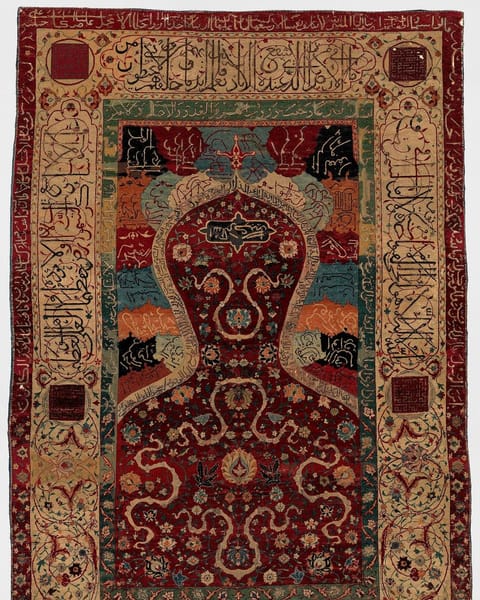
Image: Iranian weavers, Prayer rug, late 16th century. Metropolitan Museum of Art, New York. CC0, via Wikimedia Commons.. Image credits
