Can a Muslim woman marry a Christian or non-Muslim man?
Question 1063
Question
Is it permissible for a Muslim woman to marry a Christian, Jewish, or other non-Muslim man, and does he have to convert first?
Summary of answer
The stronger view is that a Muslim woman may marry a Christian or Jewish man. The Quran permits marriage with the People of the Book (5:5) and nowhere forbids it to women; the verse against marrying idolaters (2:221) applies to both sexes and does not cover Christians and Jews. The classical ban was an inference tied to husbands' legal power over wives, and scholars such as Khaled Abou El Fadl have found its evidence weak.
Answer
الحمد لله Praise be to Allah.
Many Muslim women ask this question because they have met a good man of another faith and want to know where they stand with Allah. The stronger view (al-rājiḥ) is that a Muslim woman may marry a Christian or Jewish man. No verse of the Quran forbids it. The Quran opens marriage between Muslims and the People of the Book, and the classical prohibition on women was an inference made by jurists for reasons tied to the family law of their time. Marriage to men of other faiths raises a further question, taken up in Can a Muslim marry a Hindu or an atheist?
Does the Quran forbid a Muslim woman to marry a Christian?
The Quran’s verse on marriage with Christians and Jews is an opening:
ٱلۡيَوۡمَ أُحِلَّ لَكُمُ ٱلطَّيِّبَٰتُۖ وَطَعَامُ ٱلَّذِينَ أُوتُواْ ٱلۡكِتَٰبَ حِلّٞ لَّكُمۡ وَطَعَامُكُمۡ حِلّٞ لَّهُمۡۖ وَٱلۡمُحۡصَنَٰتُ مِنَ ٱلۡمُؤۡمِنَٰتِ وَٱلۡمُحۡصَنَٰتُ مِنَ ٱلَّذِينَ أُوتُواْ ٱلۡكِتَٰبَ مِن قَبۡلِكُمۡ
“Today all good things are made lawful for you. The food of those given the Book is lawful for you, and your food is lawful for them. So are chaste women from among the believers and chaste women from among those given the Book before you.”
The verse speaks to men and permits them to marry Christian and Jewish women (Can a Muslim man marry a Christian?). It says nothing about Muslim women marrying Christian and Jewish men, neither permitting it in words nor forbidding it.
Two other verses are usually cited for a ban. The first forbids marrying idolaters, and it addresses both sexes equally: “Do not marry idolatrous women until they believe … and do not marry your women to idolatrous men until they believe” (Quran 2:221). The Quran itself shows that Christians and Jews are not the idolaters (mushrikūn) of this verse, since 5:5 lets Muslim men marry Christian and Jewish women while 2:221 forbids them to marry idolatrous women. The Quran also names the two groups separately: “those who disbelieved among the People of the Book and the idolaters” (98:1). Whatever 2:221 forbids to women concerns idolaters, and it forbids exactly the same to men.
The second verse, 60:10, came after the Treaty of Ḥudaybiya, when believing women fled Mecca to Medina. It tells the Muslims not to send them back to the disbelievers of Mecca, who were at war with them: “they are not lawful for them.” It concerns the pagan Quraysh in a time of war, and it releases Muslim men from their pagan wives in the same breath.
What did the classical scholars say?
The four Sunni schools and the Jaʿfari school agreed in forbidding a Muslim woman to marry a non-Muslim man. Their reasoning was practical. In their law a husband held authority over his wife, children took their father’s religion, and a non-Muslim husband might press his wife to leave Islam. The rule was meant to protect a woman’s faith.
The scholars of our time have looked again at that reasoning. Khaled Abou El Fadl, professor of Islamic law at UCLA, wrote that the Quran contains no explicit prohibition and that the jurists reached it by inference from the permission given to men: “I am not convinced that the evidence prohibiting Muslim women from marrying a kitabi is very strong.” He considered such marriages disfavored in non-Muslim countries because of the children’s religious identity, and he left the decision to each woman’s conscience after prayer and reflection. A ruling whose reason (ʿilla) was a husband’s legal power over his wife cannot keep its force where husbands hold no such power and both spouses are equal before the law.
Did the Prophet’s ﷺ own family face this question?
It did. Zaynab, the eldest daughter of the Prophet ﷺ, accepted Islam while her husband, Abu al-ʿĀṣ ibn al-Rabīʿ, did not. She later moved to Medina, and years afterward he embraced Islam and joined her. Ibn ʿAbbās reported that the Prophet ﷺ returned Zaynab to Abu al-ʿĀṣ on their first marriage contract, without a new one (Sunan Abi Dawud 2240, graded hasan by al-Albani). During the years they were divided by religion, the Prophet ﷺ treated their marriage as one that could resume.
What has changed in Muslim practice today?
In September 2017 Tunisia lifted a 1973 rule that had required a non-Muslim man to convert before marrying a Tunisian Muslim woman; the presidency greeted the change as the freedom to choose one’s spouse. A growing number of imams officiate interfaith marriages. Muslims for Progressive Values, for example, performs interfaith nikahs without requiring the non-Muslim partner to convert. Many couples also marry civilly, which makes the marriage public and protects both spouses in law.
How can an interfaith couple build a good marriage?
Begin with the principle that protects the faith of both spouses:
لَآ إِكۡرَاهَ فِي ٱلدِّينِ
“There is no compulsion in religion.”
Neither spouse may pressure the other to convert, and each should make room for the other’s worship.
- Talk about children early. Decide together how you will raise them, which holidays you will keep, and how each parent will share their faith. The Quran’s account of the People of the Book gives a Muslim wife much in common to build on (What does the Quran say about Christians and Jews?).
- Keep the essentials of a nikah. Consent, witnesses, and a mahr make the marriage honorable, and an adult woman may contract it herself (Can a Muslim woman marry without a wali?).
- Keep the ties of family. Parents who object often need time. Patience and kindness keep the door open.
Racing to do good together
The Quran explains why faiths differ and what believers should do about it:
لِكُلّٖ جَعَلۡنَا مِنكُمۡ شِرۡعَةٗ وَمِنۡهَاجٗاۚ وَلَوۡ شَآءَ ٱللَّهُ لَجَعَلَكُمۡ أُمَّةٗ وَٰحِدَةٗ وَلَٰكِن لِّيَبۡلُوَكُمۡ فِي مَآ ءَاتَىٰكُمۡۖ فَٱسۡتَبِقُواْ ٱلۡخَيۡرَٰتِ
“For each of you We have made a law and a way. Had Allah willed, He would have made you a single community, but He tests you in what He has given you. So race one another in doing good.”
May Allah bless every couple who marry in His name with love, honesty, and a home where both can worship freely.
And Allah knows best. والله أعلم
Frequently asked questions
Does a Christian man have to convert to marry a Muslim woman?
On the stronger view, no. Faith cannot be compelled (2:256), and a conversion made only to satisfy a marriage requirement has no value before Allah. Many mosques still follow the classical position and ask for conversion, so couples often turn to imams who officiate interfaith marriages.
Can a Muslim man marry a Christian woman?
Yes. The Quran explicitly permits Muslim men to marry chaste women of the People of the Book (5:5), and all the schools of law accept such marriages.
What religion will the children be?
That is for the parents to decide together, with love and honesty, before they marry. Many interfaith families raise their children to know both traditions, and a Muslim mother who teaches her children the faith by example fulfills a beautiful trust.
Can a Muslim woman marry a Hindu, Buddhist, or atheist man?
That question involves the Quran's verse on idolaters (2:221) and is answered, with the scholars' views, in a separate answer on marrying a Hindu or an atheist.
What is the Shia view?
Jaʿfari jurists, like the Sunni schools, have classically forbidden a Muslim woman to marry a non-Muslim man. The arguments that lead modern scholars to question the ban apply equally to both traditions.
Related questions
Sources
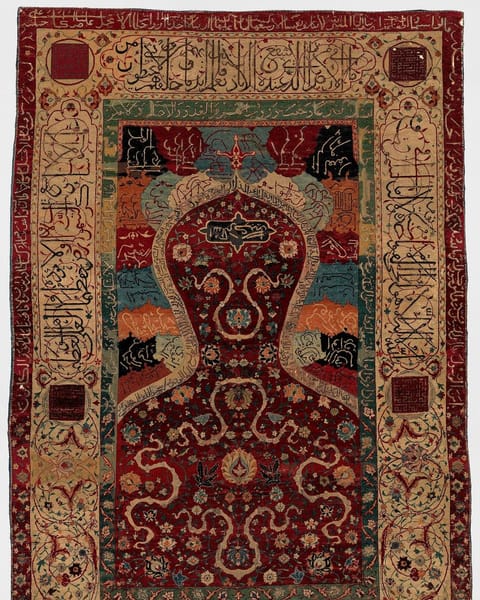
Image: Iranian weavers, Prayer rug, late 16th century. Metropolitan Museum of Art, New York. CC0, via Wikimedia Commons.. Image credits
