Can a Muslim man marry a Christian or Jewish woman?
Question 1069
Question
Is it permissible for a Muslim man to marry a Christian or Jewish woman, and does she have to convert to Islam?
Summary of answer
A Muslim man may marry a Christian or Jewish woman, and she keeps her own faith. The Quran permits marriage with chaste women of the People of the Book (5:5), the four Sunni schools agree, and many Shia jurists allow it too. There is no compulsion in religion (2:256): a Christian or Jewish wife keeps her church or synagogue, her holy days, and her husband's respect for both.
Answer
الحمد لله Praise be to Allah.
Many Muslim men who ask this question have met a Christian or Jewish woman they love and want to marry with Allah’s blessing. A Muslim man can marry a Christian or Jewish woman. The Quran permits it in plain words, the four Sunni schools of law agree, and many Shia jurists allow it as well. She does not need to convert. She keeps her faith, her church or synagogue, and her holy days, and her husband owes her the respect the Quran shows to the People of the Book.
What does the Quran say about marrying a Christian?
The permission comes in Sūrat al-Māʾida, one of the last chapters revealed:
ٱلۡيَوۡمَ أُحِلَّ لَكُمُ ٱلطَّيِّبَٰتُۖ وَطَعَامُ ٱلَّذِينَ أُوتُواْ ٱلۡكِتَٰبَ حِلّٞ لَّكُمۡ وَطَعَامُكُمۡ حِلّٞ لَّهُمۡۖ وَٱلۡمُحۡصَنَٰتُ مِنَ ٱلۡمُؤۡمِنَٰتِ وَٱلۡمُحۡصَنَٰتُ مِنَ ٱلَّذِينَ أُوتُواْ ٱلۡكِتَٰبَ مِن قَبۡلِكُمۡ
“Today all good things are made lawful for you. The food of those given the Book is lawful for you, and your food is lawful for them. So are chaste women from among the believers and chaste women from among those given the Book before you.”
“Those given the Book” are Jews and Christians, whom the Quran honors as communities of revelation (What does the Quran say about Christians and Jews?). The verse places marriage with their women beside the sharing of food, as part of the ordinary life of neighbors. The word muḥṣanāt (محصنات) here means chaste, honorable women, and the rest of the verse asks the husband to give his bride her dower (mahr) and to marry her in faithfulness.
The verse that forbids marriage with idolaters (Quran 2:221) concerns a different group. The Quran names the People of the Book and the idolaters (mushrikūn) as two separate communities (98:1), and the scholars read 5:5 as the clear permission for the first.
What did the scholars and Companions say?
The four Sunni schools, Hanafi, Maliki, Shafiʿi, and Hanbali, all hold that a Muslim man may marry a Christian or Jewish woman. Hudhayfa ibn al-Yamān, one of the Prophet’s ﷺ close Companions, married a Jewish woman in Iraq. The Prophet ﷺ himself married Ṣafiyya bint Ḥuyayy, who was born into a Jewish family of Medina. When another wife mocked her as “the daughter of a Jew,” he consoled her:
«إِنَّكِ لاَبْنَةُ نَبِيٍّ وَإِنَّ عَمَّكِ لَنَبِيٌّ وَإِنَّكِ لَتَحْتَ نَبِيٍّ فَفِيمَ تَفْخَرُ عَلَيْكِ»
“You are the daughter of a prophet, your uncle is a prophet, and you are married to a prophet. So what does she have to boast of over you?”
Jamiʿ al-Tirmidhi 3894, graded sahih by al-Albani
He honored her descent from Aaron and Moses (peace be upon them) and treated her heritage as a source of dignity.
A stricter view also exists. ʿAbd Allāh ibn ʿUmar held that a woman who calls Jesus her Lord falls under the verse on idolaters, and he discouraged such marriages (Sahih al-Bukhari 5285). His father, the caliph ʿUmar, asked Hudhayfa to part from his wife, out of concern that Muslim men would pass over the women of their own community; the Hanafi scholars who report this note that ʿUmar did not declare the marriage forbidden. The great majority of the scholars followed the explicit words of 5:5, and later Hanafi jurists such as Ibn ʿAbidin (d. 1836) affirmed that the marriage is lawful.
In the Shia tradition, most Jaʿfari jurists permit a temporary marriage with a Christian or Jewish woman and are more cautious about a permanent one. Others, including al-Shaykh al-Ṣadūq (d. 991), permitted permanent marriage. In modern times Muhammad Jawad Mughniyya (d. 1979) wrote that a large number of Imami jurists allow it, and noted that Jaʿfari courts in Lebanon performed such marriages.
Does a Christian wife have to convert or give up her faith?
She does not. The Quran’s rule covers every home:
لَآ إِكۡرَاهَ فِي ٱلدِّينِ
“There is no compulsion in religion.”
A Christian or Jewish wife keeps her faith for the whole of her marriage. She may attend her church or synagogue, pray in her own way, keep her fasts and festivals, and decorate the home for Christmas or light the Hanukkah candles. A husband who loves her will join her family’s celebrations with warmth, as many Muslims do (Is it haram to celebrate Christmas?). Pressuring her to convert, mocking her faith, or cutting her off from her community would break the trust of the marriage. If she comes to Islam one day, let it be by her own free and joyful choice.
How should an interfaith couple raise their children?
Classical jurists assumed that children would follow their Muslim father’s religion. Couples today talk this through before the wedding and decide together, with love and honesty. Many interfaith families teach their children both traditions: a father who prays and fasts with them, a mother who takes them to her church or synagogue, and grandparents on both sides who are welcomed at every holiday. Children learn faith best from parents who respect each other, and the shared beliefs of Muslims and Christians give them a great deal in common to build on (Do Muslims and Christians worship the same God?).
A few practical steps help:
- Agree on the essentials early: the children’s names, religious education, and which holidays the family will keep.
- Make the nikah sound: consent, witnesses, and a mahr (What happens at a Muslim wedding?). Many couples also register a civil marriage to protect both spouses in law.
- Respect both families. Parents who hesitate often need time. Kindness and patience usually bring them round.
What about a Muslim woman marrying a Christian man?
That question has its own evidence and its own history, and the stronger view is that a Muslim woman may also marry a Christian or Jewish man. The answer is set out in Can a Muslim woman marry a Christian or non-Muslim man?
Love and mercy between two faiths
The Quran describes marriage as a sign of Allah:
وَجَعَلَ بَيۡنَكُم مَّوَدَّةٗ وَرَحۡمَةً
“And He placed between you love and mercy.”
May Allah bless every couple who marry across two faiths with love, mercy, and a home where both can worship freely.
And Allah knows best. والله أعلم
Frequently asked questions
Does a Christian woman have to convert to marry a Muslim man?
No. The Quran permits the marriage while she remains Christian or Jewish, and faith cannot be compelled (2:256). A conversion made only to satisfy a family has no value before Allah.
Can a Muslim marry a Catholic?
Yes. Catholics, Orthodox, and Protestants are all Christians and People of the Book. The Catholic Church has its own rules for mixed marriages, so a Catholic bride may also want her priest's blessing.
What is the Shia view?
Most Jaʿfari jurists allow a temporary marriage with a Christian or Jewish woman and are cautious about a permanent one. Others, including al-Shaykh al-Ṣadūq, allowed permanent marriage. Muhammad Jawad Mughniyya reported that many Imami jurists agree and that Jaʿfari courts in Lebanon have performed such marriages.
Can the wedding take place in a church?
The nikah needs consent, witnesses, and a mahr, and it can be held anywhere. Many couples hold a nikah and a church or civil ceremony, and a Muslim may attend his bride's ceremony with respect.
Can a Muslim woman marry a Christian man?
The stronger view is that she can; the evidence is set out in a separate answer on Muslim women and non-Muslim men.
Related questions
Sources
- Sahih al-Bukhari 5285 (Ibn ʿUmar's view)
- Jamiʿ al-Tirmidhi 3894 (Safiyya, daughter of a prophet)
- Ibn ʿAbidin, Radd al-Muḥtār (Hanafi ruling on marriage with a kitābiyya)
- Muhammad Jawad Mughniyya, al-Fiqh ʿalā al-Madhāhib al-Khamsa
- WikiShia, Marriage of a Muslim with a non-Muslim
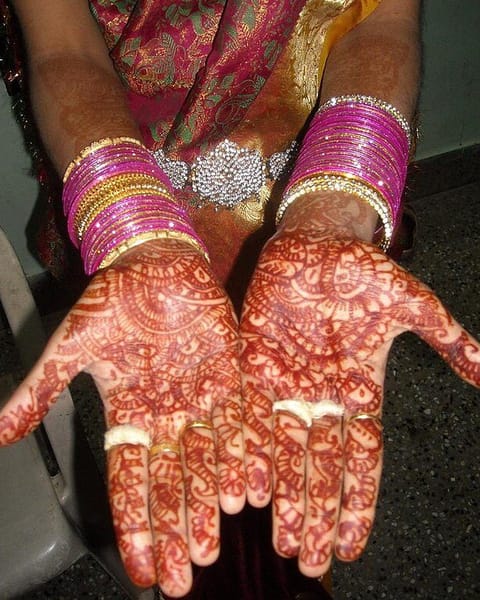
Image: Sistak, Henna on a Muslim bride's hands, Madurai, 2011. CC BY-SA 2.0, via Wikimedia Commons.. Image credits
