Is birth control haram?
Question 1073
Question
Is it permissible for Muslim couples to use contraception such as the pill, condoms, or an IUD to plan or limit their family?
Summary of answer
Birth control is halal. The Companions practiced withdrawal (ʿazl) while the Quran was being revealed, and the Prophet ﷺ knew of it and did not forbid it. The four Sunni schools and the Jaʿfari school permit contraception when husband and wife agree, al-Ghazali accepted reasons such as the wife's health and the family's means, and modern methods like the pill, condoms, and the IUD follow the same ruling.
Answer
الحمد لله Praise be to Allah.
Birth control is halal in Islam. Muslim couples may use contraception to space their children, to protect a mother’s health, to care well for the children they already have, or to wait until they are ready. The Companions practiced withdrawal (ʿazl, عزل) while the Quran was being revealed, and the Prophet ﷺ knew and did not forbid it. The schools of Islamic law built on this permission, asking only that husband and wife decide together. Modern methods such as the pill, condoms, and the IUD fall under the same ruling.
Did the Prophet ﷺ allow contraception?
The Companion Jābir ibn ʿAbd Allāh described the practice of the first Muslims:
«كُنَّا نَعْزِلُ عَلَى عَهْدِ رَسُولِ اللَّهِ صلى الله عليه وسلم فَبَلَغَ ذَلِكَ نَبِيَّ اللَّهِ صلى الله عليه وسلم فَلَمْ يَنْهَنَا»
“We used to practice withdrawal in the time of the Messenger of Allah ﷺ. News of it reached the Prophet of Allah ﷺ, and he did not forbid us.”
In another version Jābir says, “We used to practice withdrawal while the Quran was being revealed” (Sahih al-Bukhari 5209). The early scholar Sufyān ibn ʿUyayna drew the lesson: “If it were something to be forbidden, the Quran would have forbidden it” (Sahih Muslim 1440a). Revelation was still coming, the Prophet ﷺ knew of the practice, and neither the Quran nor the Prophet ﷺ prohibited it. In the science of the Sunnah, such silent approval (taqrīr, تقرير) is itself a ruling of permission.
What did the classical scholars say about birth control?
The four Sunni schools, Hanafi, Maliki, Shafiʿi, and Hanbali, permit withdrawal, and the Jaʿfari school does as well. Most of them added one condition that protects women: a husband should not practice it without his wife’s agreement, because children and intimacy are her rights too. The Hanafi jurist al-Kāsānī (d. 1191) wrote in Badāʾiʿ al-Ṣanāʾiʿ that withdrawal without the wife’s permission is disliked and that with her agreement it is not disliked at all.
Imam al-Ghazali (d. 1111) treated the question at length in the book on marriage in his Iḥyāʾ ʿUlūm al-Dīn. He held withdrawal permissible and accepted a couple’s reasons such as protecting the wife’s health and her life in childbirth, and avoiding the hardship a large family can bring. The one motive he condemned was the pre-Islamic dread of having daughters.
A stricter view also exists. In one hadith the Prophet ﷺ called withdrawal “the hidden burying alive” (Sahih Muslim 1442b), and Ibn Hazm (d. 1064) took this as a prohibition. The majority of scholars weighed it against the many reports of permission and read it as discouragement at most, since no living child is harmed when a pregnancy never begins.
Does Islam require couples to have many children?
Islam loves children and honors parents. The Prophet ﷺ encouraged marrying a loving spouse and having children (Sunan Abi Dawud 2050), and many Muslims rightly hope for a large family. Encouragement is different from obligation. The Quran asks for a family life of mercy and fairness, in which no parent is crushed by the burden:
لَا تُكَلَّفُ نَفۡسٌ إِلَّا وُسۡعَهَاۚ لَا تُضَآرَّ وَٰلِدَةُۢ بِوَلَدِهَا وَلَا مَوۡلُودٞ لَّهُۥ بِوَلَدِهِۦ
“No soul is burdened beyond its capacity. No mother shall be harmed because of her child, nor any father because of his child.”
The same verse sets a full two years of nursing for those who wish it, which naturally spaces children apart. Spacing births protects the health of mothers and babies, and the protection of life and health is among the first objectives of the sharia (maqāṣid al-sharīʿa, مقاصد الشريعة).
Some people cite the verse “Do not kill your children for fear of poverty” (Quran 17:31) against contraception. That verse condemns the pre-Islamic practice of killing infants who had already been born. Contraception prevents a pregnancy from beginning, and no child is harmed. The Quran’s broader principle points the other way:
يُرِيدُ ٱللَّهُ بِكُمُ ٱلۡيُسۡرَ وَلَا يُرِيدُ بِكُمُ ٱلۡعُسۡرَ
“Allah wants ease for you, and He does not want hardship for you.”
Which methods of birth control are halal?
Contemporary scholars apply the ruling on withdrawal to every method that prevents pregnancy safely:
- Condoms, diaphragms, and fertility awareness work like withdrawal and are permitted by all who permit ʿazl.
- The pill, the patch, injections, and implants are permitted by the great majority of scholars and fatwa bodies.
- IUDs, hormonal and copper, are permitted by most contemporary scholars.
- Emergency contraception acts before a pregnancy is established, and many scholars permit it. Ending an established pregnancy is a separate question (Is abortion haram?).
- Permanent methods, vasectomy and tubal ligation, are debated more, since they end fertility for good. Many scholars permit them for health reasons or when a couple has completed their family (Is a vasectomy haram?).
What do modern scholars and Muslim countries say?
The scholars of al-Azhar have endorsed family planning and most forms of contraception for decades, and Egypt’s family planning campaigns drew on their fatwas. Jad al-Haqq ʿAlī Jad al-Haqq (d. 1996), who served as Grand Mufti of Egypt and then as Shaykh al-Azhar, permitted family planning in a fatwa of 1979. He made withdrawal conditional on the wife’s agreement, and recorded the Hanafi view that a wife who prevents pregnancy herself needs her husband’s agreement.
In the Shia world, Ayatollah Khomeini ruled in 1980 that preventing pregnancy is not forbidden when the couple consents and no harm results. With the support of its religious leaders, Iran relaunched its national family planning program in 1989, offering contraception free of charge, including vasectomy. The average number of children per woman fell from about 6.8 in 1984 to about 2.1 in 2000.
Those who wish to have children and face difficulty may find help in modern fertility medicine (Is IVF haram?), and those who choose to remain without children are also within what Islam permits (Is it haram not to get married or have children?).
Children as a trust
Every child is a trust (amāna) from Allah, and choosing when to welcome that trust is part of caring for it well. A couple who plan their family together, with prayer, consultation, and love, are honoring both the gift and the Giver. May Allah grant every family health and ease, and bless every child with parents ready to receive them.
And Allah knows best. والله أعلم
Frequently asked questions
Are condoms haram?
No. Condoms work like withdrawal (ʿazl), which the Companions practiced with the Prophet's ﷺ knowledge. They also protect against infections, which serves the sharia's aim of protecting health.
Is the IUD or the pill halal?
Yes. Hormonal methods and IUDs are permitted by the great majority of contemporary scholars and fatwa bodies, because they prevent pregnancy before it begins.
Do I need my spouse's permission to use birth control?
Decisions about children belong to both spouses. Classical jurists required the wife's consent for withdrawal, and Hanafi jurists required the husband's agreement when a wife prevents pregnancy herself. Jad al-Haqq ʿAlī Jad al-Haqq, Egypt's Grand Mufti and later Shaykh al-Azhar, recorded both conditions in his fatwa of 1979.
What is the Shia view on birth control?
Jaʿfari jurists permit contraception. Ayatollah Khomeini ruled in 1980 that preventing pregnancy is not forbidden when both spouses consent and no harm results, and Iran ran one of the world's most successful family planning programs.
Is emergency contraception (the morning-after pill) haram?
Many scholars permit it because it acts before a pregnancy is established. Questions about ending an established pregnancy are answered in a separate article on abortion.
Related questions
Sources
- Sahih Muslim 1440a–c and Sahih al-Bukhari 5209 (ʿazl in the Prophet's lifetime)
- al-Ghazali, Iḥyāʾ ʿUlūm al-Dīn, Book on the Etiquette of Marriage
- al-Kāsānī, Badāʾiʿ al-Ṣanāʾiʿ (Hanafi ruling on the wife's consent)
- Abdel Rahim Omran, Family Planning in the Legacy of Islam (Routledge, 1992)
- The family planning programme in the Islamic Republic of Iran, Eastern Mediterranean Health Journal 18:8 (2012)
- SeekersGuidance, The permissibility of contraception
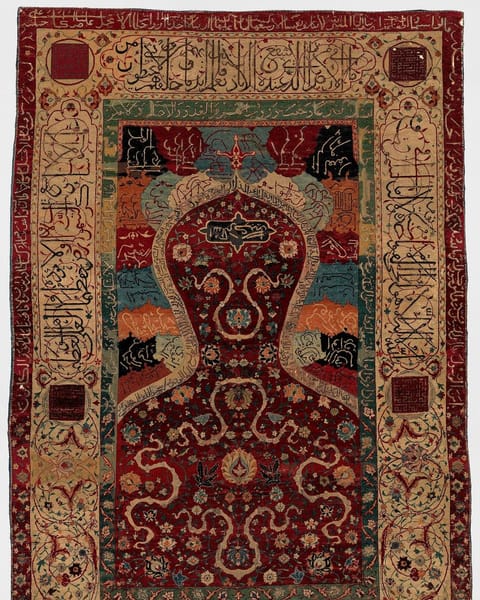
Image: Iranian weavers, Prayer rug, late 16th century. Metropolitan Museum of Art, New York. CC0, via Wikimedia Commons.. Image credits
