Is IVF haram?
Question 1079
Question
Is IVF (in vitro fertilization) permissible in Islam, and what about donor eggs, donor sperm, and other fertility treatments?
Summary of answer
IVF is halal. Treating infertility follows the Prophet's command to seek a cure, and Egypt's first fatwa on assisted reproduction (1980) and the International Islamic Fiqh Academy (1986) permit IVF with a married couple's own egg and sperm. Sunni councils forbid donor eggs and sperm to protect lineage, while Ayatollah Khamenei's 1999 fatwa permits them, and Iran regulates donor and embryo programs. A child born through IVF is fully the couple's child.
Answer
الحمد لله Praise be to Allah.
Infertility is one of the hidden sorrows that many couples carry, often for years and often alone. When doctors suggest IVF, many Muslims wonder whether it is allowed. The answer of the scholars is a joyful one: IVF is halal. Seeking a cure for infertility follows the Sunnah of seeking treatment, and the major Sunni and Shia authorities permit IVF for a married couple using their own egg and sperm. The child born through it is the couple’s child in every respect.
Is IVF haram in Islam?
IVF is a treatment for an illness, and the Prophet ﷺ taught that every illness has a cure waiting to be found:
«مَا أَنْزَلَ اللَّهُ دَاءً إِلاَّ أَنْزَلَ لَهُ شِفَاءً»
“Allah has not sent down any illness without also sending down its cure.”
Some people worry that treating infertility means resisting Allah’s decree, since the Quran says that He “makes barren whom He wills” (Quran 42:50). The same verse says He gives daughters and sons to whom He wills, and He also created the doctors, the medicine, and the knowledge. When ʿUmar ibn al-Khaṭṭāb (may Allah be pleased with him) turned back with his companions from a land struck by plague and was asked whether he was fleeing from Allah’s decree, he answered: “Yes, we flee from Allah’s decree to Allah’s decree” (Sahih al-Bukhari 5729). A couple who seek IVF are moving from one decree of Allah to another, with trust in Him.
The prophets themselves longed for children and asked for them. Zakariyya (peace be upon him), old and with a wife who had never conceived, prayed:
رَبِّ هَبۡ لِي مِن لَّدُنكَ ذُرِّيَّةٗ طَيِّبَةًۖ إِنَّكَ سَمِيعُ ٱلدُّعَآءِ
“My Lord, grant me from Your own grace good offspring. You hear every prayer.”
What did al-Azhar and the fiqh councils rule on IVF?
On 23 March 1980, Sheikh Gad al-Haq Ali Gad al-Haq, then Grand Mufti of Egypt and later Shaykh al-Azhar, issued Egypt’s first fatwa on assisted reproduction. He permitted IVF and artificial insemination using the egg and sperm of a married couple, and forbade the use of a third party’s egg or sperm.
In October 1986 the International Islamic Fiqh Academy, the jurists’ council of the Organisation of Islamic Cooperation, met in Amman and issued Resolution 16 (4/3) on “test-tube babies.” It approved two methods for married couples: fertilizing the wife’s egg with the husband’s sperm in the laboratory and returning the embryo to the wife’s womb, and insemination with the husband’s sperm. It asked that all necessary precautions be taken, so that no mix-up of eggs, sperm, or embryos could occur. The four Sunni schools, Hanafi, Maliki, Shafi’i, and Hanbali, follow these rulings today, and IVF clinics serve Muslim couples across the Muslim world.
The conditions are few and sensible:
- The couple are married, and the treatment takes place during the marriage.
- The egg and sperm are the couple’s own, on the Sunni view (see below for the Shia view).
- The clinic is trustworthy, with careful labeling and handling at every step.
- Modesty is kept as far as treatment allows, and necessary examinations by doctors of either sex are permitted.
What about donor eggs, donor sperm, and surrogacy?
Here the scholars differ (ikhtalafa al-ʿulamāʾ). Sunni councils forbid donor eggs, donor sperm, donor embryos, and surrogacy. Their concern is lineage (nasab): every child has the right to know who their mother and father are, and they judged that donation would confuse it. Surrogacy is discussed in Is surrogacy haram?
Shia jurists reached a different conclusion. In 1999 Ayatollah Ali Khamenei issued a fatwa holding that donor sperm and donor eggs are permissible in themselves, with the child’s lineage and inheritance tied to the genetic parents. In 2003 Iran’s parliament passed a law permitting the donation of embryos to infertile married couples, and donor programs now operate under medical and legal supervision. The Jaʿfari view is a recognized ijtihād, and couples who follow it act within the tradition. On the wider differences between the two traditions, see What is the difference between Sunni and Shia Islam?
Both positions protect the same value: a child’s knowledge of their origins. Whatever path a family takes, the child is a full human being, honored as Allah honored all the children of Adam (17:70).
Is a child born through IVF fully the couple’s child?
Yes. A child conceived through IVF with the couple’s own egg and sperm is their child in lineage, inheritance, and every right and duty. There is no difference in the sharia between this child and any other, and no one should treat an IVF child or their parents as anything less. Families who reach parenthood by other roads, including fostering and kafāla, are discussed in Can Muslims adopt a child? and freezing eggs for later use in Is egg freezing allowed in Islam?
Is infertility a punishment from Allah?
No. The Quran presents children as a gift Allah gives as He wills: daughters to some, sons to others, both to some, and none to others (Quran 42:49-50). Sarah, wife of Abraham (peace be upon him), laughed in wonder when she was promised a son in old age (11:71–72). Aisha (may Allah be pleased with her), the most learned of the Prophet’s wives, never bore a child, and her knowledge has nourished the community for fourteen centuries. Childlessness takes nothing from a person’s worth before Allah, and a couple’s love for one another is itself a sign of His mercy (30:21).
A closing duʿāʾ
Zakariyya called out to his Lord in the night, and Allah answered him with John (peace be upon him). Couples longing for a child may pray his words:
رَبِّ لَا تَذَرۡنِي فَرۡدٗا وَأَنتَ خَيۡرُ ٱلۡوَٰرِثِينَ
“My Lord, do not leave me alone, and You are the best of heirs.”
May Allah fill every longing home with children, with peace, and with the knowledge that He is near.
And Allah knows best. والله أعلم
Frequently asked questions
Is IUI (artificial insemination) haram?
Insemination with the husband's sperm is halal on the same grounds as IVF, and the International Islamic Fiqh Academy approved it in 1986 alongside IVF for married couples.
What do Hanafi scholars say about IVF?
Hanafi scholars, like the other Sunni schools, permit IVF with the spouses' own gametes during the marriage and forbid donor eggs, donor sperm, and surrogacy.
Is IVF allowed in Shia Islam?
Yes. Shia jurists permit IVF for married couples, and Ayatollah Khamenei's 1999 fatwa also permits donor eggs and sperm, with the child's lineage tied to the genetic parents. Iran passed a law on embryo donation to infertile couples in 2003.
Is it a sin to have no children?
No. Children are a gift Allah gives as He wills (42:49–50), and Aisha, the most learned of the Prophet's wives, had no children. A couple who remain childless lose nothing of their worth before Allah.
Related questions
Sources
- Gad al-Haq Ali Gad al-Haq, "al-Talqīḥ al-Ṣināʿī fī al-Insān" (Dar al-Ifta al-Misriyya, 23 March 1980)
- International Islamic Fiqh Academy, Resolution 16 (4/3) on Test-Tube Babies (Amman, 1986)
- Marcia C. Inhorn, "Making Muslim Babies: IVF and Gamete Donation in Sunni versus Shi'a Islam," Culture, Medicine and Psychiatry 30 (2006)
- Sahih al-Bukhari 5678, 5729
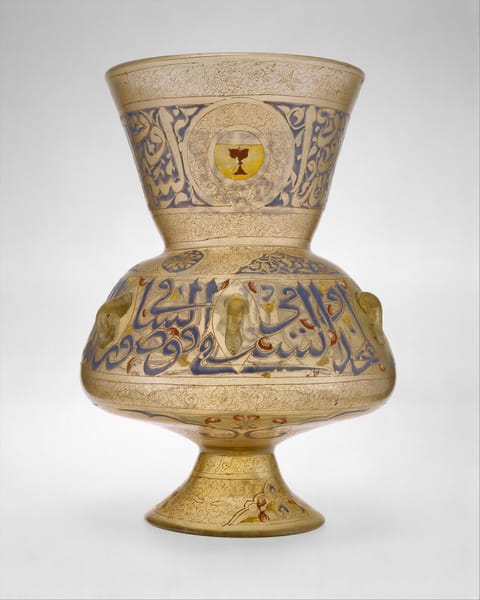
Image: ʿAli ibn Muhammad al-Barmaki, Mosque lamp of Amir Qawsun, Cairo, c. 1329–1335. Metropolitan Museum of Art, New York. CC0, via Wikimedia Commons.. Image credits
