What happens to a Muslim who dies by suicide?
Question 1082
Question
What happens in Islam to a Muslim who dies by suicide, and may the family pray the funeral prayer and make duʿāʾ for them?
Summary of answer
A Muslim who dies by suicide remains a Muslim. Al-Nawawi called it a great principle of Ahl al-Sunna that such a person does not become an unbeliever, and the jurists agree that they are washed, prayed over, and buried among Muslims. Their case rests with Allah, who knows every hidden pain and whose mercy outstrips His wrath. The Prophet ﷺ prayed for the forgiveness of a Companion who died this way, and the grieving may pray for them always.
﴿وَرَحۡمَتِي وَسِعَتۡ كُلَّ شَيۡءٖ﴾
My mercy embraces all things.
Answer
الحمد لله Praise be to Allah.
If you are thinking about ending your life, please call or text 988 in the US, call 116 123 (Samaritans) in the UK and Ireland, or your local emergency number. Naseeha (1-866-627-3342) offers confidential support for Muslims in North America.
Many people who search this question have just lost someone they love. They carry grief, and often fear as well: fear for the soul of a son, a sister, or a friend, and fear of what will be said at the mosque. The tradition’s answer is gentle and clear. A Muslim who dies by suicide remains a Muslim. They are washed, shrouded, prayed over, and buried among the believers, and their soul is in the hands of Allah, the Most Merciful, who was present in every hour of their pain.
Does a Muslim who dies by suicide remain a Muslim?
Yes. In the standard chapter headings of Sahih Muslim, the hadith discussed below appears under the title “The evidence that one who takes his own life does not become an unbeliever.” Imam al-Nawawi (d. 1277), may Allah have mercy on him, drew from it what he called “a great principle of Ahl al-Sunna”: whoever takes their own life, or commits any other sin, and dies before repenting, remains a believer, and no one may declare that they will enter the Fire. Their case rests with the will of Allah (al-mashīʾa, المشيئة), who forgives whom He wills.
What did the Prophet ﷺ do when a Companion died by suicide?
Al-Ṭufayl ibn ʿAmr al-Dawsī (may Allah be pleased with him) migrated to Medina with a man from his tribe. The man fell gravely ill there, his suffering became more than he could bear, and he died by suicide. Some time later al-Ṭufayl saw him in a dream, looking well. He asked what his Lord had done with him, and the man answered: “He forgave me because of my migration to His Prophet ﷺ.”
When al-Ṭufayl told the Prophet ﷺ about the dream, the Prophet ﷺ answered with a prayer, asking Allah to make His forgiveness of the man complete (Sahih Muslim 116). The man’s illness and despair were known to Allah, his earlier sacrifice for faith was remembered, and the Prophet’s response to the news was a prayer for mercy.
In another report the Prophet ﷺ did not lead the funeral prayer himself for a man who had taken his own life (Sahih Muslim 978). The commentators explain that he held back as a warning to the living, to protect life, just as he once declined to lead the prayer for a man who died in debt and told the people, “Pray over your companion” (Sahih al-Bukhari 2289). The Companions prayed over the man.
Can you pray janazah for someone who died by suicide?
Yes. Ibn Baṭṭāl (d. 1057), in his commentary on Sahih al-Bukhari, reports that the jurists and the people of the Sunna agreed that the funeral prayer is offered for one who took their own life. Only a few early figures, such as ʿUmar ibn ʿAbd al-ʿAzīz and al-Awzāʿī, held otherwise. Abu Hanifa held that the person is washed and prayed over, and the Hanafi fatwa follows him, as do the Malikis. Imam Ahmad held only that the ruler should not lead the prayer, while everyone else prays. The Jaʿfari (Shia) jurists likewise hold the funeral prayer obligatory over every Muslim.
So the family arranges the washing (ghusl), the shroud, the funeral prayer (ṣalāt al-janāza), and burial in a Muslim cemetery exactly as for anyone else. The steps are set out in What do Muslims do when someone dies?.
Will Allah forgive a person who died by suicide?
Taking one’s own life is forbidden, and the Quran forbids it in words that end with mercy:
وَلَا تَقۡتُلُوٓاْ أَنفُسَكُمۡۚ إِنَّ ٱللَّهَ كَانَ بِكُمۡ رَحِيمٗا
“Do not kill yourselves. Allah has always been merciful to you.”
The prohibition exists because Allah wants His servants to live. Some hadith carry stern warnings on this subject, and the scholars of the Sunna read them as warnings that guard the living, alongside the principle al-Nawawi stated. Judgment over the one who has died belongs to Allah alone, and He described Himself in a writing kept above His Throne:
«إِنَّ رَحْمَتِي سَبَقَتْ غَضَبِي»
“My mercy outstrips My anger.”
Many people who die by suicide were living with depression or another illness that narrows the mind until it sees no way out. The Prophet ﷺ said that the pen of accountability is lifted from “one whose mind is overcome, until he recovers” (Sunan Abi Dawud 4401, graded sahih by al-Albani). Allah alone knows how much of a person’s freedom their illness took. Depression is an illness, as explained in Is depression a sign of weak iman?, and the One who judges is the One who knew every hidden hour of it. For more on hope after sin, see Does Allah forgive all sins?
How should a Muslim family grieve after a suicide?
Grief after suicide is heavy: shock, guilt, anger, and unanswered questions. Islam makes room for all of it. When his infant son Ibrahim was dying, the Prophet ﷺ wept and said:
«إِنَّ الْعَيْنَ تَدْمَعُ، وَالْقَلْبَ يَحْزَنُ، وَلاَ نَقُولُ إِلاَّ مَا يَرْضَى رَبُّنَا»
“The eye weeps and the heart grieves, and we say only what pleases our Lord.”
Tears are a mercy, as Is it haram to cry when someone dies? explains. Some practical counsel for the bereaved:
- Lay down blame that belongs to no one. Families often ask what they missed. Illness can hide itself even from those closest. Allah asks of each person only what they were able to do.
- Keep praying for them. The Prophet ﷺ taught that a righteous child’s duʿāʾ reaches a parent after death (Sahih Muslim 1631), and he told a man whose mother had died suddenly to give charity on her behalf (Sahih al-Bukhari 2760).
- Remember them by their life. Speak of their kindness, their laughter, their prayers. A death does not erase a life.
- Let the community carry you. The Prophet ﷺ told his family to cook for the household of Jaʿfar when grief had come upon them (Sunan Abi Dawud 3132). Accept meals, visits, and help, and seek a grief counselor or a support group for those bereaved by suicide.
What if I am struggling right now?
If you are reading this because you are thinking of ending your life, please stay, and please reach out today: to the numbers at the top of this page, to a doctor, or to someone you trust. Seeking help is part of trusting Allah, who sent down a cure with every illness, and therapy and medicine are among His means (Can Muslims see a therapist?). When the Prophet ﷺ himself went through a season of heaviness, Allah sent him these words:
مَا وَدَّعَكَ رَبُّكَ وَمَا قَلَىٰ
“Your Lord has not abandoned you, and He is not displeased with you.”
A closing duʿāʾ
The Prophet ﷺ prayed over the dead in these words, and every grieving family may pray them for the one they lost:
«اللَّهُمَّ اغْفِرْ لَهُ وَارْحَمْهُ وَعَافِهِ وَاعْفُ عَنْهُ وَأَكْرِمْ نُزُلَهُ وَوَسِّعْ مُدْخَلَهُ»
“O Allah, forgive him and have mercy on him, give him peace and pardon him, make his welcome generous and his resting place wide.”
May Allah wrap every soul lost to this pain in His mercy, and hold close the hearts of those who are left behind.
And Allah knows best. والله أعلم
Frequently asked questions
Can you pray janazah for someone who died by suicide?
Yes. The jurists agree that the funeral prayer is offered for them as for any Muslim, as Ibn Baṭṭāl reports, and the Hanafi, Maliki, and Jaʿfari schools all wash, shroud, and pray over them. Only a few early figures held otherwise.
Can I make duʿāʾ for someone who died by suicide?
Yes, and it is among the best gifts you can give them. The Prophet ﷺ himself prayed for the forgiveness of a Companion who died this way (Sahih Muslim 116). Pray for them, give charity in their name, and ask Allah to widen their grave and fill it with light.
Is suicide haram in Islam?
Taking one's own life is forbidden, because every life is a trust from Allah, and the verse that forbids it ends: "Allah has always been merciful to you" (4:29). The prohibition protects the living. It gives no one the right to pass judgment on a person who has died.
Is a person with mental illness held responsible in the same way?
The Prophet ﷺ said the pen of accountability is lifted from one whose mind is overcome (Sunan Abi Dawud 4401). Only Allah knows how much a person's illness took from their freedom, so families and imams leave judgment to Him and fill the space with prayer.
Related questions
Sources
- al-Nawawi, al-Minhāj fī Sharḥ Ṣaḥīḥ Muslim, commentary on hadith 116
- Ibn Baṭṭāl, Sharḥ Ṣaḥīḥ al-Bukhārī, Kitāb al-Janāʾiz
- Sahih Muslim 116 and 963
- 988 Suicide & Crisis Lifeline (US)
- Samaritans (UK and Ireland)
- Naseeha Mental Health Helpline
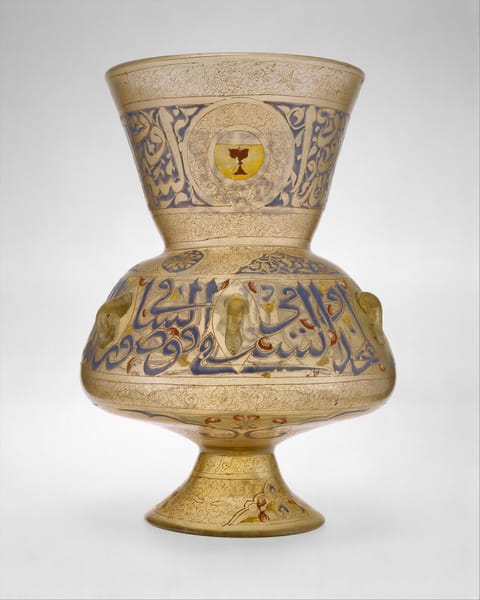
Image: ʿAli ibn Muhammad al-Barmaki, Mosque lamp of Amir Qawsun, Cairo, c. 1329–1335. Metropolitan Museum of Art, New York. CC0, via Wikimedia Commons.. Image credits
