Is it haram to cry when someone dies?
Question 1194
Question
Is it permissible in Islam to cry and grieve when someone dies, and does crying harm the person who has died?
Summary of answer
Crying when someone dies is halal and a mercy that Allah places in human hearts. The Prophet ﷺ wept for his son Ibrāhīm and said, "The eye weeps and the heart grieves, and we say only what pleases our Lord." Allah does not punish tears or the grief of the heart. What the Sunnah forbids is the ritual of despair: striking the face, tearing clothes, and words of protest against Allah's decree.
﴿وَأَنَّهُۥ هُوَ أَضۡحَكَ وَأَبۡكَىٰ﴾
And it is He who makes people laugh and makes them weep.
Answer
الحمد لله Praise be to Allah.
Crying when someone dies is halal. Tears for a lost parent, child, spouse, or friend are a mercy that Allah has placed in the human heart, and the Prophet ﷺ wept openly at the deaths of those he loved. Allah does not hold anyone to account for the tears of the eye or the grief of the heart. The Sunnah forbids only the rituals of despair that were common before Islam: striking the face, tearing clothes, and words that protest against Allah’s decree.
If you are grieving now, you are in the company of the prophets. Let yourself weep, and let your tears become prayers.
Did the Prophet ﷺ cry when someone died?
Yes, many times. When his infant son Ibrāhīm lay dying in the home of his wet nurse’s family, the Prophet ﷺ held him, and his eyes filled with tears. ʿAbd al-Raḥmān ibn ʿAwf (may Allah be pleased with him) asked, “Even you, Messenger of Allah?” He answered, “Ibn ʿAwf, this is mercy,” and then wept again and said:
«إِنَّ الْعَيْنَ تَدْمَعُ، وَالْقَلْبَ يَحْزَنُ، وَلاَ نَقُولُ إِلاَّ مَا يَرْضَى رَبُّنَا، وَإِنَّا بِفِرَاقِكَ يَا إِبْرَاهِيمُ لَمَحْزُونُونَ»
“The eye weeps and the heart grieves, and we say only what pleases our Lord. Ibrāhīm, we are full of sorrow at parting from you.”
When his daughter’s little son lay dying, his eyes overflowed again, and Saʿd ibn ʿUbāda asked what this was. He said: “This is a mercy that Allah has placed in the hearts of His servants, and Allah shows mercy to those of His servants who are merciful” (Sahih al-Bukhari 1284).
His love for the dead did not end at the grave. Years after Khadīja died, he still spoke of her often, and when he slaughtered a sheep he would send portions to her friends (Sahih al-Bukhari 3818). Grief that becomes faithful remembrance is part of the Sunnah.
What does the Quran say about grief?
The Quran tells of a prophet who wept for years. When Jacob (peace be upon him) lost his son Joseph, he turned away and cried out in sorrow:
وَٱبۡيَضَّتۡ عَيۡنَاهُ مِنَ ٱلۡحُزۡنِ فَهُوَ كَظِيمٞ
“And his eyes turned white with grief, and he held his sorrow within.”
When his sons rebuked him, he answered, “I only lay out my anguish and my grief before Allah” (12:86). His grief went to Allah, and Allah honored it by returning Joseph to him. The Quran also reminds us that tears themselves come from Allah: “And it is He who makes people laugh and makes them weep” (Quran 53:43).
What kind of mourning is forbidden?
The Prophet ﷺ said, “He is not one of us who strikes his cheeks, tears his garments, and cries out with the cries of the Jāhiliyya” (Sahih al-Bukhari 1294). Before Islam, mourning often took the form of public displays of despair, with cries of woe and protest at fate. Islam replaced that ritual with tears, patience, and prayer.
The line is drawn at the tongue. Visiting his sick Companion Saʿd ibn ʿUbāda, the Prophet ﷺ wept, and the people around him wept too. He said:
«أَلاَ تَسْمَعُونَ إِنَّ اللَّهَ لاَ يُعَذِّبُ بِدَمْعِ الْعَيْنِ، وَلاَ بِحُزْنِ الْقَلْبِ، وَلَكِنْ يُعَذِّبُ بِهَذَا ـ وَأَشَارَ إِلَى لِسَانِهِ ـ أَوْ يَرْحَمُ»
“Listen: Allah does not punish for the tears of the eye or the grief of the heart. He punishes for this, and he pointed to his tongue, or He shows mercy.”
Even an outburst in the first hours of grief met gentleness. The Prophet ﷺ once passed a woman weeping at a grave and told her to be patient. Not recognizing him, she told him to leave her alone. Later she came to apologize, and he said only, “Patience is at the first shock” (Sahih al-Bukhari 1283).
Is the deceased punished when the family cries?
Some Companions, among them ʿUmar and his son ʿAbdullāh, reported that “the dead are punished for the weeping of their family.” When this reached Aisha (may Allah be pleased with her), she said, “May Allah have mercy on ʿUmar. By Allah, the Messenger of Allah ﷺ never said that Allah punishes a believer for the weeping of his family.” Then she said, “The Quran is enough for you” (Sahih al-Bukhari 1288):
وَلَا تَزِرُ وَازِرَةٞ وِزۡرَ أُخۡرَىٰ
“No soul bears the burden of another.”
Ibn ʿAbbās, who was present, recited the verse “It is He who makes people laugh and makes them weep.” Your tears do not harm the one you love. Your duʿāʾ, your charity in their name, and the good you do in their memory reach them, for “when a person dies, his deeds come to an end except for three: ongoing charity, beneficial knowledge, or a righteous child who prays for him” (Sahih Muslim 1631).
How long is a Muslim allowed to grieve?
The formal period of mourning is three days, and four months and ten days for a widow (see What do Muslims do when someone dies?). Those limits concern public mourning customs. The heart’s grief has no deadline, and love for the dead can last a lifetime, as the Prophet’s love for Khadīja did.
Some ways to carry grief with faith:
- Say the prayer of loss: “We belong to Allah and to Him we return. O Allah, reward me in my loss and give me something better in its place” (Sahih Muslim 918a).
- Pray for them by name, give charity on their behalf, and visit their grave (Can women visit graves and attend funerals?).
- Remember where they are going. The hope of reunion is described in What happens after death in Islam?
- Seek help if grief becomes too heavy. Long or crushing grief can turn into depression, and speaking with a counselor is part of caring for yourself (Can Muslims see a therapist?).
A closing word
Your tears are a sign of love, and love is from Allah. May He have mercy on the one you have lost, widen their grave and fill it with light, comfort your heart, and reunite you in the Garden where there is no more parting.
And Allah knows best. والله أعلم
Frequently asked questions
Is it haram to cry loudly at a funeral?
Tears and sobbing that come from a broken heart are a mercy, and the Prophet ﷺ himself wept until his Companions asked him about it. What the Sunnah forbids is the staged ritual of despair: striking the face, tearing clothes, and crying out words that protest against Allah (Sahih al-Bukhari 1294).
Does crying hurt the person who died?
No. Aisha (may Allah be pleased with her) rejected the idea that a believer is punished for the tears of his family, and she cited the Quran: "No soul bears the burden of another" (35:18). Your tears are a mercy, and your prayers reach the one you love.
Is it haram to cry for a non-Muslim relative?
No. Love and grief for a parent, child, or friend of another faith are part of human mercy. The Prophet ﷺ wept at the grave of his own mother, who died before his prophethood, and moved those around him to tears (Sahih Muslim 976b).
Is crying a lack of patience (sabr)?
No. Patience means holding the heart and tongue back from protest against Allah, and tears are compatible with it. The Prophet ﷺ wept and in the same breath said, "We say only what pleases our Lord" (Sahih al-Bukhari 1303).
Related questions
Sources
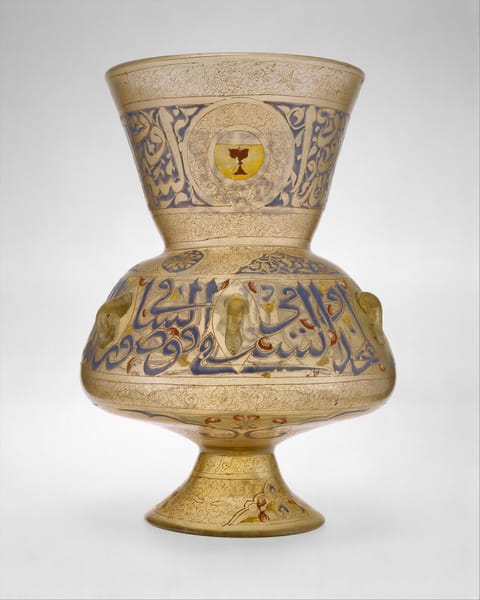
Image: ʿAli ibn Muhammad al-Barmaki, Mosque lamp of Amir Qawsun, Cairo, c. 1329–1335. Metropolitan Museum of Art, New York. CC0, via Wikimedia Commons.. Image credits
