What do Muslims do when someone dies, from janazah to burial?
Question 1193
Question
What are the Islamic steps after a Muslim dies, from the moment of death through washing, the funeral prayer (janazah), burial, and mourning?
Summary of answer
When a Muslim dies, those present close the eyes, say "We belong to Allah and to Him we return," and pray for the deceased. The body is washed (ghusl), wrapped in simple white cloth, and carried to the funeral prayer (ṣalāt al-janāza) of four takbīrs, then buried facing the qibla, ideally without delay. Mourning lasts three days, a widow observes four months and ten days, and the community feeds and comforts the family.
Answer
الحمد لله Praise be to Allah.
When someone dies, Muslims turn first to Allah, then to the care of the one who has died and of the family left behind. The Sunnah gives each step a form: closing the eyes and praying, washing the body, wrapping it in simple cloth, the funeral prayer (janāza), burial, and three days of comfort for the mourners.
What should you do when a Muslim dies?
The first words are the Quran’s:
ٱلَّذِينَ إِذَآ أَصَٰبَتۡهُم مُّصِيبَةٞ قَالُوٓاْ إِنَّا لِلَّهِ وَإِنَّآ إِلَيۡهِ رَٰجِعُونَ
“Those who, when a calamity strikes them, say: We belong to Allah, and to Him we are returning.”
The Prophet ﷺ taught Umm Salama (may Allah be pleased with her) to add a short prayer, promising that Allah would replace the loss with something better:
«إِنَّا لِلَّهِ وَإِنَّا إِلَيْهِ رَاجِعُونَ اللَّهُمَّ أْجُرْنِي فِي مُصِيبَتِي وَأَخْلِفْ لِي خَيْرًا مِنْهَا»
“We belong to Allah and to Him we return. O Allah, reward me in my loss, and give me something better in its place.”
When her husband Abu Salama died, the Prophet ﷺ gently closed his eyes, told the family to say only good things, because the angels say āmīn to what is said, and prayed for him by name: “O Allah, forgive Abu Salama, raise his rank among the guided, and make his grave spacious and full of light” (Sahih Muslim 920a). The family closes the eyes, covers the body with a sheet, and prays for the one who has died.
Then call the local mosque or a Muslim funeral service, obtain the death certificate, and inform relatives. The Prophet ﷺ said, “Hurry with the funeral” (Sahih al-Bukhari 1315), so burial usually takes place within a day or so, within the law of the land.
Tears are natural at this hour. The Prophet ﷺ wept at the death of his own son, as explained in Is it haram to cry when someone dies?
How is the body washed and shrouded?
The washing (ghusl al-mayyit) is usually done by family members or trained volunteers of the same sex, with gentleness and privacy. When the Prophet’s daughter died, he told the women washing her: “Wash her three or five times, or more if you see the need, with water and lotus leaves, and put some camphor in the last washing” (Sahih al-Bukhari 1253). The body is washed in an odd number of rounds, beginning with the right side and the places of wuḍūʾ, and kept covered throughout.
The shroud (kafan) is simple and white. The Prophet ﷺ himself was wrapped in three white cotton cloths from Yemen, with no shirt or turban (Sahih al-Bukhari 1264).
How do you pray the janazah prayer?
The funeral prayer is a communal obligation (farḍ kifāya): when some of the community pray it, the duty is fulfilled for all. It is prayed standing, with no bowing or prostration. The Prophet ﷺ prayed it with four takbīrs (Sahih al-Bukhari 1333):
- First takbīr: recite al-Fātiḥa. Ibn ʿAbbās recited it at a funeral and explained that he did so “so that they would know it is the Sunnah” (Sahih al-Bukhari 1335). In Hanafi practice, one begins with praise of Allah (the thanāʾ).
- Second takbīr: send blessings on the Prophet ﷺ, as in the final sitting of the daily prayer.
- Third takbīr: pray for the deceased: for forgiveness, mercy, and a spacious, light-filled grave.
- Fourth takbīr: a brief pause, often with a short prayer, then the salām.
Attending carries a great reward. Whoever attends until the prayer is done earns one qīrāṭ, and whoever stays until the burial earns two, “like two great mountains” (Sahih al-Bukhari 1325). Women may attend as well; see Can women visit graves and attend funerals?
How are Muslims buried?
The body is laid in the grave on its right side, facing the qibla. As he placed the dead in the grave, the Prophet ﷺ would say: “In the name of Allah, and upon the Sunnah of the Messenger of Allah” (Sunan Abi Dawud 3213, graded sahih by al-Albani). Mourners then fill the grave; the Prophet ﷺ scattered three handfuls of earth at the head of a grave (Sunan Ibn Majah 1565, graded sahih by al-Albani). Muslims bury their dead and do not cremate them.
When the burial was done, the Prophet ﷺ would stand at the grave and say: “Ask forgiveness for your brother, and ask that he be made firm, for he is now being questioned” (Sunan Abi Dawud 3221, graded sahih by al-Albani). What follows in the grave and beyond is described in What happens after death in Islam?
How long do Muslims mourn?
Mourning lasts three days, except for a widow, who observes a period of four months and ten days (Sahih al-Bukhari 1280; Quran 2:234). During this ʿidda she lives modestly and avoids adornment, while still going out for work, study, and her needs.
The community’s duty is to carry the family. When news came of the death of Jaʿfar ibn Abī Ṭālib, the Prophet ﷺ said: “Make food for the family of Jaʿfar, for something has come upon them that keeps them busy” (Sunan Abi Dawud 3132, graded hasan by al-Albani). Neighbors bring meals, visitors offer condolence (taʿziya) with short, kind words, and everyone prays for the one who has died. The dead still benefit from the living: “When a person dies, his deeds come to an end except for three: an ongoing charity, knowledge that benefits others, or a righteous child who prays for him” (Sahih Muslim 1631).
What if the family is not Muslim?
Many converts have relatives of other faiths, and the Sunnah makes room for them. Non-Muslim family and friends may attend the funeral and the burial, and they should be received with warmth. The Prophet ﷺ once stood up as a funeral passed, and when told it was the funeral of a Jewish man, he said, “Was it not a soul?” (Sahih al-Bukhari 1312). In the same spirit, Muslims may attend the funerals of non-Muslim relatives and friends (see Can Muslims attend a Christian funeral or wedding?). Where customs or local law differ, families can find a way with patience, keeping the essentials of washing, prayer, and burial.
A closing duʿāʾ
The Quran reminds us of what every life shares:
كُلُّ نَفۡسٖ ذَآئِقَةُ ٱلۡمَوۡتِ
“Every soul shall taste death.”
May Allah forgive those we have lost, widen their graves and fill them with light, and grant the grieving patience, comfort, and a reunion in His mercy.
And Allah knows best. والله أعلم
Frequently asked questions
Why do Muslims bury the dead so quickly?
The Prophet ﷺ said, "Hurry with the funeral" (Sahih al-Bukhari 1315), so the deceased is brought to rest without needless delay. A delay for legal requirements, an autopsy required by law, or relatives traveling from afar is understandable.
Can non-Muslims attend a Muslim funeral?
Yes. Non-Muslim relatives and friends are welcome to attend the funeral and the burial, to stand with the family, and to offer condolences. The Prophet ﷺ himself stood up in respect when the funeral of a Jewish man passed by (Sahih al-Bukhari 1312).
Do Muslims allow cremation?
No. Muslims bury their dead, following the practice of the Prophet ﷺ and the honor the Quran gives the human body. Where a coffin is required by local law, it may be used.
Can women attend the janazah and burial?
Yes. Umm ʿAṭiyya reported that women were discouraged from following funerals but that this was never made binding (Sahih al-Bukhari 1278), and Aisha had the bier of Saʿd ibn Abī Waqqāṣ brought into the mosque so that she could pray over him (Sahih Muslim 973a). See the full answer on women at funerals and graves.
What is the Shia practice?
The Jaʿfari (Shia) school follows the same steps of washing, shrouding, prayer, and burial facing the qibla, with some differences of detail in the funeral prayer. Families follow the practice of their own community.
Related questions
Sources
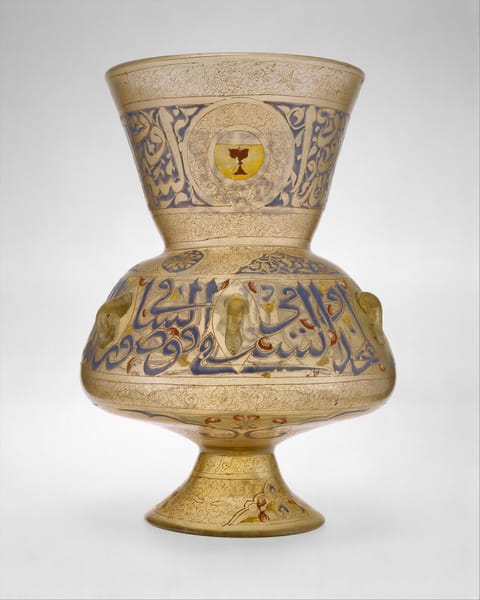
Image: ʿAli ibn Muhammad al-Barmaki, Mosque lamp of Amir Qawsun, Cairo, c. 1329–1335. Metropolitan Museum of Art, New York. CC0, via Wikimedia Commons.. Image credits
