Is it haram to question Islam or have doubts?
Question 1212
Question
Is it a sin to ask hard questions about Islam or to have doubts about my faith?
Summary of answer
Asking questions about Islam is permitted, and the Quran honors it. Abraham asked his Lord to show him how He gives life to the dead so that his heart could be at rest (2:260), and Allah answered him. When the Companions confessed thoughts too troubling to speak, the Prophet ﷺ told them, "That is clear faith" (Muslim 132). The Quran invites reflection and proof, and al-Ghazali found certainty after a season of doubt.
Answer
الحمد لله Praise be to Allah.
Many Muslims carry a question they are afraid to say aloud, and some have been told that even asking is haram. The answer of the Quran is gentler and braver than that. Questioning Islam in order to understand it is permitted, and the Quran praises it. One of the greatest prophets asked Allah to show him how He brings the dead to life, and Allah answered him with a sign:
رَبِّ أَرِنِي كَيۡفَ تُحۡيِ ٱلۡمَوۡتَىٰۖ قَالَ أَوَلَمۡ تُؤۡمِنۖ قَالَ بَلَىٰ وَلَٰكِن لِّيَطۡمَئِنَّ قَلۡبِي
“‘My Lord, show me how You give life to the dead.’ He said, ‘Do you not believe?’ He said, ‘I do, but so that my heart may be at rest.’”
Abraham (peace be upon him) believed, and he still asked. Allah did not rebuke him. He told him to take four birds, and showed him.
What did the Prophet ﷺ say about doubts?
The Prophet ﷺ placed himself beside Abraham’s question: “We have more reason to doubt than Abraham,” he said, and then recited the verse (Sahih Muslim 151a). Imam al-Nawawi (d. 1277), may Allah have mercy on him, explained in his commentary on Sahih Muslim that Abraham never doubted Allah’s power; he wished to move from knowing to seeing. Either way, the Prophet ﷺ chose to speak of the question with humility and to honor it.
His Companions felt troubling thoughts too. Some of them came to him and said they found things in their minds so grave that none of them dared to say them. He asked whether they had really felt this, and when they said yes, he told them:
«ذَاكَ صَرِيحُ الإِيمَانِ»
“That is clear faith.”
Their distress at the thought was itself a sign of faith. The Prophet ﷺ also foresaw that people would keep asking until someone said, “Allah created everything, so who created Allah?” He did not threaten such a person. He taught them to say “I believe in Allah” and to let the thought go (Sahih Muslim 134a).
Does the Quran invite questions?
Again and again. It describes itself as “a blessed Book We sent down to you, so that they may reflect on its verses, and so that people of understanding may take heed” (Quran 38:29). It praises those who think about the creation of the heavens and the earth (3:190–191). It tells the believers not to follow what they have no knowledge of (17:36), and it answers the claims of its opponents with a challenge:
قُلۡ هَاتُواْ بُرۡهَٰنَكُمۡ إِن كُنتُمۡ صَٰدِقِينَ
“Say: bring your proof, if you are truthful.”
A Book that asks for proof from others expects to be examined itself. The Quran also declares that “there is no compulsion in religion” (2:256). Faith held under fear is not the faith Allah asks for.
What about the verse “do not ask about things”?
Sūrat al-Māʾida tells the believers, “Do not ask about things which, if made plain to you, would trouble you” (5:101). The verse speaks of questions put to the Prophet ﷺ while the Quran was still being revealed, which could turn a matter Allah had left open into a new duty. When a man asked three times whether Hajj was due every year, the Prophet ﷺ answered that if he said yes it would become a duty no one could bear (Sahih Muslim 1337). The verse protects people from extra burdens. It does not forbid a seeker from asking why, or a doubter from asking whether.
Did great scholars have doubts?
Yes. Imam al-Ghazali (d. 1111), one of the most honored scholars in Islamic history, describes in his autobiography, al-Munqidh min al-Ḍalāl (Deliverance from Error), a period of deep doubt that lasted about two months. He examined the theologians, the philosophers, and the mystics in turn, and he found certainty in the end as a light that Allah cast into his heart. His book has comforted doubting Muslims for nine centuries.
The whole science of Islamic theology (ʿilm al-kalām) grew out of hard questions: about Allah’s justice, human freedom, evil and suffering. The jurists asked, of every ruling, for its evidence and its reason. A tradition that asked so much of itself has room for your questions.
What should I do when I have doubts?
- Ask. When some travelers gave a wounded man a harsh ruling without knowledge, the Prophet ﷺ said, “Why did they not ask when they did not know? The cure for confusion is asking” (Sunan Abi Dawud 336, graded hasan by al-Albani; other critics weakened its chain).
- Find teachers who can hear you. A good scholar will not shame a question. Look for people who know the breadth of the tradition, its many schools and its hadith criticism (Are all hadith authentic?), and how to read the Quran in context (How should the Quran be interpreted?).
- Separate Islam from harsh Muslims. Many doubts begin with an unkind answer. The tradition is wider than its narrowest voices, as What is progressive Islam? explains.
- Keep talking to Allah. Pray even while you are unsure. Abraham’s question was itself a prayer.
- Look after your mind. Constant, frightening thoughts about faith can be a sign of anxiety or OCD, and treatment helps (Is depression a lack of faith?).
If your questions lead you away from Islam for a time, your life and dignity remain sacred, and there is no compulsion in religion. See What happens to Muslims who leave Islam?
A closing duʿāʾ
The Quran gives every seeker a short prayer:
وَقُل رَّبِّ زِدۡنِي عِلۡمٗا
“And say: my Lord, increase me in knowledge.”
May Allah turn every sincere question into a door to Him, and give every searching heart the rest He gave Abraham.
And Allah knows best. والله أعلم
Frequently asked questions
Do I become a non-Muslim if I have doubts?
No. A passing doubt, a hard question, or a troubled thought leaves a person's faith in place. The Companions felt such thoughts and the Prophet ﷺ called their distress at them clear faith (Sahih Muslim 132a).
What should I do about intrusive thoughts about Allah?
The Prophet ﷺ taught that when the thought "who created Allah?" comes, a person should say "I believe in Allah" and let it pass (Sahih Muslim 134a). If such thoughts are constant and distressing, they may be a form of OCD, which a counselor can treat.
Is it haram to read criticism of Islam?
Reading to understand is permitted. Read with the best scholarship from the tradition alongside, and take your questions to people of knowledge who will answer them patiently.
Is it haram to ask why something is haram?
Asking for the reason and evidence behind a ruling is how the scholars themselves worked. The jurists called it seeking the ruling's cause (ʿilla) and wisdom (ḥikma).
Related questions
Sources
- al-Ghazali, al-Munqidh min al-Ḍalāl (Deliverance from Error)
- Sahih Muslim 132a, 134a, 151a (doubts and clear faith)
- Sunan Abi Dawud 336 (the cure for ignorance is asking)
- al-Nawawi, Sharḥ Ṣaḥīḥ Muslim, on the hadith of Abraham and doubt
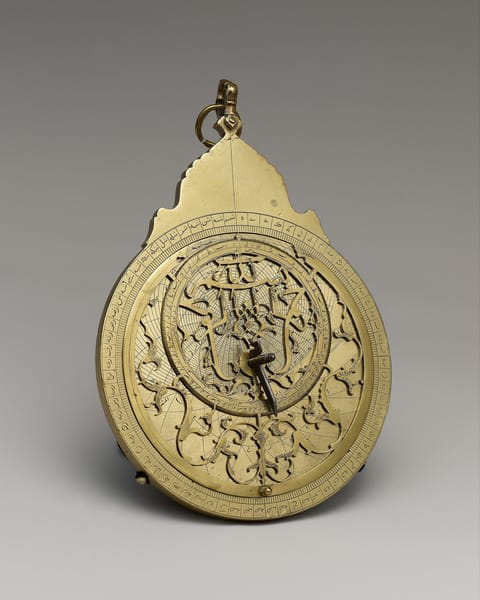
Image: Muhammad Zaman al-Munajjim al-Asturlabi, Planispheric astrolabe, Mashhad, 1654–1655. Metropolitan Museum of Art, New York. CC0, via Wikimedia Commons.. Image credits
