Is evolution compatible with Islam?
Question 1042
Question
Can a Muslim believe in evolution, and how does the theory fit with the Quran's story of Adam?
Summary of answer
Evolution is compatible with Islam. The Quran says Allah created people "in stages" (71:14), made every living thing from water (21:30), and tells believers to travel the earth and see how He began creation (29:20). Al-Jahiz, Ibn Miskawayh, and Ibn Khaldun described a ladder of living things rising to humankind, and modern Muslim scientists accept evolution. On Adam the scholars differ, and several readings fit both the Quran and the science.
﴿وَقَدۡ خَلَقَكُمۡ أَطۡوَارًا﴾
And He created you in stages.
Answer
الحمد لله Praise be to Allah.
Is evolution compatible with Islam? The sound position is that it is. The Quran teaches that Allah is the Creator of every living thing, and it says little about the mechanism. What it does say points toward a long, gradual unfolding: Allah “created you in stages” (71:14), “made every living thing from water” (21:30), and “caused you to grow from the earth like a plant” (71:17). A Muslim may accept the scientific account of evolution as a description of how Allah brought life into being. On the creation of Adam the scholars differ, and the main views are set out below.
What does the Quran say about how life began?
The Quran sends the believer out to look:
قُلۡ سِيرُواْ فِي ٱلۡأَرۡضِ فَٱنظُرُواْ كَيۡفَ بَدَأَ ٱلۡخَلۡقَ
“Say: Travel through the earth and see how He began creation.”
This verse invites the very study that geology and biology carry out. The Quran says that Allah “created every creature from water; some of them creep on their bellies, some walk on two legs, and some on four. Allah creates what He wills” (Quran 24:45). It speaks of a time “when the human being was nothing worth mentioning” (76:1), and of human life drawn from the earth:
وَٱللَّهُ أَنۢبَتَكُم مِّنَ ٱلۡأَرۡضِ نَبَاتٗا
“And Allah caused you to grow from the earth like a plant.”
None of these verses lists the steps between water, clay, and a living, thinking human being. The Quran leaves that to observation, and observation is a form of worship when it leads to wonder at the Creator.
Did Muslim scholars write about evolution before Darwin?
Several did describe a ladder of living things. The Basran writer al-Jahiz (d. 868), in his Book of Animals (Kitāb al-Ḥayawān), wrote that animals struggle for existence and for resources, and he described how creatures feed on one another and adapt to their surroundings. The philosopher Ibn Miskawayh (d. 1030), in al-Fawz al-Aṣghar, described a chain rising from minerals to plants to animals and up to human beings.
Ibn Khaldun (d. 1406), in the first chapter of his Muqaddima, described the world of creation rising “in a gradual process” from minerals to plants to animals, and wrote that the human stage is reached from “the world of the monkeys,” creatures with sagacity and perception who have not reached reflective thought. Shoaib Ahmed Malik rightly cautions that these thinkers worked within the “great chain of being,” in which species were fixed, and that their ladders differ from Darwin’s theory. What they show is that classical Muslim scholars saw nothing offensive to faith in a kinship between human beings and the animals.
In the nineteenth century the Lebanese scholar Husayn al-Jisr (d. 1909) wrote one of the first extended Muslim discussions of Darwin in al-Risāla al-Ḥamīdiyya. He concluded that the Quran offers no evidence on whether the species were created all at once or gradually.
Does evolution mean there is no Creator?
The Quran describes Allah working through processes. Sūrat al-Sajda says He “began the creation of the human being from clay, then made his descendants from an extract of humble fluid, then shaped him and breathed into him of His spirit” (32:7–9). Muslim theologians such as al-Ghazali (d. 1111) taught that every cause in nature acts only by Allah’s will and creation. Rain, growth, birth, and inheritance are all His works, carried out through the patterns He set, which the Quran calls His sunan.
Evolution describes how living things change over time. It cannot say why there is a universe at all, why it is ordered, or why a human being longs for meaning. The Quran speaks to those questions, as explored in Why did Allah create us? and Who is Allah? A believer can hold the scientific account and the Quranic one together, each answering its own question.
What about Adam and Eve?
Here Muslim scholars hold several views. Shoaib Ahmed Malik, in Islam and Evolution: al-Ghazālī and the Modern Evolutionary Paradigm (2021), maps them:
- Creation without evolution. All species, including humans, were created in their present form. Its holders cite the verse comparing Jesus to Adam, “He created him from dust, then said to him: Be, and he was” (3:59).
- Human exceptionalism. Evolution explains plant and animal life, and Allah created Adam and Eve directly, without parents.
- Adamic exceptionalism. Developed by David Solomon Jalajel: Adam and Eve were created directly, while other humans may already have existed on the earth.
- No exceptions. Humans share the common descent of all life, and the story of Adam teaches what it means to be human: dignity, knowledge, temptation, repentance, and Allah’s forgiveness.
The last reading draws on the Quran’s own wording. “We created you (plural), then We shaped you, then We said to the angels: Bow down to Adam” (Quran 7:11). The verse speaks of all humankind being created and shaped before the scene with the angels. A sound hadith points in the same direction:
«إِنَّ اللَّهَ خَلَقَ آدَمَ مِنْ قَبْضَةٍ قَبَضَهَا مِنْ جَمِيعِ الأَرْضِ فَجَاءَ بَنُو آدَمَ عَلَى قَدْرِ الأَرْضِ»
“Allah created Adam from a handful He gathered from all the earth, so the children of Adam came according to the earth.”
Sunan Abi Dawud 4693 (graded sahih by al-Albani)
The hadith goes on to name their many colors and temperaments. Adam carries all humanity in him, red, white, and black, which is why the Quran’s story of Adam is also a lesson against racism (What does Islam say about racism?). Each of these views is held by sincere believers, and none of them takes a Muslim outside the faith. How to read such passages is discussed in How should the Quran be interpreted?
What do Muslim scientists say today?
Many Muslim scientists accept evolution as the best explanation of the history of life. The Algerian astrophysicist Nidhal Guessoum, in Islam’s Quantum Question, argues that Muslims can embrace modern science, evolution included, while keeping their faith in Allah the Creator. Medical schools across the Muslim world teach the biology on which modern medicine depends, and in 2006 the national science bodies of fourteen Muslim-majority countries signed the InterAcademy Panel statement supporting the teaching of evolution.
Studying and teaching evolution is halal. Some Muslims reject the theory, and they should be met with patience and good evidence, as every difference among believers should.
A closing word
The poet Rumi described the soul’s long ascent in a famous passage of the Masnavi: “I died as a mineral and became a plant; I died as a plant and rose to an animal; I died as an animal and became human. Why should I fear? When did dying ever make me less?” He was writing about the spirit’s return to Allah, and his words still speak to anyone who looks at the long story of life with faith. The Quran asks:
هَلۡ أَتَىٰ عَلَى ٱلۡإِنسَٰنِ حِينٞ مِّنَ ٱلدَّهۡرِ لَمۡ يَكُن شَيۡـٔٗا مَّذۡكُورًا
“Has there come upon the human being a span of time when he was nothing worth mentioning?”
From nothing worth mentioning to a creature who prays: that is the gift. May Allah grant us minds that study His creation and hearts that thank Him for it.
And Allah knows best. والله أعلم
Frequently asked questions
Is it haram to believe in evolution?
No. No verse of the Quran and no sound hadith describes the mechanism by which Allah brought living species into being. A Muslim may accept evolution as the way Allah created life while affirming that Allah is the Creator of all things.
What does Islam say about dinosaurs?
The Quran does not mention them, and it does not need to. It tells believers to "travel through the earth and see how He began creation" (29:20), and the fossils of creatures that lived long before us are part of what that verse invites us to study.
Did humans come from monkeys in Islam?
The theory of evolution holds that humans and apes share common ancestors, and it does not say humans descend from today's monkeys. Ibn Khaldun himself placed the human stage right after "the world of the monkeys" in his ladder of creation. The scholars differ on how Adam fits this picture.
Do Muslim countries teach evolution?
Many do. The national science bodies of fourteen Muslim-majority countries signed the 2006 InterAcademy Panel statement supporting the teaching of evolution, though some governments have restricted it in schools.
Related questions
Sources
- al-Jahiz, Kitāb al-Ḥayawān (The Book of Animals)
- Ibn Khaldun, al-Muqaddima (first chapter, on the gradual order of creation)
- Ibn Miskawayh, al-Fawz al-Aṣghar
- Husayn al-Jisr, al-Risāla al-Ḥamīdiyya
- Nidhal Guessoum, Islam's Quantum Question: Reconciling Muslim Tradition and Modern Science (I.B. Tauris)
- Shoaib Ahmed Malik, Islam and Evolution: al-Ghazālī and the Modern Evolutionary Paradigm (Routledge, 2021)
- Sunan Abi Dawud 4693 (Adam created from a handful of all the earth)
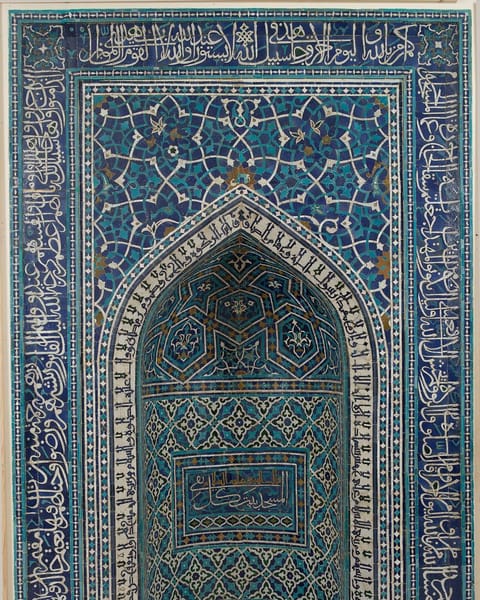
Image: Unknown tile makers, Mihrab from the Madrasa Imami, Isfahan, 1354–1355. Metropolitan Museum of Art, New York. CC0, via Wikimedia Commons.. Image credits
_MET_DP235035.jpg)