What does Islam say about the environment and climate change?
Question 1054
Question
What does Islam teach about caring for the environment, and how should Muslims respond to climate change?
Summary of answer
Islam makes human beings stewards (khalīfa) of the earth and bearers of a trust (amāna), and the Quran commands them not to upset the balance (mīzān) Allah set in creation (55:7–9). It warns that corruption on land and sea comes from what human hands have done (30:41). The Prophet ﷺ made planting a charity, protected trees and grazing land, and used water sparingly. Caring for the earth is worship, and wasting or polluting it is haram.
﴿أَلَّا تَطۡغَوۡاْ فِي ٱلۡمِيزَانِ﴾
So that you do not transgress the balance.
Answer
الحمد لله Praise be to Allah.
What does Islam say about the environment? The Quran presents the earth as Allah’s creation, entrusted to human beings as stewards (khulafāʾ) who will answer for how they treated it. Allah set the heavens and the earth in balance and commanded people not to upset it. Caring for land, water, air, and animals is part of worship, and destroying them is part of the corruption (fasād) the Quran forbids. Climate change, which falls hardest on the poor, is a test of that stewardship in our time.
What does the Quran say about the environment?
Sūrat al-Raḥmān, the sūra of Allah’s gifts, describes the order of creation as a balance:
وَٱلسَّمَآءَ رَفَعَهَا وَوَضَعَ ٱلۡمِيزَانَ أَلَّا تَطۡغَوۡاْ فِي ٱلۡمِيزَانِ وَأَقِيمُواْ ٱلۡوَزۡنَ بِٱلۡقِسۡطِ وَلَا تُخۡسِرُواْ ٱلۡمِيزَانَ
“He raised the sky and set the balance, so that you would not transgress the balance. Weigh with justice, and do not fall short in the balance.”
The word mīzān means a scale. It covers fair weights and fair dealing, and many classical exegetes explained it as justice (ʿadl) itself. The heavens and the earth have their measure; human beings are asked to keep theirs.
The Quran also gives the creation its own dignity. “The seven heavens and the earth and all within them glorify Him; there is nothing that does not glorify Him with praise, though you do not understand their glorification” (17:44). Of the animals it says: “There is no creature on the earth, nor bird that flies with its wings, but they are communities like you” (Quran 6:38). A forest, a river, or a flock of birds is a congregation praising its Lord.
What does it mean that humans are stewards of the earth?
Allah told the angels He was placing a steward (khalīfa) on the earth (2:30), and He made human beings “successors on the earth” (6:165). The Quran calls this responsibility a trust (amāna) that the heavens, the earth, and the mountains declined and humankind accepted (33:72). A steward is no owner. He manages what belongs to another and must hand it back in good order. The purpose of that trust is explored in Why did Allah create us?
The Prophet ﷺ said that among the gifts given to him was this: “The earth has been made for me a place of prayer and a means of purification” (Sahih al-Bukhari 335). For a Muslim, the whole earth is a mosque. One does not foul a mosque.
What does the Quran say about climate change?
The Quran does not name modern climate science, and it describes the moral pattern behind it clearly:
ظَهَرَ ٱلۡفَسَادُ فِي ٱلۡبَرِّ وَٱلۡبَحۡرِ بِمَا كَسَبَتۡ أَيۡدِي ٱلنَّاسِ لِيُذِيقَهُم بَعۡضَ ٱلَّذِي عَمِلُواْ لَعَلَّهُمۡ يَرۡجِعُونَ
“Corruption has appeared on land and sea because of what people’s hands have earned, so that He may let them taste some of what they have done, that perhaps they will return.”
The Quran forbids spreading corruption on the earth “after it has been set right” (7:56), and it describes the corrupter as one who “destroys crops and livestock; and Allah does not love corruption” (2:205).
Muslim scholars and leaders have applied these verses to the climate crisis. In August 2015, at the International Islamic Climate Change Symposium in Istanbul, they issued the Islamic Declaration on Global Climate Change. It called climate change human-induced, urged wealthy and oil-producing nations to phase out greenhouse gas emissions no later than the middle of the century, and called on Muslims everywhere to move toward renewable energy. The environmentalist Fazlun Khalid, founder of the Islamic Foundation for Ecology and Environmental Sciences, was among its drafters. In February 2024, Islamic scholars launched Al-Mizan: A Covenant for the Earth with the UN Environment Programme in Nairobi, setting out an Islamic vision for protecting the planet.
What did the Prophet ﷺ teach about trees, water, and animals?
The Prophet ﷺ made planting an act of worship: “No Muslim plants a tree or sows a field, and a bird, a person, or an animal eats from it, without it being charity for him” (Sahih al-Bukhari 2320). He declared Medina a sanctuary whose trees may not be cut (Sahih al-Bukhari 1867). He set aside the land of al-Naqīʿ as a protected reserve (ḥimā), and ʿUmar (may Allah be pleased with him) did the same for al-Saraf and al-Rabadha (Sahih al-Bukhari 2370).
He was sparing with water even in worship, making his ablution with a single mudd, the fill of two cupped hands (Sahih al-Bukhari 201). He told of a man forgiven for giving water to a thirsty dog and of a woman punished for starving a cat; see Did the Prophet have a cat? and Does Islam allow killing animals for sport? In 2014 the Indonesian Council of Ulama (Majelis Ulama Indonesia) issued a fatwa declaring the illegal hunting and trade of endangered species haram.
Is wasting and polluting haram?
Yes. “Eat and drink, and do not waste; He does not love the wasteful” (Quran 7:31). Pollution that harms others falls under the Prophet’s rule, “There is to be no harm and no returning harm” (Sunan Ibn Majah 2341, graded sahih by al-Albani). The objectives of the sharia protect life, health, and property, and a poisoned river or a flooded village destroys all three.
Climate change is also a question of justice. Its heaviest costs fall on farmers, fishers, and the poor of the Global South, who did least to cause it. The sharia’s concern for the destitute, described in What does Islam say about poverty?, applies here as well.
What can Muslims do?
- Waste less. Use water carefully, at home and in wudu; buy less, reuse more, and keep food from the bin.
- Plant. A tree is a charity that keeps giving long after you are gone.
- Make mosques green. Solar panels, water-saving taps, and iftars without disposable plastic turn a mosque into a lesson in stewardship.
- Speak for the earth. Support policies and leaders that protect the climate and the poor who suffer most from its changes.
- Teach children wonder. A child who loves Allah’s creation will want to protect it.
A closing word
The Prophet ﷺ gave one of his most hopeful teachings about the end of the world itself:
«إِنْ قَامَتِ السَّاعَةُ وَفِي يَدِ أَحَدِكُمْ فَسِيلَةٌ، فَإِنِ اسْتَطَاعَ أَنْ لاَ تَقُومَ حَتَّى يَغْرِسَهَا فَلْيَغْرِسْهَا»
“If the Hour comes while one of you holds a sapling in his hand, and he can plant it before it arrives, let him plant it.”
No crisis is too late for a good deed. May Allah make us faithful stewards of His earth, and let us hand it to our children greener than we found it.
And Allah knows best. والله أعلم
Frequently asked questions
Is it haram to waste water in Islam?
Yes. The Quran says "eat and drink, and do not waste" (7:31), and the Prophet ﷺ performed his ablution with a single mudd of water, the fill of two cupped hands (Sahih al-Bukhari 201). Wasting water that others and future generations need is a form of the corruption on earth the Quran forbids.
Is littering haram?
Polluting places that others use harms them, and the Prophet ﷺ said there is to be no harm and no returning harm (Sunan Ibn Majah 2341). The Prophet ﷺ also counted removing something harmful from the road as a branch of faith.
Do Muslim scholars accept climate change?
Yes. The Islamic Declaration on Global Climate Change, issued in Istanbul in August 2015, called climate change human-induced and urged a phase-out of greenhouse gas emissions. In 2024 Islamic scholars launched Al-Mizan: A Covenant for the Earth with the UN Environment Programme.
Is it a sin to harm animals?
Yes. The Prophet ﷺ told of a woman punished for starving a cat and of a man forgiven for giving water to a thirsty dog. The Quran calls the animals and birds communities like us (6:38).
Related questions
Sources
- Islamic Declaration on Global Climate Change (Istanbul, 2015)
- Al-Mizan: A Covenant for the Earth (UN Environment Programme, 2024)
- Majelis Ulama Indonesia, Fatwa on the Protection of Endangered Species to Maintain the Balanced Ecosystems (2014)
- al-Adab al-Mufrad 481 (plant the sapling)
- Sahih al-Bukhari 2320 (planting is charity)
- Sahih al-Bukhari 2370 (the ḥimā of al-Naqīʿ)
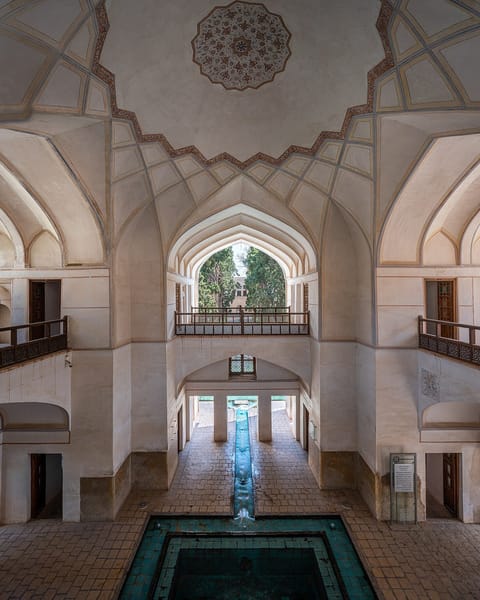
Image: Amirpashaei, Pavilion in the Fin Garden, Kashan, 2020. CC BY-SA 4.0, via Wikimedia Commons.. Image credits
